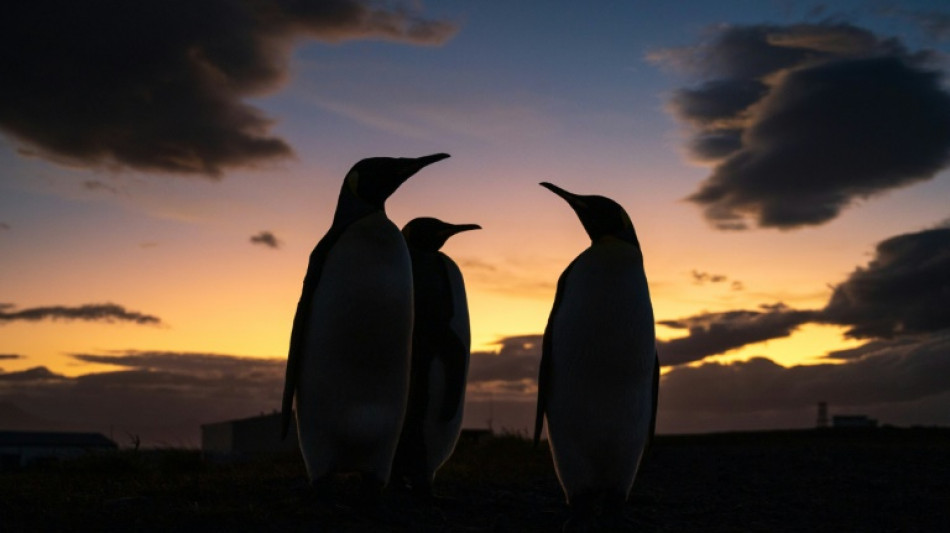
Satellite mapping finds new colony of Emperor penguins / Photo: PATRICK HERTZOG - AFP/File

 Kenya's economy faces climate change risks: World Bank

 Amazon beats expectations with cloud and AI growth

 Blowout Microsoft results lift US stocks as oil retreats

 'Beginning of the end': Relief but no party as French wildfire winds down

 Southern Europe 'becoming more flammable' in hotter climate, experts say

 Mammoth bones found on parched bed of Danube in Bulgaria

 MEXC Lists Grvt (GRVT) with $60,000 Worth of GRVT and 10,000 USDT in Airdrop+ Rewards

 George and Amal Clooney flee French home due to wildfire

 MEXC Ventures Supports Alpha Arena's APAC Debut at Coinfest Bali

 AI data centre supplier Zhongji InnoLight slips on Hong Kong debut

 May, June heatwaves caused 2,877 extra deaths in England: govt

 BMW profit down a third as carmaker plans job cuts

 Seoul extends losses as most Asian markets drop, oil rises again

 Gambling.com Group Is Now Grandstand

 Meet the astronomer digging into the Milky Way's 'fossils'

 AI data centre supplier Zhongji InnoLight falls on Hong Kong debut

 Samsung operating profit up 1,800% in second quarter on AI boom

 Japanese population below 120 million for first time in decades

 US actor Jared Leto denies latest accusations of sexual assault

 Danube drops to 'historic lows' as fresh heatwave hits

 BTS pulls out of Grammys after Asian pop category introduction

 OpenAI says rogue AI agent attack hit other companies

 How an AFP beach snap became emblem of Europe's wildfire summer

 TRX Spot and Perpetuals Listing Launches on Backpack, Expanding Access to the TRON Ecosystem

 Nepal's tiger numbers climb 20 percent to estimated 429: survey

Satellite mapping technology has discovered another new colony of the highly threatened Emperor penguins in Antarctica, researchers revealed Friday.
The find, announced by the British Antarctic Survey (BAS) to mark Penguin Awareness Day, brings the total number of known emperor penguin breeding sites around Antarctica's coastline to 66.
It is the latest in a series of Emperor penguin breeding sites detected using the satellite technology.
The birds, which are endemic to Antarctica and the biggest of the 18 penguin species at around 1.2 metres (nearly four feet) tall, face almost complete annihilation due to climate change and the loss of sea ice.
The US Fish and Wildlife Service last year placed Emperor penguins, which need sea ice to breed, on its endangered species list, calling the move "an alarm bell" and "call to action".
Recent projections suggest that under current warming trends, 80 percent of colonies will be quasi-extinct by the end of the century.
Scientists from the BAS uncovered the latest site, home to around 500 birds, by identifying signs of penguin excrement, known as guano, on the landscape at Verleger Point in West Antarctica.
Guano stains the snow and rock terrain brown and is easy to spot, while the flightless birds themselves are too small to be seen from satellites.
- 'Good news' -
The researchers studied images from the EU's Copernicus Sentinel-2 satellite mission and compared them with high resolution footage from the MAXAR WorldView3 satellite.
Peter Fretwell, who studies wildlife from space at BAS and was lead author of the research revealing the find, called it "exciting" but cautioned that the existential risk to the birds remained.
"Whilst this is good news, like many of the recently discovered sites, this colony is small and, in a region badly affected by recent sea ice loss," he said.
Emperor penguins are found in areas that are very hard to study because they are remote, inaccessible and extremely cold, with temperatures dropping as low as minus 60 Celsius (-76 Fahrenheit), according to the BAS.
Its researchers have for been looking for new colonies 15 years by searching satellite images for penguin guano.
The technology also helped the BAS detect a "catastrophic" breeding failure among the second largest Emperor colony in Antarctica between 2016 and 2019.
Nearly all chicks born over the three years died as their icy Antarctic habitat shrank due to abnormally warm and stormy weather breaking up the critical sea ice.
Emperors came to global fame with a 2005 documentary, "March of the Penguins", portraying their annual trek across the icy wastes, and the 2006 cartoon movie "Happy Feet".
H.Cho--CPN