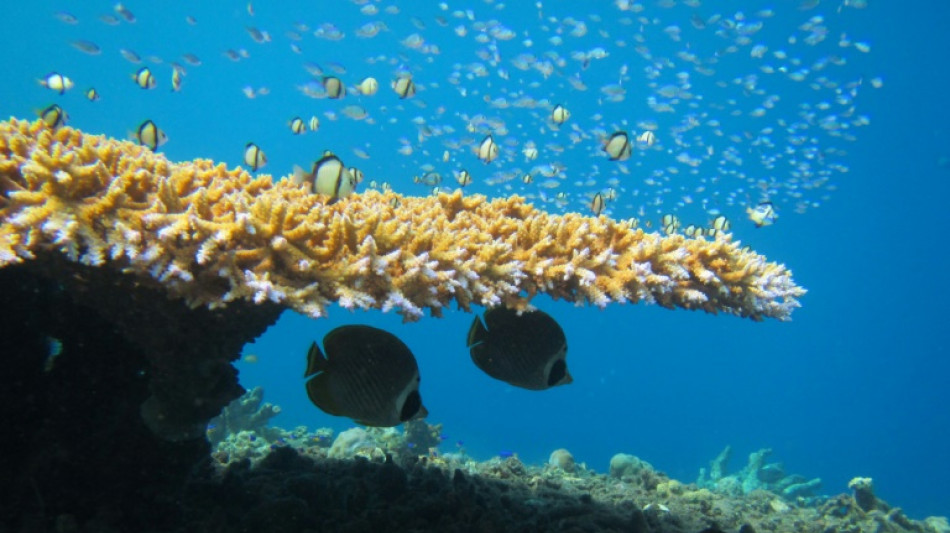
Coral bleaching causing 'unnecessary' fish fights / Photo: Sally A. KEITH - LANCASTER UNIVERSITY/AFP

 Kenya's economy faces climate change risks: World Bank

 Apple tops estimates in CEO Cook's final quarter, but shares fall

 Milei demands expulsion of foreigners expressing 'hate' against Argentina

 Italy's Po River valley on drought alert

 Prada profits pinched as growth hard to chase

 Stocks climb on earnings and rates, oil retreats

 US economic growth slows in second quarter, missing expectations

 Russia adds Telegram founder Durov to 'terrorist' blacklist

 Stocks diverge on earnings, as oil steadies

 Eurozone economy grows despite Middle East war

 Singapore group will develop 'most promising' Ebola vaccine

 Shell profit surges as Mideast war fuels oil prices

 Car maker Stellantis says back in profit in second quarter

 Samsung quarterly operating profit up 1,800% on AI boom

 South Korean stocks bounce after rout, oil holds gains on Mideast woes

 South Korea's women web sleuths fight AI deepfake porn

 Anything but programmable: New cost-efficient EC-power-supply-series for the DIN rail by CAMTEC PS

 Meta misses profit expectations, sticks to massive AI spending

 Campari - king of the spritz - hopes to conquer American heartland
 Air France-KLM and Lufthansa bid for Portugal's TAP airline

 Profits soar at Airbus as it delivers more planes

 Rheinmetall shares surge after armsmaker reports record profit
 FIFA hit by furious backlash over plans to sell stake in competitions

 MEXC Integrates World-Check to Fortify Institutional Grade Compliance Architecture
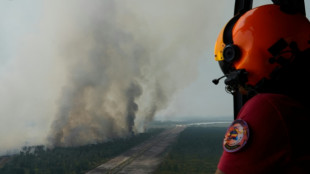 Spain returns wildfire evacuees as France braces for worsening weather

Fish that have lost food due to mass coral bleaching are getting into more unnecessary fights, causing them to expend precious energy and potentially threatening their survival, new research said Wednesday.
With the future of the world's coral reefs threatened by climate change, a team of researchers studied how a mass bleaching event affected 38 species of butterflyfish.
The colourfully patterned reef fish are the first to feel the effect of bleaching because they eat coral, so their "food source is hugely diminished really quickly", said Sally Keith, a marine ecologist at Britain's Lancaster University.
Keith and her colleagues had no idea a mass bleaching event was coming when they first studied the fish at 17 reefs off Japan, the Philippines, Indonesia and Christmas Island.
But when one of history's worst global bleaching events struck in 2016, it offered "the perfect opportunity" to study how it affected the fish's behaviour, Keith told AFP.
The researchers returned within a year and were "shocked" to see the devastation of the once beautiful reefs, she said.
Donning their snorkels or scuba gear, the team watched the fish "swimming around looking for food that just isn't there anymore," she added.
"There was a bit of crying in our masks."
- Losing battle -
The bleaching particularly affected Acropora coral, the main food source for the butterflyfish.
That "changed the playing field of who's eating what," Keith said, putting different species of butterflyfish in increased competition for other types of coral.
When a butterflyfish wants to signal to a competitor that a particular bit of coral is theirs, they point their noses down and raise their spiny dorsal fins.
"It's almost like raising your hackles," Keith said.
If that fails, one fish will chase the other, usually until the other gives up.
"I followed one for about 50 metres (165 feet) once, that was quite tiring, they're very fast," Keith said.
The team observed 3,700 encounters between butterflyfish.
Before the coral bleaching event, different species of butterflyfish were able to resolve disputes using signalling around 28 percent of the time.
But that number fell to just 10 percent after the bleaching, indicating many "unnecessary attacks," according to the new study in the journal Proceedings of the Royal Society B.
"Making poor decisions about who to fight, and where to invest their really valuable energy, could be that little bit that tips them over the edge towards actual starvation," said Keith, the study's lead author.
It is not clear if the fish will be able to adapt to the changes brought about by coral bleaching quickly enough, the researchers warned.
It could also have knock-on effects between species and up the food chain, she added.
Human-driven climate change has spurred mass coral bleaching as the world's oceans get warmer.
Modelling research last year found that even if the Paris climate goal of holding global warming to 1.5 degrees Celsius is reached, 99 percent of the world's coral reefs will not be able to recover. At two degrees of warming, the number rose to 100 percent.
Ch.Lefebvre--CPN