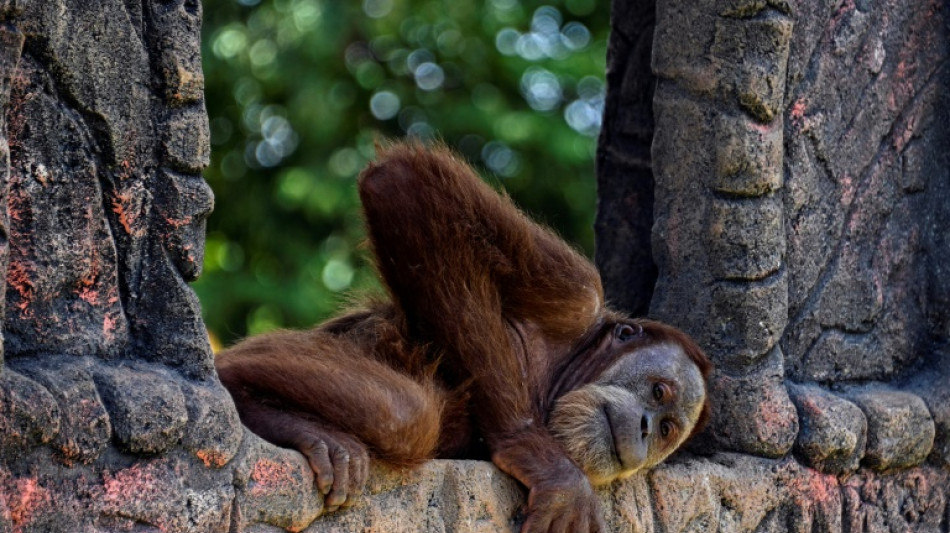
NGOs take aim at Indonesia over orangutans, academic freedom / Photo: CHAIDEER MAHYUDDIN - AFP

 Airbus aims for record deliveries despite disappointing quarter

 Real Madrid, La Liga apology over Mbappe shows power of Chinese market

 'Cruise for life' strands passengers in Cambodia as operator goes bust

 Canada hikes rates to contain oil price surge caused by Iran war

 Nintendo producer 'all nervous' as Zelda classic remake hits shelves

 Three killed by storm in southern India

 Two hundred 'Cruise for life' passengers stranded in Cambodia

 Billionaire Ambani's Jio jumps 21% in market debut after record India IPO

 Sri Lanka's Tamil farmers fight to reclaim land after civil war

 'They don't care about us': Trump food aid cuts leave Americans struggling and angry

 Palestinian activist Khalil returns to Columbia after US detention

 Youths testify about 'despair' in unprecedented Canadian climate trial

 Charles tackles thorny legacy of slavery on Caribbean trip

More than a dozen NGOs have issued a letter accusing Indonesia of stymieing scientific research, after Jakarta banned a group of foreign academics who opposed an official claim that orangutan numbers are increasing.
Indonesia is home to the world's oldest tropical rainforest where the critically endangered apes are losing tracts of their habitat to logging, palm oil plantations and mining.
The legal letter of objection, filed to the environment ministry Thursday by 18 groups including Greenpeace and Amnesty International, called on authorities to lift a ban imposed in September on the five Western scientists and allow researchers to work freely.
The NGOs could decide to file a lawsuit if their demands are not met.
The five academics -- all based outside Indonesia -- had penned an op-ed in a local newspaper citing studies showing the orangutan population is in decline, countering official claims their numbers were set to grow.
They were banned from the country the day the piece was published.
The NGOs called the ban anti-science and said it restricted academic freedom. They demanded a public apology from the government for what they said was an abuse of power by silencing dissenting opinions.
"It is a manifestation of power control of knowledge production, which has violated the academic freedom principle," they said in a statement Thursday.
Arie Rompas, Greenpeace Indonesia's forest campaign team leader, said the ministry's move was "authoritarian", stressing that credible data was essential for sound environmental policies.
"If the data lacks credibility, policies will not solve issues such as deforestation, forest fires, or the orangutan population," Rompas told AFP Friday.
The environment ministry did not respond to a request from AFP for comment.
"We are still waiting on the ministry's response to see what are the next steps," said Rompas.
Poaching and habitat loss had already decimated the orangutan population in the Southeast Asian nation before the coronavirus emerged as another threat to the mammals, who share 97 percent of their DNA with humans.
Fewer than 120,000 orangutans were estimated to remain in the wild before the recent dispute erupted, but the exact number was unknown.
The population of orangutans in Borneo alone plummeted from about 288,000 in 1973 to around 100,000 by 2017, according to the International Union for Conservation of Nature.
The letter by the NGOs calls on the government to work with scientists to reach an agreed estimate on current numbers.
Ch.Lefebvre--CPN