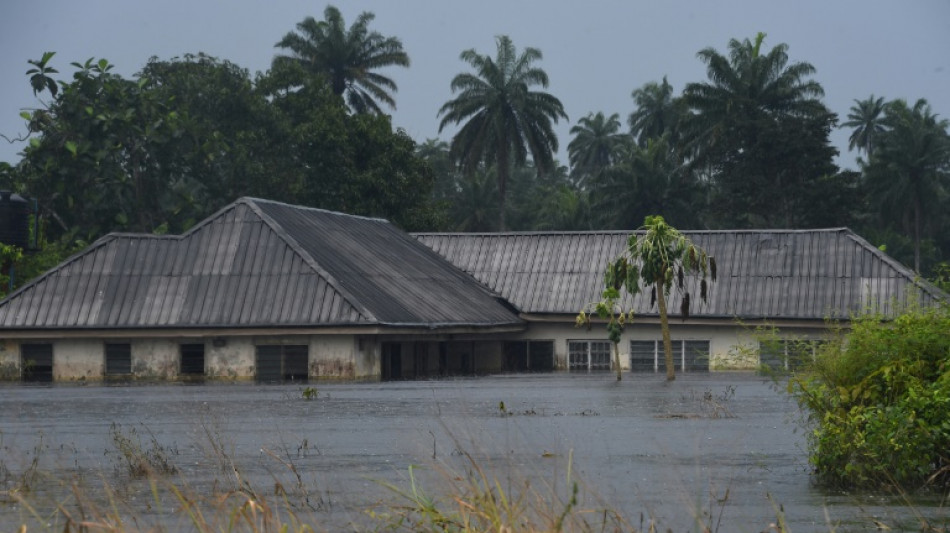
Climate change fuelled rains behind deadly Nigeria floods: study / Photo: PIUS UTOMI EKPEI - AFP

 US Fed raises rates to tackle 'too high' inflation, irking Trump

 Turkey releases 106 protesters, jails more LGBTQ activists

 Candidate for UN chief calls for AI regulation akin to nuclear weapons

 'We're losing control,' AI pioneer Yoshua Bengio tells AFP

 IR-MED and Dice Technologies Announce collaboration to Evaluate and Advance Pressure-Injury Prevention Platform in Japan

 Watts, Pitt, Cruz to light up Spain's top film festival

 Toogood Gold's Table Mountain Sits in the Shadow of a Nevada Gold Rush

 MEXC July–August Security Report: 38.66M USDT in Risk Funds Intercepted, Futures Insurance Fund Hits 792M USDT

 Emporio Armani names Dario Vitale new creative director

 EU to ban social media for under 13s, curb access until 15

 Wildfires push endangered Sumatran elephants to brink: Indonesian NGO

 Bank of Japan set to raise rates under pressure from inflation, US

 EU chief to unveil social media, gaming curbs for under-15s

 'Resident Evil' film brings video game's ethos to the big screen

 GA-ASI Mojave First UAS To Complete Battlefield Short Field Ops

 Sanders, Bannon warn of AI dangers in rare US left-right alignment

 Empty benches as schools reopen in Venezuela's quake-hit Guaira

 Tiny English village holds 'independence' vote over asylum seeker housing

 US Treasury chief says to meet Chinese counterpart at weekend

 BingX Evolves into a Multi-Asset Trading Platform, Connecting Users to Global Opportunities

 International Trading Institute Expands Professional Trader Development Beyond the Master’s in Trading

 Lake Energy Secures $80 Million for U.S. Renewable Energy Expansion

 Stocks drop, oil climbs and Treasury yields hit 19-year high

 SkySail Strategies Outperforms Wall Street's 30-Year Risk Standard With Proprietary AI Inference Model

 Just add fish: Scientists pursue more rice, less disease in Senegal paddies

Heavy rains behind floods that killed over 600 people in Nigeria this year were about 80 times likelier because of human-induced climate change, scientists reported Wednesday.
The floods mainly struck Nigeria but also Niger, Chad and neighbouring countries, displacing over 1.4 million people and devastating homes and farmland in a region already vulnerable to food insecurity.
Researchers from the World Weather Attribution (WWA) consortium said in a study that the floods -- among the deadliest on record in the region -- were directly linked to human activity that is exacerbating climate change.
They matched long-term data on climate -- which shows the planet has warmed by about 1.2 degrees Celsius (2.2 degrees Fahrenheit) since 1800 as carbon emissions have risen -- against weather events.
The heavy rainfall that sparked the floods was 80 times likelier because of "human-caused climate change," according to their findings.
In addition, "this year's rainy season was 20 percent wetter than it would have been without the influence of climate change," they said.
"The influence of climate change means the prolonged rain that led to the floods is no longer a rare event," the study found.
"The above-average rain over the wet season now has approximately a one in 10 chance of happening each year; without human activities it would have been an extremely rare event."
Over 600 people were killed in Nigeria alone because of the floods from June to October this year, and nearly 200 in Niger and 22 in Chad.
- 'Real and present problem' -
The report comes as COP27 climate talks are underway in Egypt's Sharm el-Sheikh, where developing nations are demanding rich polluters pay for climate-change linked calamities.
Africa is home to some of the countries least responsible for carbon emissions but hardest hit by an onslaught of weather extremes, with the Horn of Africa currently in the grips of a severe drought.
"This is a real and present problem, and it's particularly the poorest countries that are getting hit very hard. So it's clear that solutions are needed," Maarten van Aalst, director of the Red Cross Red Crescent Climate Centre, said at a WWA press conference.
In a separate WWA study also released Wednesday, researchers examined a 2021 drought that reduced crop production in Mali, Burkina Faso, Niger, Nigeria and Chad that contributed to a food crisis this year.
The study failed to find concrete climate change links, because of "a lack of reliable weather station data", but showed "that even small shifts in rainfall can have major effects in the region".
It added that high global food prices deepened the crisis, along with the Russian invasion of Ukraine which disrupted deliveries of key fertilisers to Africa.
The WWA publishes rapid-response reports following extreme climate events.
Their studies are not peer-reviewed, a process that can take months, but are widely backed by scientists.
M.Mendoza--CPN