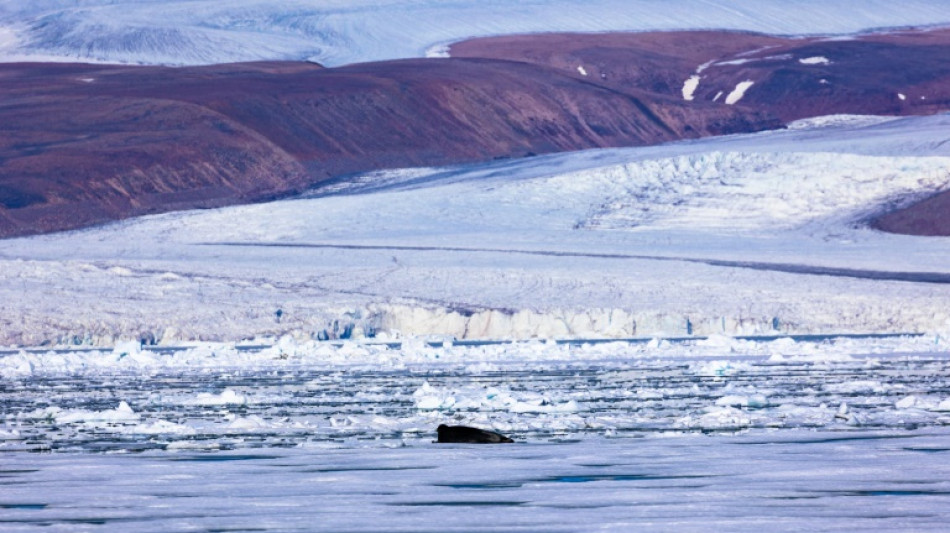
Thinning Greenland ice sheet may mean more sea level rise: study / Photo: Kerem Yücel - AFP

 Candidate for UN chief calls for AI regulation akin to nuclear weapons

 'We're losing control,' AI pioneer Yoshua Bengio tells AFP

 IR-MED and Dice Technologies Announce collaboration to Evaluate and Advance Pressure-Injury Prevention Platform in Japan

 Watts, Pitt, Cruz to light up Spain's top film festival

 Toogood Gold's Table Mountain Sits in the Shadow of a Nevada Gold Rush

 MEXC July–August Security Report: 38.66M USDT in Risk Funds Intercepted, Futures Insurance Fund Hits 792M USDT

 Emporio Armani names Dario Vitale new creative director

 EU to ban social media for under 13s, curb access until 15

 Wildfires push endangered Sumatran elephants to brink: Indonesian NGO

 Bank of Japan set to raise rates under pressure from inflation, US

 EU chief to unveil social media, gaming curbs for under-15s

 'Resident Evil' film brings video game's ethos to the big screen

 GA-ASI Mojave First UAS To Complete Battlefield Short Field Ops

 Sanders, Bannon warn of AI dangers in rare US left-right alignment

 Empty benches as schools reopen in Venezuela's quake-hit Guaira

 Tiny English village holds 'independence' vote over asylum seeker housing

 US Treasury chief says to meet Chinese counterpart at weekend

 BingX Evolves into a Multi-Asset Trading Platform, Connecting Users to Global Opportunities

 International Trading Institute Expands Professional Trader Development Beyond the Master’s in Trading

 Lake Energy Secures $80 Million for U.S. Renewable Energy Expansion

 Stocks drop, oil climbs and Treasury yields hit 19-year high

 SkySail Strategies Outperforms Wall Street's 30-Year Risk Standard With Proprietary AI Inference Model

 Just add fish: Scientists pursue more rice, less disease in Senegal paddies

 Belgium completes outer structure of offshore energy island

 China retail sales growth weakens further in August

Part of Greenland's ice sheet is thinning further inland than previously believed, which will likely lead to greater sea level rise by the end of this century, a new study found Wednesday.
The findings pertain to a northeast section of the giant ice block covering, but the trend is likely happening elsewhere on Greenland and Earth's other ice sheet, in Antarctica.
The implications are worrying, as sea level rise already threatens millions of people living along coasts that could find themselves underwater in the decades and centuries to come.
Scientists have previously focused on the edges of Greenland's ice sheet to examine active melting as global temperatures rise, largely using satellite data.
But the authors of Wednesday's study looked further inland, over 100 kilometres from the coast.
What they found was alarming: thinning from Greenland's coast stretched back 200 to 300 kilometres (125 to 185 miles).
"What we see happening at the front reaches far back into the heart of the ice sheet," said first author Shfaqat Abbas Khan in a press release about the study, published in Nature.
"The new model really captures what's going on inland, the old ones do not... you end up with a completely different mass change, or sea level projection," he told AFP in an interview.
The researchers installed GPS stations on the ice sheet to gather more precise information, and also used satellite data and numerical modelling, all of which provided a new set of data likely to alter global sea level rise projections.
The research was conducted at the Northeast Greenland Ice Stream (NEGIS), which covers an estimated 12 percent of Greenland, according to co-author Mathieu Morlighem.
It found that the thinning could add between 13.5 and 15.5 millimetres to sea levels by the end of this century -- equivalent to the entire Greenland ice sheet's contribution during the past 50 years.
"The NEGIS could lose six times more ice than existing climate models estimate," the report found.
- 'Reduce CO2' -
One reason for the inland thinning is the intrusion of warm ocean currents, which in 2012 caused the floating extension of the NEGIS to collapse.
That event "has accelerated ice flow and triggered a wave of rapid ice thinning that has spread upstream".
The Greenland ice sheet is currently the main factor in swelling the Earth's oceans, according to NASA, with the Arctic region heating at a faster rate than the rest of the planet.
In a landmark report on climate science last year, the Intergovernmental Panel on Climate Change (IPCC) said the Greenland ice sheet would contribute up to 18 centimetres to sea level rise by 2100 under the highest emissions scenario.
The massive ice sheet, two kilometres thick, contains enough frozen water to lift global seas by over seven metres (23 feet) in total.
The researchers will now extend their methods to look at other glaciers on Greenland and Antarctica, and some new data could be available in a year or so.
Earth's surface has warmed, on average, nearly 1.2 degrees Celsius since pre-industrial times, unleashing a catalogue of impacts from heatwaves to more intense storms.
Under the Paris climate deal, countries have agreed to limit warming to well under 2C.
World leaders are currently meeting in Sharm el-Sheikh, Egypt, for UN climate talks aimed at slashing harmful emissions and boosting funding to green developing country economies.
Khan said the thinning trend on Greenland's ice sheet will be near impossible to reverse, but can at least be slowed with the right policies in place.
"I really hope that they agree on a reduction on CO2 and as soon as possible," he said in a message to leaders at the COP27 climate talks.
H.Meyer--CPN