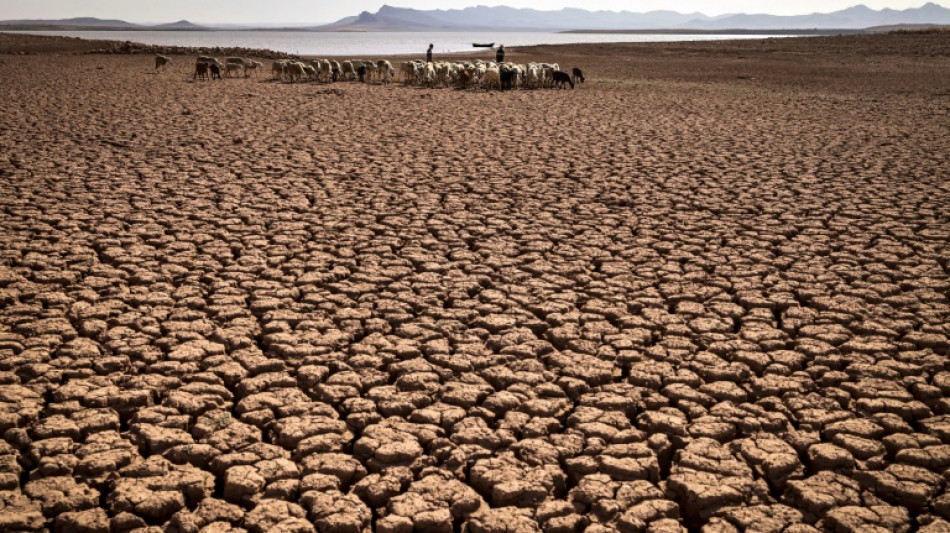
Rich nation 'gestures' on climate damage only a start: observers / Photo: FADEL SENNA - AFP/File

 Candidate for UN chief calls for AI regulation akin to nuclear weapons

 'We're losing control,' AI pioneer Yoshua Bengio tells AFP

 IR-MED and Dice Technologies Announce collaboration to Evaluate and Advance Pressure-Injury Prevention Platform in Japan

 Watts, Pitt, Cruz to light up Spain's top film festival

 Toogood Gold's Table Mountain Sits in the Shadow of a Nevada Gold Rush

 MEXC July–August Security Report: 38.66M USDT in Risk Funds Intercepted, Futures Insurance Fund Hits 792M USDT

 Emporio Armani names Dario Vitale new creative director

 EU to ban social media for under 13s, curb access until 15

 Wildfires push endangered Sumatran elephants to brink: Indonesian NGO

 Bank of Japan set to raise rates under pressure from inflation, US

 EU chief to unveil social media, gaming curbs for under-15s

 'Resident Evil' film brings video game's ethos to the big screen

 GA-ASI Mojave First UAS To Complete Battlefield Short Field Ops

 Sanders, Bannon warn of AI dangers in rare US left-right alignment

 Empty benches as schools reopen in Venezuela's quake-hit Guaira

 Tiny English village holds 'independence' vote over asylum seeker housing

 US Treasury chief says to meet Chinese counterpart at weekend

 BingX Evolves into a Multi-Asset Trading Platform, Connecting Users to Global Opportunities

 International Trading Institute Expands Professional Trader Development Beyond the Master’s in Trading

 Lake Energy Secures $80 Million for U.S. Renewable Energy Expansion

 Stocks drop, oil climbs and Treasury yields hit 19-year high

 SkySail Strategies Outperforms Wall Street's 30-Year Risk Standard With Proprietary AI Inference Model

 Just add fish: Scientists pursue more rice, less disease in Senegal paddies
 Belgium completes outer structure of offshore energy island

 China retail sales growth weakens further in August
A trickle of climate "loss and damage" funding pledges from rich countries at the COP27 summit in Egypt have been welcomed by observers and developing nations, who say they must pave the way for a broad global financing deal.
The controversial issue is a key focus of the UN meeting, as a relentless surge of impacts wreak death, destruction and mounting economic losses on developing nations least responsible for planet-heating emissions.
A handful of European nations and regions have announced small funding pledges during the Sharm el-Sheikh talks, with Germany, Austria, Ireland and Belgium saying they would make contributions.
"These are good gestures. It shows that the issue has been acknowledged after years of advocacy," said Harjeet Singh, head of global political strategy at the Climate Action Network.
But he said that this should not distract from calls by developing nations for a robust framework that can pay out when countries are hit by increasingly ferocious floods, heatwaves and droughts, along with slow-onset impacts such as sea level rise.
Pledges so far are miniscule in comparison to the damages already incurred.
Austria has offered $50 million and Belgium says it will give $2.5 million to Mozambique, adding to $13 million that Denmark has earmarked for loss and damage in North Africa and the Sahel.
Scotland, which kicked off the loss and damage pledges last year when Britain hosted the COP26 summit, has also upped its contribution to $8 million.
Meanwhile, Germany is touting its "global shield" project, due to be officially launched in Egypt next week, as a way to provide climate risk insurance and prevention to vulnerable countries.
It announced $170 million for the project this week, while Ireland said it would contribute $10 million for 2023.
- Heatwaves, droughts, floods -
These countries "have begun to show the way" by recognising the need to provide funds to countries already being slammed by the impacts of climate change," Gaston Browne, the Prime Minister of Antigua and Barbuda, told delegates on Tuesday.
"It would be right for the major polluters -- particularly those that have been involved in the historical use of fossil fuel energies -- to follow this example."
The summit is taking place at as a devastating drought is threatening millions with starvation in the Horn of Africa.
Heatwaves and droughts have caused crops to wither on four continents, while Pakistan is still reeling from catastrophic flooding that destroyed homes, roads and bridges and swallowed vast areas of farmland.
The World Bank has estimated the Pakistan floods alone caused $30 billion in damages and economic loss. Millions of people were displaced and two million homes destroyed.
Rachel Cleetus, policy director and lead economist for the Climate and Energy Program, Union of Concerned Scientists, said climate disasters and rocketing fossil fuel prices were hurting countries already burdened with "crushing debt".
She said that while measures like Germany's insurance programme are important additions to loss and damage, they would be "inadequate" to deal with loss and damage more broadly.
"We're talking about losing land to sea level rise and desertification. Insurance can help you up to a point but climate change is now creating conditions in many parts of the world that are beyond the bounds of what's insurable," she said.
"In a year like this, on this climate vulnerable continent of Africa, it would just be unconscionable to come away without an agreement on a loss and damage facility."
Y.Uduike--CPN