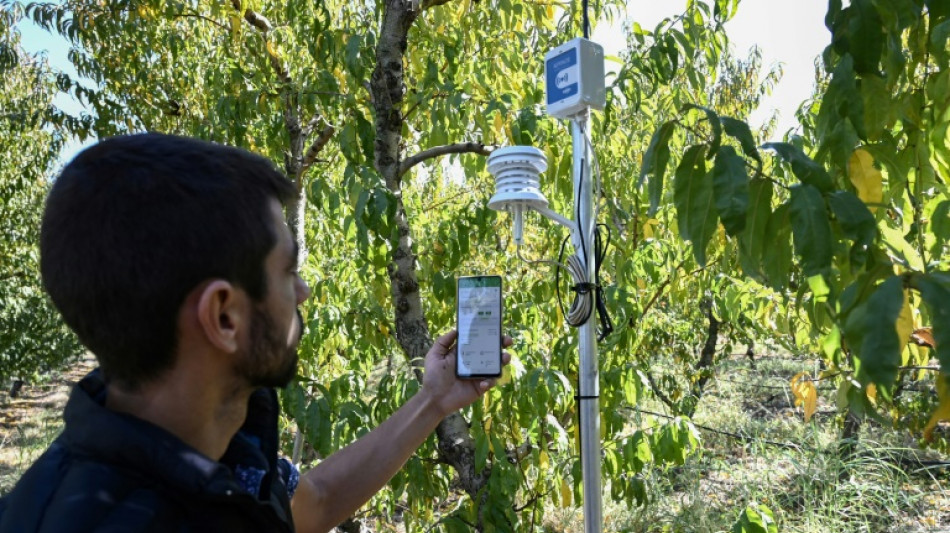
Smart farming tech offers sprout of hope in Greece / Photo: Sakis MITROLIDIS - AFP

 Candidate for UN chief calls for AI regulation akin to nuclear weapons

 'We're losing control,' AI pioneer Yoshua Bengio tells AFP

 IR-MED and Dice Technologies Announce collaboration to Evaluate and Advance Pressure-Injury Prevention Platform in Japan

 Watts, Pitt, Cruz to light up Spain's top film festival

 Toogood Gold's Table Mountain Sits in the Shadow of a Nevada Gold Rush

 MEXC July–August Security Report: 38.66M USDT in Risk Funds Intercepted, Futures Insurance Fund Hits 792M USDT

 Emporio Armani names Dario Vitale new creative director

 EU to ban social media for under 13s, curb access until 15

 Wildfires push endangered Sumatran elephants to brink: Indonesian NGO

 Bank of Japan set to raise rates under pressure from inflation, US

 EU chief to unveil social media, gaming curbs for under-15s

 'Resident Evil' film brings video game's ethos to the big screen

 GA-ASI Mojave First UAS To Complete Battlefield Short Field Ops

 Sanders, Bannon warn of AI dangers in rare US left-right alignment

 Empty benches as schools reopen in Venezuela's quake-hit Guaira

 Tiny English village holds 'independence' vote over asylum seeker housing

 US Treasury chief says to meet Chinese counterpart at weekend

 BingX Evolves into a Multi-Asset Trading Platform, Connecting Users to Global Opportunities

 International Trading Institute Expands Professional Trader Development Beyond the Master’s in Trading

 Lake Energy Secures $80 Million for U.S. Renewable Energy Expansion

 Stocks drop, oil climbs and Treasury yields hit 19-year high

 SkySail Strategies Outperforms Wall Street's 30-Year Risk Standard With Proprietary AI Inference Model

 Just add fish: Scientists pursue more rice, less disease in Senegal paddies

 Belgium completes outer structure of offshore energy island

 China retail sales growth weakens further in August

Eyes glued to his mobile phone, farmer Sotiris Mournos pores over the latest microclimate and humidity data about his fields on the plain of Imathia in northern Greece.
The high-tech farming techniques he uses are making slow progress in Greece's tradition-bound and struggling agricultural sector, but growers like him see them as key to their future.
Mournos, 25, employs a Greek smart-farming app to boost production of his family's cotton fields and fruit trees.
Using real-time data recorded by a weather station, he can analyse and correlate the impact of weather conditions on his 10-hectare (nearly 25-acre) cotton plantation.
"We've managed to reduce the use of fertiliser and irrigation... (and thereby to) increase the financial return" of the farm, said Mournos, who gave up studying computer science at university to devote himself to the family holding in the town of Platy.
Measuring the humidity or the nitrogen level in the soil helps to curb the excessive use of fertilisers and saves water, he notes.
As in many other southern European countries, Greece's agricultural sector is chronically short of water and smart farming could help deal with that problem.
- Boosting yields -
The sector has also lost a major share of its available labour in recent decades, as young people snub farm work for better-paid jobs in services such as tourism.
Agriculture now represents just five percent of Greece's GDP, half what it was 20 years ago.
The government has budgeted 230 million euros ($231 million) over the next three years to revive the country's farming industry.
Most of that derives from the European Union's Common Agricultural Policy innovation fund.
"Most young people in my village prefer other jobs and have given up working in the fields," Mournos told AFP.
But he is making a go at farming, aiming to work smart by using the farming app for several years now.
It means he uses 40 percent less fertiliser on his cotton field and can avoid using two pesticide sprays -- altogether saving 9,000 euros (about $9,000) -- without affecting production rates.
Analysts say the farming app is not widely used in Greece although interest is gradually picking up.
But persuading farmers who may be less technologically minded than Mournos to embrace it faces myriad challenges.
A key hurdle is the small size of Greek farms -- less than 10 hectares on average -- and the country's largely mountainous terrain.
Greek farms are often family businesses or involve rented fields, making investment in tools and practices less appealing.
- Convincing farmers -
Meanwhile, an "endemic" lack of cooperation among farmers prevents them sharing costs, says Aikaterini Kasimati, an agricultural engineer at the University of Agronomy in Athens.
As a result, Greece lags far behind other European states in the use of smart farming, says Vassilis Protonotarios, marketing manager of Neuropublic, a company specialising in digital agriculture.
He said farmers could benefit from new technology without having to invest in expensive equipment or have "specialised digital skills".
Then, there is the difficulty of convincing farmers to try something new.
Organic farmer Thodoris Arvanitis says his colleagues are not interested in new technologies because they don't know enough about them and prefer long-used conventional methods.
"Farmers won't go after technology when they don't have enough money for fuel," he added, at his farm in the small town of Kiourka, some 30 kilometres (nearly 20 miles) north of Athens.
Attitudes may change in time as climate change puts additional pressure on farm costs, says Machi Symeonidou, an agronomist and creator of the agricultural IT startup Agroapps.
The war in Ukraine and its impact on global food supplies also shows that it is increasingly necessary to produce food at a local level, said agricultural engineer Kasimati.
"We see a constant degradation of fields and a fall in yield," she said, adding that water was also becoming expensive.
"But as the technology becomes simpler and cheaper, these tools will see more use," she added.
H.Müller--CPN