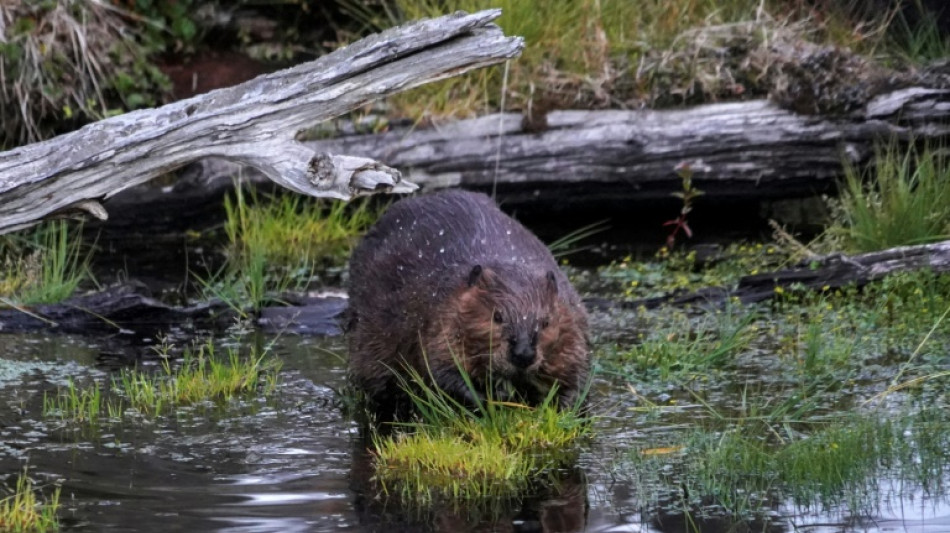
Eager beaver: dams improve quality of river water hit by climate change / Photo: PABLO COZZAGLIO - AFP

 Candidate for UN chief calls for AI regulation akin to nuclear weapons

 'We're losing control,' AI pioneer Yoshua Bengio tells AFP

 IR-MED and Dice Technologies Announce collaboration to Evaluate and Advance Pressure-Injury Prevention Platform in Japan

 Watts, Pitt, Cruz to light up Spain's top film festival

 Toogood Gold's Table Mountain Sits in the Shadow of a Nevada Gold Rush

 MEXC July–August Security Report: 38.66M USDT in Risk Funds Intercepted, Futures Insurance Fund Hits 792M USDT

 Emporio Armani names Dario Vitale new creative director

 EU to ban social media for under 13s, curb access until 15

 Wildfires push endangered Sumatran elephants to brink: Indonesian NGO

 Bank of Japan set to raise rates under pressure from inflation, US

 EU chief to unveil social media, gaming curbs for under-15s

 'Resident Evil' film brings video game's ethos to the big screen

 GA-ASI Mojave First UAS To Complete Battlefield Short Field Ops

 Sanders, Bannon warn of AI dangers in rare US left-right alignment

 Empty benches as schools reopen in Venezuela's quake-hit Guaira

 Tiny English village holds 'independence' vote over asylum seeker housing

 US Treasury chief says to meet Chinese counterpart at weekend

 BingX Evolves into a Multi-Asset Trading Platform, Connecting Users to Global Opportunities

 International Trading Institute Expands Professional Trader Development Beyond the Master’s in Trading

 Lake Energy Secures $80 Million for U.S. Renewable Energy Expansion

 Stocks drop, oil climbs and Treasury yields hit 19-year high

 SkySail Strategies Outperforms Wall Street's 30-Year Risk Standard With Proprietary AI Inference Model

 Just add fish: Scientists pursue more rice, less disease in Senegal paddies

 Belgium completes outer structure of offshore energy island

 China retail sales growth weakens further in August

Hotter, drier weather means beaver populations are spreading in the western United States, and their dams are helping to mitigate the negative impacts of climate change on river water quality, according to a new study on Tuesday.
The findings -- discovered almost by accident -- offered a "rare bright spot" in an otherwise bleak landscape of climate change news, the lead author told AFP.
Stanford University scientists and colleagues conducted the research over three years on the East River, a main tributary of the Colorado River in the US state of Colorado.
It has long been known that beaver dams can improve the quality of river water by filtering out contaminants.
But what came as a surprise is what the Stanford team described as a virtuous climate change-induced "feedback" loop.
It works like this: hotter, drier spells linked to a warming world often reduce water quality, mainly because less water leads to a higher concentration of contaminants such as nitrate, a form of nitrogen.
At the same time, a changing climate has increased the range of industrious buck-toothed beavers, and widened the impact of their dams, thus helping to dilute the negative impact of global warming.
"In building more dams, they mitigate that degradation in water quality that's caused by climate change," lead author Christian Dewey told AFP.
When the beavers' dams raise water levels upstream, water is diverted into surrounding soils and secondary waterways, collectively called a riparian zone.
"These zones act like filters, straining out excess nutrients and contaminants before water re-enters the main channel downstream," according to a press release about the study, published in Nature Communications.
- 'Rare bright spot' -
The same contaminants -- potentially harmful to humans, animals or plants in river water -- are thus dispersed with little or no negative impact in soils.
This is good news in the area where the research was conducted, as the Colorado River provides drinking water and supports livelihoods for some 40 million people, according to the US government.
Nitrogen in particular promotes algae overgrowth, which starves water of oxygen needed to support diverse animal life and a healthy ecosystem.
The study found that the benefits provided by the beaver dams improved water quality in both high- and low-water conditions linked to climate change -- whether hot and dry spells, or heavy rainfall and snowmelt.
In both cases, "the beaver dam pushed more water and nitrate into surrounding soil than did either seasonal extreme, leading to vastly more removal of nitrate", Dewey said.
He said he did not set out to study beaver dams initially, but one cropped up on the river he was testing for seasonal changes in hydrology.
"It was incredibly lucky," he said.
He cautioned that the feedback dynamic may be unique to the particular conditions in western United States, and thus may not be found elsewhere.
But the findings are still "a rare bright spot in climate news", and perhaps an example of nature restoring balance.
"We push too far, and then (there's) sort of a swinging back in the other direction, at least in the case of beavers."
Y.Uduike--CPN