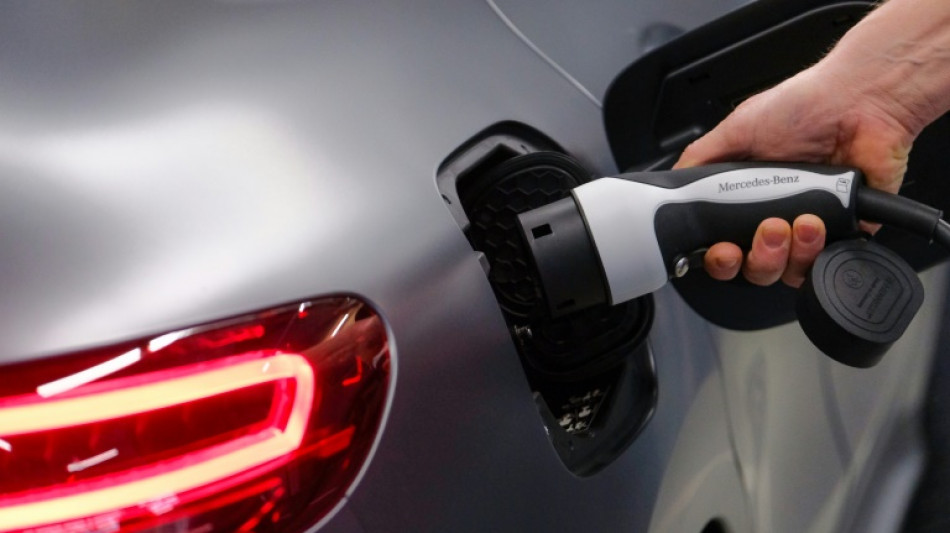
EU strikes deal to ban combustion-engine cars by 2035 / Photo: Patrik Stollarz - AFP/File

 Candidate for UN chief calls for AI regulation akin to nuclear weapons

 'We're losing control,' AI pioneer Yoshua Bengio tells AFP

 IR-MED and Dice Technologies Announce collaboration to Evaluate and Advance Pressure-Injury Prevention Platform in Japan

 Watts, Pitt, Cruz to light up Spain's top film festival

 Toogood Gold's Table Mountain Sits in the Shadow of a Nevada Gold Rush

 MEXC July–August Security Report: 38.66M USDT in Risk Funds Intercepted, Futures Insurance Fund Hits 792M USDT

 Emporio Armani names Dario Vitale new creative director

 EU to ban social media for under 13s, curb access until 15

 Wildfires push endangered Sumatran elephants to brink: Indonesian NGO

 Bank of Japan set to raise rates under pressure from inflation, US

 EU chief to unveil social media, gaming curbs for under-15s

 'Resident Evil' film brings video game's ethos to the big screen

 GA-ASI Mojave First UAS To Complete Battlefield Short Field Ops

 Sanders, Bannon warn of AI dangers in rare US left-right alignment

 Empty benches as schools reopen in Venezuela's quake-hit Guaira

 Tiny English village holds 'independence' vote over asylum seeker housing

 US Treasury chief says to meet Chinese counterpart at weekend

 BingX Evolves into a Multi-Asset Trading Platform, Connecting Users to Global Opportunities

 International Trading Institute Expands Professional Trader Development Beyond the Master’s in Trading

 Lake Energy Secures $80 Million for U.S. Renewable Energy Expansion

 Stocks drop, oil climbs and Treasury yields hit 19-year high

 SkySail Strategies Outperforms Wall Street's 30-Year Risk Standard With Proprietary AI Inference Model

 Just add fish: Scientists pursue more rice, less disease in Senegal paddies

 Belgium completes outer structure of offshore energy island

 China retail sales growth weakens further in August

The European Union on Thursday struck an agreement on legislation to phase out new CO2-emitting vehicles by 2035, negotiators announced.
The talks between representatives of the European Council, fronting the 27 member states, and the European Parliament started Thursday and underpin the bloc's transition towards a carbon-neutral future.
"We have just finished the negotiations on CO2 standards for cars," tweeted French MEP Pascal Canfin, who heads the European parliament's environment commission.
"Historic (EU) decision for the climate which definitively confirms the target of 100 percent zero emission vehicles in 2035 with intermediary phases between 2025 and 2030."
Cars currently account for about 15 percent of all CO2 emissions in the EU, while transportation overall accounts for around a quarter.
The agreed text, based on a proposal by the EU executive in July 2021, calls for reducing CO2 emissions from new cars in Europe to zero by 2035.
This means a de facto halt to sales of new petrol and diesel cars, light commercial vehicles and hybrids in the bloc by that date, in favour of all-electric vehicles.
European Commission chief Ursula von der Leyen praised the agreement as "a crucial milestone to reach our 2030 climate target".
There is a waiver for "niche" manufacturers, or those producing fewer than 10,000 vehicles per year.
Sometimes called the "Ferrari amendment" as it will benefit luxury brands in particular, these vehicles are allowed to be equipped with a combustion engine until the end of 2035.
- 'Far-reaching' -
BMW CEO Oliver Zipse, who is also the president of the European Automobile Manufacturers' Association (ACEA), said the decision was "extremely far-reaching".
"Make no mistake, the European automobile industry is up to the challenge of providing these zero-emission cars and vans," he said.
But more needed to be done for the industry to meet this target, added Zipse, such as having "an abundance of renewable energy, a seamless private and public charging infrastructure network, and access to raw materials".
The European Parliament had in June voted in favour of the 2035 ban on all vehicles with internal combustion engines.
Conservative MEPs and Germany had shown reluctance over some of the targets, fearing the costly burden they will place on EU automakers competing against global rivals with looser targets.
Currently around 12 percent of new cars sold in the European Union are electric vehicles, with its consumers shifting away from CO2-emitting models as energy costs and greener traffic regulations bite.
Meanwhile, China -- the world's biggest automobile market -- wants at least half of all new cars to be electric, plug-in hybrid or hydrogen-powered by 2035.
O.Ignatyev--CPN