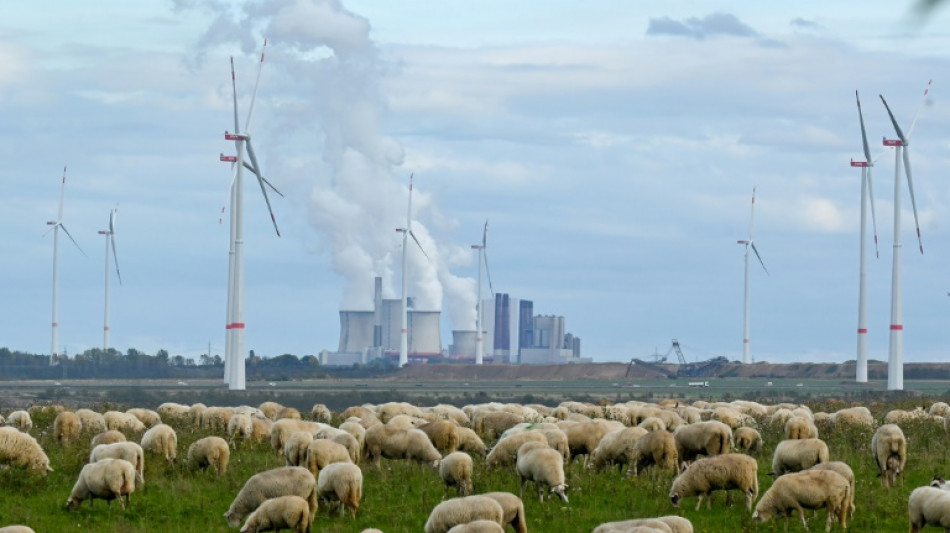
IEA sees global energy emissions peaking in 2025 / Photo: INA FASSBENDER - AFP

 Candidate for UN chief calls for AI regulation akin to nuclear weapons

 'We're losing control,' AI pioneer Yoshua Bengio tells AFP

 IR-MED and Dice Technologies Announce collaboration to Evaluate and Advance Pressure-Injury Prevention Platform in Japan

 Watts, Pitt, Cruz to light up Spain's top film festival

 Toogood Gold's Table Mountain Sits in the Shadow of a Nevada Gold Rush

 MEXC July–August Security Report: 38.66M USDT in Risk Funds Intercepted, Futures Insurance Fund Hits 792M USDT

 Emporio Armani names Dario Vitale new creative director

 EU to ban social media for under 13s, curb access until 15

 Wildfires push endangered Sumatran elephants to brink: Indonesian NGO

 Bank of Japan set to raise rates under pressure from inflation, US

 EU chief to unveil social media, gaming curbs for under-15s

 'Resident Evil' film brings video game's ethos to the big screen

 GA-ASI Mojave First UAS To Complete Battlefield Short Field Ops

 Sanders, Bannon warn of AI dangers in rare US left-right alignment

 Empty benches as schools reopen in Venezuela's quake-hit Guaira

 Tiny English village holds 'independence' vote over asylum seeker housing

 US Treasury chief says to meet Chinese counterpart at weekend

 BingX Evolves into a Multi-Asset Trading Platform, Connecting Users to Global Opportunities

 International Trading Institute Expands Professional Trader Development Beyond the Master’s in Trading

 Lake Energy Secures $80 Million for U.S. Renewable Energy Expansion

 Stocks drop, oil climbs and Treasury yields hit 19-year high

 SkySail Strategies Outperforms Wall Street's 30-Year Risk Standard With Proprietary AI Inference Model

 Just add fish: Scientists pursue more rice, less disease in Senegal paddies

 Belgium completes outer structure of offshore energy island

 China retail sales growth weakens further in August

The International Energy Agency said Thursday it believes global energy emissions will peak in 2025 as surging prices due to the Russian invasion of Ukraine propel investment in renewables.
Only last year the IEA said there was "no clear peak in sight" in energy emissions, but the new higher investment in wind and solar is setting up demand for all fossil fuels to peak or plateau, leading to a drop in emissions.
"The global energy crisis triggered by Russia's invasion of Ukraine is causing profound and long-lasting changes that have the potential to hasten the transition to a more sustainable and secure energy system," the IEA said as it released its latest annual World Energy Outlook report.
Based on the latest measures and policies announced by governments in the face of soaring energy prices, the IEA forecasts global clean energy investment to rise by more than 50 percent from today's levels to $2 trillion per year by 2030.
Those measures will propel sustained gains in renewables and nuclear power.
"As a result, a high point for global emissions is reached in 2025," the IEA said.
Global energy-related CO2 emissions are then set to fall back slowly from a high point of 37 billion tonnes per year to 32 billion tonnes by 2050, it added.
The Paris-based organisation, which advises energy-consuming nations, said that its forecast sees demand for all types of fossil fuels peaking or hitting a plateau.
Coal use, which has seen a temporary bump higher, will drop back in the next few years as more renewables come online.
Natural gas hits a plateau in the end of the decade, instead of the previous forecast of a steady rise.
Oil demand levels off in the mid-2030s and then gradually declines towards mid-century due to uptake of electric vehicles, instead of the earlier estimate of a steady increase.
Overall, the share of fossil fuels in the global energy mix in the IEA's stated policies scenario falls from around 80 percent to just above 60 percent by 2050.
"Energy markets and policies have changed as a result of Russia's invasion of Ukraine, not just for the time being, but for decades to come," said IEA Executive Director Fatih Birol in a statement as the report was released.
But that will still leave the world on track for a rise in global temperatures of around 2.5 degrees Celsius by the end of the century, which would likely trigger severe climate change impacts.
The IEA also has a scenario to arrive at zero net emissions in 2050, which is seen as necessary to hit the 1.5C warming target enshrined in the Paris climate pact.
That would require clean energy investments to rise to $4 trillion per year by 2030, instead of the current forecast of $2 trillion.
"The IEA, with all its expertise and authority is clear: clean energy investments must triple by 2030, and gas is a dead end," said Laurence Tubiana, head of the European Climate Foundation and France's former climate ambassador.
"The current European energy crisis clearly proves the dangers of gas: high price, volatility, geopolitical dependence," she added.
St.Ch.Baker--CPN