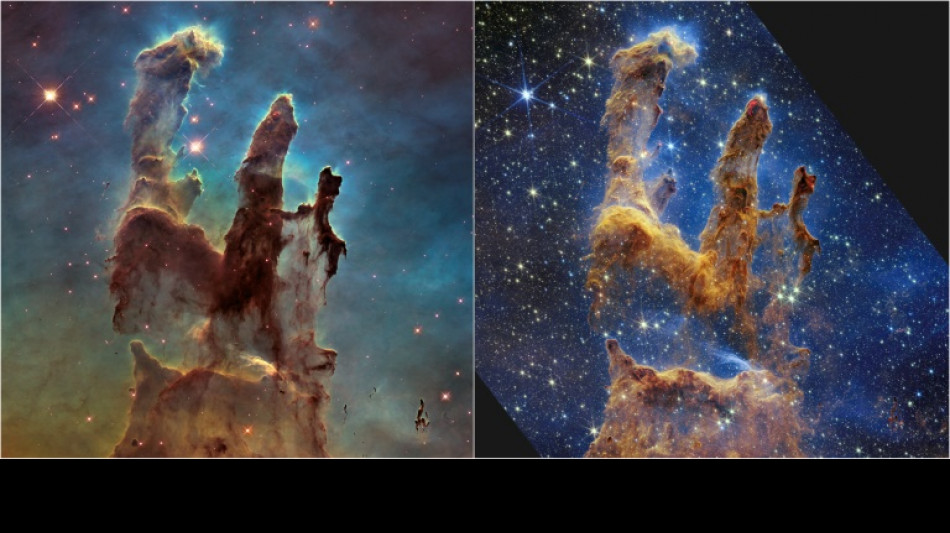
Iconic 'Pillars of Creation' captured in new Webb image / Photo: Space Telescope Science Institut - NASA/ESA/CSA/AFP

 Candidate for UN chief calls for AI regulation akin to nuclear weapons

 'We're losing control,' AI pioneer Yoshua Bengio tells AFP

 IR-MED and Dice Technologies Announce collaboration to Evaluate and Advance Pressure-Injury Prevention Platform in Japan

 Watts, Pitt, Cruz to light up Spain's top film festival

 Toogood Gold's Table Mountain Sits in the Shadow of a Nevada Gold Rush

 MEXC July–August Security Report: 38.66M USDT in Risk Funds Intercepted, Futures Insurance Fund Hits 792M USDT

 Emporio Armani names Dario Vitale new creative director

 EU to ban social media for under 13s, curb access until 15

 Wildfires push endangered Sumatran elephants to brink: Indonesian NGO

 Bank of Japan set to raise rates under pressure from inflation, US

 EU chief to unveil social media, gaming curbs for under-15s

 'Resident Evil' film brings video game's ethos to the big screen

 GA-ASI Mojave First UAS To Complete Battlefield Short Field Ops

 Sanders, Bannon warn of AI dangers in rare US left-right alignment

 Empty benches as schools reopen in Venezuela's quake-hit Guaira

 Tiny English village holds 'independence' vote over asylum seeker housing

 US Treasury chief says to meet Chinese counterpart at weekend

 BingX Evolves into a Multi-Asset Trading Platform, Connecting Users to Global Opportunities

 International Trading Institute Expands Professional Trader Development Beyond the Master’s in Trading

 Lake Energy Secures $80 Million for U.S. Renewable Energy Expansion

 Stocks drop, oil climbs and Treasury yields hit 19-year high

 SkySail Strategies Outperforms Wall Street's 30-Year Risk Standard With Proprietary AI Inference Model

 Just add fish: Scientists pursue more rice, less disease in Senegal paddies

 Belgium completes outer structure of offshore energy island

 China retail sales growth weakens further in August
The James Webb Space Telescope captured the iconic "Pillars of Creation," huge structures of gas and dust teeming with stars, NASA said Wednesday, and the image is as majestic as one could hope.
The twinkling of thousands of stars illuminates the telescope's first shot of the gigantic gold, copper and brown columns standing in the midst of the cosmos.
At the ends of several pillars are bright red, lava-like spots. "These are ejections from stars that are still forming," only a few hundred thousand years old, NASA said in a statement.
These "young stars periodically shoot out supersonic jets that collide with clouds of material, like these thick pillars," the US space agency added.
The "Pillars of Creation" are located 6,500 light years from Earth, in the Eagle Nebula of our Milky Way galaxy.
The pillars were made famous by the Hubble Space Telescope, which first captured them in 1995 and then again in 2014.
But thanks to Webb's infrared capabilities, the newer telescope -- launched into space less than a year ago -- can peer through the opacity of the pillars, revealing many new stars forming.
"By popular demand, we had to do the Pillars of Creation" with Webb, Klaus Pontoppidan, the science program manager at the Space Telescope Science Institute, said Wednesday on Twitter.
STScI operates Webb from Baltimore, Maryland.
"There are just so many stars!" Pontoppidan added.
NASA astrophysicist Amber Straughn summed it up: "The universe is beautiful!" she wrote on Twitter.
The image, covering an area of about eight light years, was taken by Webb's primary imager NIRCam, which captures near-infrared wavelengths -- invisible to the human eye.
The colors of the image have been "translated" into visible light.
According to NASA, the new image "will help researchers revamp their models of star formation by identifying far more precise counts of newly formed stars, along with the quantities of gas and dust in the region."
Operational since July, Webb is the most powerful space telescope ever built, and has already unleashed a raft of unprecedented data. Scientists are hopeful it will herald a new era of discovery.
One of the main goals for the $10-billion telescope is to study the life cycle of stars. Another main research focus is on exoplanets, planets outside Earth's solar system.
H.Müller--CPN