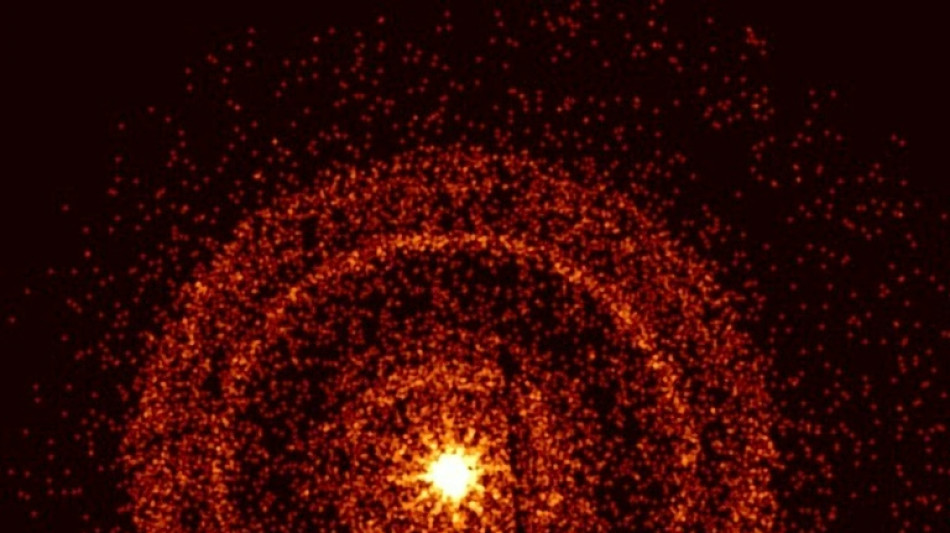
Astronomers are captivated by brightest flash ever seen / Photo: Handout - NASA/Swift/A. Beardmore (University of Leicester)/AFP

 Candidate for UN chief calls for AI regulation akin to nuclear weapons

 'We're losing control,' AI pioneer Yoshua Bengio tells AFP

 IR-MED and Dice Technologies Announce collaboration to Evaluate and Advance Pressure-Injury Prevention Platform in Japan

 Watts, Pitt, Cruz to light up Spain's top film festival

 Toogood Gold's Table Mountain Sits in the Shadow of a Nevada Gold Rush

 MEXC July–August Security Report: 38.66M USDT in Risk Funds Intercepted, Futures Insurance Fund Hits 792M USDT

 Emporio Armani names Dario Vitale new creative director

 EU to ban social media for under 13s, curb access until 15

 Wildfires push endangered Sumatran elephants to brink: Indonesian NGO

 Bank of Japan set to raise rates under pressure from inflation, US

 EU chief to unveil social media, gaming curbs for under-15s

 'Resident Evil' film brings video game's ethos to the big screen

 GA-ASI Mojave First UAS To Complete Battlefield Short Field Ops

 Sanders, Bannon warn of AI dangers in rare US left-right alignment

 Empty benches as schools reopen in Venezuela's quake-hit Guaira

 Tiny English village holds 'independence' vote over asylum seeker housing

 US Treasury chief says to meet Chinese counterpart at weekend

 BingX Evolves into a Multi-Asset Trading Platform, Connecting Users to Global Opportunities

 International Trading Institute Expands Professional Trader Development Beyond the Master’s in Trading

 Lake Energy Secures $80 Million for U.S. Renewable Energy Expansion

 Stocks drop, oil climbs and Treasury yields hit 19-year high

 SkySail Strategies Outperforms Wall Street's 30-Year Risk Standard With Proprietary AI Inference Model

 Just add fish: Scientists pursue more rice, less disease in Senegal paddies

 Belgium completes outer structure of offshore energy island

 China retail sales growth weakens further in August
Astronomers have observed the brightest flash of light ever seen, from an event that occurred 2.4 billion light years from Earth and was likely triggered by the formation of a black hole.
The burst of gamma-rays -- the most intense form of electromagnetic radiation -- was first detected by orbiting telescopes on October 9, and its afterglow is still being watched by scientists across the world.
Astrophysicist Brendan O'Connor told AFP that gamma-ray bursts that last hundreds of seconds, as occurred on Sunday, are thought to be caused by dying massive stars, greater than 30 times bigger than our Sun.
The star explodes in a supernova, collapses into a black hole, then matter forms in a disk around the black hole, falls inside, and is spewed out in a jet of energy that travels at 99.99 percent the speed of light.
The flash released photons carrying a record 18 teraelectronvolts of energy -- that's 18 with 12 zeros behind it -- and it has impacted long wave radio communications in Earth's ionosphere.
"It's really breaking records, both in the amount of photons, and the energy of the photons that are reaching us," said O'Connor, who used infrared instruments on the Gemini South telescope in Chile to take fresh observations early Friday.
"Something this bright, this nearby, is really a once-in-a-century event," he added.
"Gamma-ray bursts in general release the same amount of energy that our Sun produces over its entire lifetime in the span of a few seconds -- and this event is the brightest gamma ray burst."
The gamma-ray burst, known as GRB 221009A, was first spotted by telescopes including NASA's Fermi Gamma-ray Space Telescope, Neil Gehrels Swift Observatory, and Wind spacecraft on Sunday morning Eastern time.
- 1.9 billion-year-old movie -
It originated from the direction of the constellation Sagitta, and traveled an estimated 1.9 billion years to reach Earth -- less than the current distance of its starting point, because the universe is expanding.
Observing the event now is like watching a 1.9 billion-year-old recording of those events unfold before us, giving astronomers a rare opportunity to glean new insights into things like black hole formation.
"That's what makes this sort of science so addictive -- you get this adrenaline rush when these things happen," said O'Connor, who is affiliated with the University of Maryland and George Washington University.
He added that though the initial burst may have been visible to lucky amateur astronomers, it has since faded out of their view.
Over the coming weeks, he and others will continue watching for the signatures of supernovas at optical and infrared wavelengths, to confirm that their hypothesis about the origins of the flash are correct, and that the event conforms to known physics.
Unfortunately, while the initial burst may have been visible to amateur astronomers, it has since faded
Supernova explosions are also predicted to be responsible for producing heavy elements -- such as gold, platinum, uranium -- and astronomers will also be on the hunt for their signatures.
Astrophysicists have written in the past that the sheer power of gamma-ray bursts could cause extinction level events here on Earth.
But O'Connor pointed out that because the jets of energy are very tightly focused, and aren't likely to arise in our galaxy, this scenario is not something we should worry much about.
O.Ignatyev--CPN