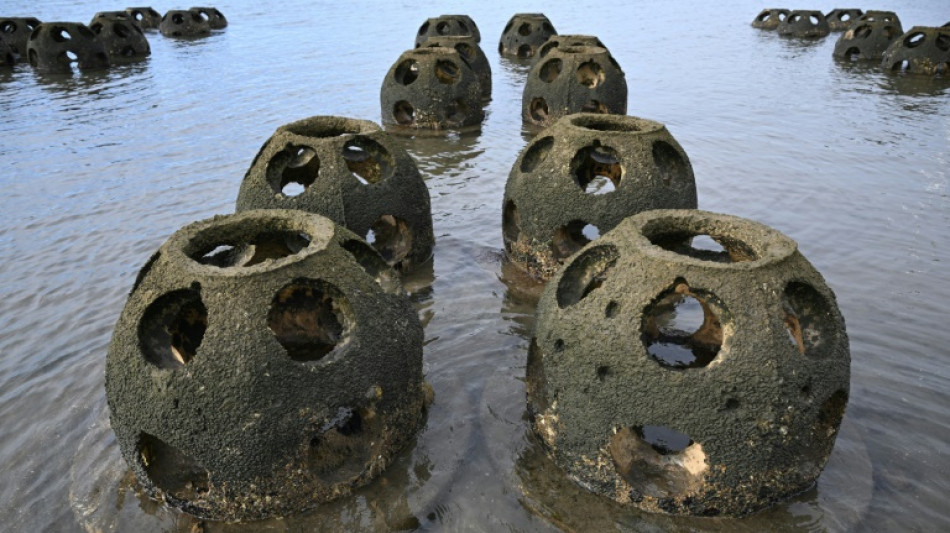
To save California coasts, scientists turn to the humble oyster / Photo: Robyn Beck - AFP/File

 US House faces test on sweeping Russia sanctions bill

 British PM says to make 'difficult decisions' as inflation rises

 Global fuel price demos: a round-up

 Leverate Launches MCP for Traders to Connect AI Assistants With Trading Platforms

 MEXC Launches $1M "Discover Your Wall Street DNA" Campaign to Help Traders Find Their Market Fit

 Stocks edge higher ahead of US Fed rate call

 BASIS.pro Expands On-Chain Infrastructure with XDC Network Partnership and Zypher DAO as Auto Earn Goes Live

 Pickle-flavoured tart? AI inspires Japan's convenience stores

 EU chief hosts Canada's Carney in push to 'deepen' alliance

 Meta chief pushes back on AI slowdown calls

 US Fed to deliver rate decision with markets betting on hike

 Sanders, Bannon warn of AI dangers in rare US left-right alignment

 Empty benches as schools reopen in Venezuela's quake-hit Guaira

 Tiny English village holds 'independence' vote over asylum seeker housing

 US Treasury chief says to meet Chinese counterpart at weekend

 BingX Evolves into a Multi-Asset Trading Platform, Connecting Users to Global Opportunities

 International Trading Institute Expands Professional Trader Development Beyond the Master’s in Trading

 Lake Energy Secures $80 Million for U.S. Renewable Energy Expansion

 Stocks drop, oil climbs and Treasury yields hit 19-year high

 SkySail Strategies Outperforms Wall Street's 30-Year Risk Standard With Proprietary AI Inference Model

 Just add fish: Scientists pursue more rice, less disease in Senegal paddies

 Belgium completes outer structure of offshore energy island

 China retail sales growth weakens further in August

 In Kashmir, lake weeds mix with traditional art
 'Widow's Bay' and 'The Pitt' take key Emmy awards

There are no pearls growing on the oyster reefs in San Diego Bay, but scientists hope they will yield an even more valuable treasure: protection against coastal erosion wrought by rising sea levels.
Thousands of the tiny mollusks have begun growing on the artificial reefs dropped in the bay as part of a plan to mitigate damage in California's far south.
"We look at numerous different ways to help combat sea-level rise, and these reef balls are one of the tools in our toolbox to do that," Eileen Maher, director of environmental conservation at the Port of San Diego, told AFP.
The port implanted 360 structures last December, along a peninsula wedged between the salt marshes of Southern California and the Coronado peninsula -- home to the naval air base that inspired "Top Gun."
These hemispheres weigh 300 pounds (135 kilograms) and look like huge thimbles.
They are made from a mixture of cement, sand and crushed oyster shells -- a crucial ingredient that attracts living oysters to make their home there.
After 10 months in the water, the reefs are covered with a greenish silt, which hides thousands of still-microscopic oysters, says Maher.
Eventually, the dozen scientists working on this pilot project hope to see the formation of real oyster reefs, which they believe will have a genuine impact on their local environment.
- Miniature filters -
The reefs are much more than a natural bulwark against tidal erosion; their bivalve occupants are all miniature filtration plants that are essential to the marine ecosystem.
That's because to capture the nutrients an oyster needs to survive, each one filters around 50 gallons (190 liters) of water every day, said Maher.
"They help remove that turbidity out of the water and help clean the water, which will provide additional benefits to eelgrass, the submerged aquatic vegetation," she said.
"The more eelgrass sits in the bay, the less chance there is of the shoreline eroding, because it helps -- any plant will help prevent shorelines from eroding."
And like the oysters, these long-filament seagrass beds will also provide a crucial food source for the 80 species of fish and 300 varieties of birds that make their home in the area.
- Flooding and erosion -
By 2050, sea levels around California are expected to have risen 20 centimeters (eight inches), according to a National Oceanic and Atmospheric Administration (NOAA) study released early this year.
This would drastically increase the frequency of flooding on the West Coast, which will also occur more often due to storms and heavy rainfall events exacerbated by human-caused climate change.
And rising seas will worsen the erosion that threatens California's coastline.
Around San Diego, this future is already apparent.
To the south, the streets of Imperial Beach are regularly flooded during high tides. An hour's drive to the north, the rail line that carries the "Pacific Surfliner" has just been closed at San Clemente, where the rocks that support it are sinking because of erosion.
In this context, "We have to make sure that we're resilient," said Jason Giffen, vice president of planning and environment for the Port of San Diego.
The $1.3 million oyster reef project is being evaluated over five years. Similar schemes have been established in San Francisco and New York.
The oyster barriers work only in areas of shallow water, Giffen said.
Elsewhere, the port is exploring other solutions.
In the northern part of the bay, small hollow reinforcements have been attached to the piers.
They not only offer stability but provide refuge to algae, fish and shellfish, helping to bolster biodiversity.
Currently, about 70 percent of the shoreline around San Diego Bay has some type of artificially contructed rock protection.
"We can look at replacing in the long run that infrastructure with something that's more biologically and environmentally sensitive and actually would be a value-add in terms of environmental quality," said Giffen.
A.Agostinelli--CPN

