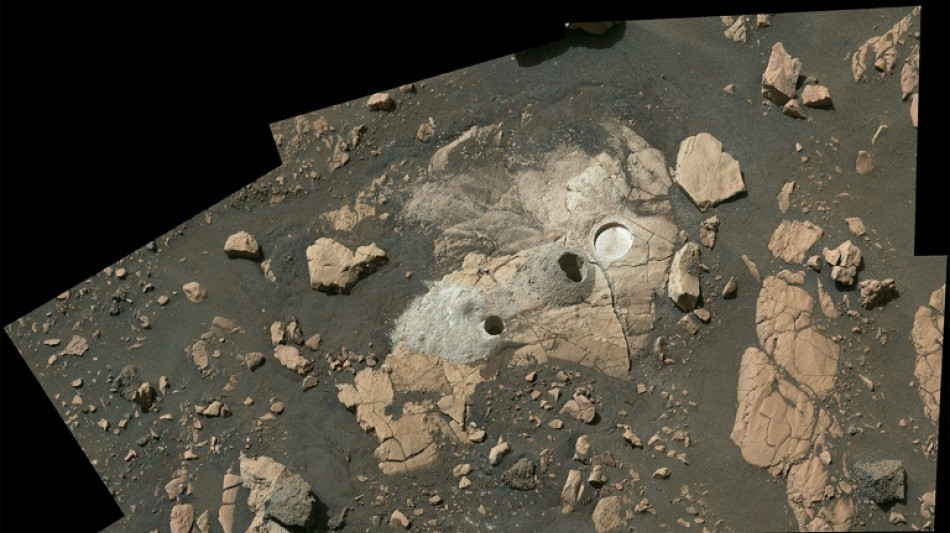
Mars rover sees hints of past life in latest rock samples / Photo: Handout - NASA/JPL-Caltech/ASU/MSSS/AFP

 US House faces test on sweeping Russia sanctions bill

 British PM says to make 'difficult decisions' as inflation rises

 Global fuel price demos: a round-up

 Leverate Launches MCP for Traders to Connect AI Assistants With Trading Platforms

 MEXC Launches $1M "Discover Your Wall Street DNA" Campaign to Help Traders Find Their Market Fit

 Stocks edge higher ahead of US Fed rate call

 BASIS.pro Expands On-Chain Infrastructure with XDC Network Partnership and Zypher DAO as Auto Earn Goes Live

 Pickle-flavoured tart? AI inspires Japan's convenience stores

 EU chief hosts Canada's Carney in push to 'deepen' alliance

 Meta chief pushes back on AI slowdown calls

 US Fed to deliver rate decision with markets betting on hike

 Sanders, Bannon warn of AI dangers in rare US left-right alignment

 Empty benches as schools reopen in Venezuela's quake-hit Guaira

 Tiny English village holds 'independence' vote over asylum seeker housing

 US Treasury chief says to meet Chinese counterpart at weekend

 BingX Evolves into a Multi-Asset Trading Platform, Connecting Users to Global Opportunities

 International Trading Institute Expands Professional Trader Development Beyond the Master’s in Trading

 Lake Energy Secures $80 Million for U.S. Renewable Energy Expansion

 Stocks drop, oil climbs and Treasury yields hit 19-year high

 SkySail Strategies Outperforms Wall Street's 30-Year Risk Standard With Proprietary AI Inference Model

 Just add fish: Scientists pursue more rice, less disease in Senegal paddies

 Belgium completes outer structure of offshore energy island

 China retail sales growth weakens further in August

 In Kashmir, lake weeds mix with traditional art

 'Widow's Bay' and 'The Pitt' take key Emmy awards

NASA's Perseverance Mars rover has detected its highest concentrations yet of organic molecules, in a potential signal of ancient microbes that scientists are eager to confirm when the rock samples are eventually brought to Earth.
While organic matter has been found on the Red Planet before, the new discovery is seen as especially promising because it came from an area where sediment and salts were deposited into a lake -- conditions where life could have arisen.
"It is very fair to say that these are going to be, these already are, the most valuable rock samples that have ever been collected," David Shuster, a Perseverance return sample scientist, told reporters during a briefing.
Organic molecules -- compounds made primarily of carbon that usually include hydrogen and oxygen, but also at times other elements -- are not always created by biological processes.
Further analysis and conclusions will have to wait for the Mars Sample Return mission -- a collaboration between NASA and the European Space Agency (ESA) to bring back the rocks that is set for 2033.
Nicknamed Percy, the rover landed on Mars' Jezero Crater in February 2021, tasked with caching samples that may contain signs of ancient life, as well as characterizing the planet's geology and past climate.
The delta it is exploring formed 3.5 billion years ago. The rover is currently there investigating sedimentary rocks, which came about from particles of various sizes settling in the then watery environment.
Percy cored two samples from a rock called "Wildcat Ridge," which is about three feet (one meter) wide, and on July 20 abraded some of its surface so it could be analyzed with an instrument called SHERLOC that uses ultraviolet light.
The results showed a class of organic molecules called aromatics, which play a key role in biochemistry.
"This is a treasure hunt for potential signs of life on another planet," NASA astrobiologist Sunanda Sharma said.
"Organic matter is a clue and we're getting stronger and stronger clues...I personally find these results so moving because it feels like we're in the right place, with the right tools, at a very pivotal moment."
There have been other tantalizing clues about the possibility of life on Mars before, including repeated detections of methane by Perseverance's predecessor, Curiosity.
While methane is a digestive byproduct of microbes here on Earth, it can also be generated by geothermal reactions where no biology is at play.
X.Cheung--CPN