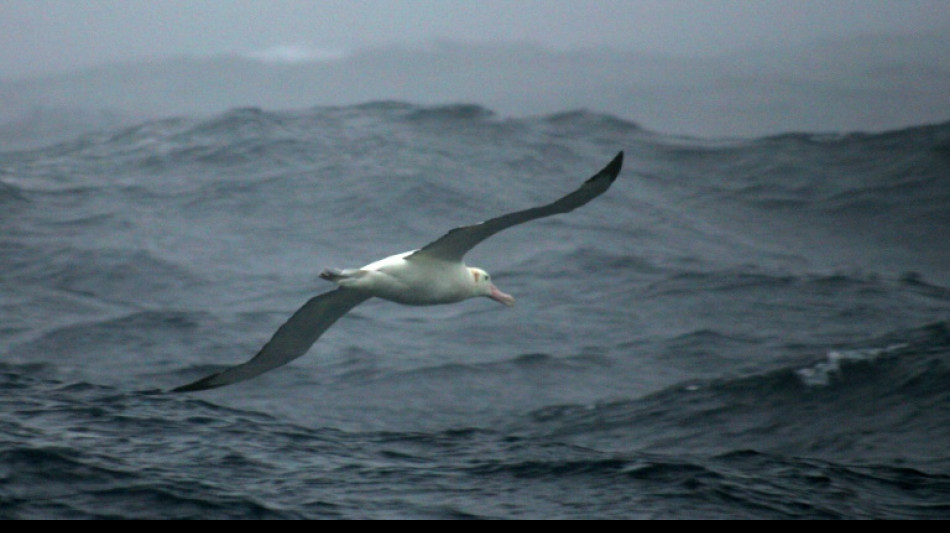
Shy male albatrosses prefer divorce to confrontation: study / Photo: MARCEL MOCHET - AFP/File

 US House faces test on sweeping Russia sanctions bill

 British PM says to make 'difficult decisions' as inflation rises

 Global fuel price demos: a round-up

 Leverate Launches MCP for Traders to Connect AI Assistants With Trading Platforms

 MEXC Launches $1M "Discover Your Wall Street DNA" Campaign to Help Traders Find Their Market Fit

 Stocks edge higher ahead of US Fed rate call

 BASIS.pro Expands On-Chain Infrastructure with XDC Network Partnership and Zypher DAO as Auto Earn Goes Live

 Pickle-flavoured tart? AI inspires Japan's convenience stores

 EU chief hosts Canada's Carney in push to 'deepen' alliance

 Meta chief pushes back on AI slowdown calls

 US Fed to deliver rate decision with markets betting on hike

 Sanders, Bannon warn of AI dangers in rare US left-right alignment

 Empty benches as schools reopen in Venezuela's quake-hit Guaira

 Tiny English village holds 'independence' vote over asylum seeker housing

 US Treasury chief says to meet Chinese counterpart at weekend

 BingX Evolves into a Multi-Asset Trading Platform, Connecting Users to Global Opportunities

 International Trading Institute Expands Professional Trader Development Beyond the Master’s in Trading

 Lake Energy Secures $80 Million for U.S. Renewable Energy Expansion

 Stocks drop, oil climbs and Treasury yields hit 19-year high

 SkySail Strategies Outperforms Wall Street's 30-Year Risk Standard With Proprietary AI Inference Model

 Just add fish: Scientists pursue more rice, less disease in Senegal paddies

 Belgium completes outer structure of offshore energy island

 China retail sales growth weakens further in August
 In Kashmir, lake weeds mix with traditional art

 'Widow's Bay' and 'The Pitt' take key Emmy awards

Most albatrosses mate for life but shy males who avoid confrontation are more likely to get dumped, researchers said Wednesday, adding it was the first time personality had been shown to predict divorce in a wild animal.
Wandering albatrosses, which traverse the Southern Hemisphere and have the largest wingspan of any bird at more than three metres (10 feet), are among the most monogamous animals.
They can live for more than 50 years, and while they spend much of that time on the wing, they meet up every two years with the same partner to breed.
Divorce is a "super rare event", occurring around 13 percent of the time, Ruijiao Sun, the lead author of a new study published in the journal Biology Letters, told AFP.
But "if they find that their breeding success is too low with a specific partner they may look for another one," said the PhD student at Woods Hole Oceanographic Institution in the US.
To find out how an individual bird's personality affects their likeliness of getting divorced, the researchers drew on a unique database.
Since 1959, scientists have been tracking a colony of wandering albatrosses on Possession Island, in the southern Indian Ocean's Crozet archipelago.
"We put a stainless ring on the leg with a number," marine biologist and study co-author Stephanie Jenouvrier told AFP.
"Because they're not really scared we can approach very slowly and we can read the number," she added, saying it allowed the team to "reconstruct the entire history of these birds".
Sun said the birds "breed every two years because they take a whole year to rear their chick and it's super energy-consuming, so they take a one-year sabbatical after to recover and they do not spend that time together".
- Shy guys finish last -
Over more than a decade, the researchers measured the boldness of nearly 2,000 birds by observing how they respond to a human approaching their nest.
They found that shyer male albatrosses were up to twice as likely to get divorced than their bolder rivals -- but no difference was found in females.
"We show for the first time the link between personality and divorce in a wild species, thanks to probably the best dataset in the world," Sun said.
Wandering albatrosses have "elaborate courtship processes", the study said, as the birds raise up their wings, squawk and generally dance around.
Sometimes during the process, a pushy outsider male couple tries to cut in. That is when the shyer males avoid confrontation -- and accept divorce.
However there are other factors affecting divorce rates, the researchers said.
There are more male than female albatrosses, because females tend to forage in areas where they are more likely to get caught up in fishing lines.
The surplus of males means that females quickly find a new mate, but it can take males more than four years, the study found.
Also, "individuals that are in a long-term relationship are less likely to divorce than the ones that are new to each other," Jenouvrier said.
Last year research indicated that climate change could also be driving albatrosses to divorce, as the birds have to travel farther to find decreasing numbers of fish.
X.Cheung--CPN