Mechanical elephants, homemade howitzers as India turns 75 / Photo: Money SHARMA - AFP

 Watts, Pitt, Cruz to light up Spain's top film festival

 Toogood Gold's Table Mountain Sits in the Shadow of a Nevada Gold Rush

 MEXC July–August Security Report: 38.66M USDT in Risk Funds Intercepted, Futures Insurance Fund Hits 792M USDT

 Emporio Armani names Dario Vitale new creative director

 EU to ban social media for under 13s, curb access until 15

 Wildfires push endangered Sumatran elephants to brink: Indonesian NGO

 Bank of Japan set to raise rates under pressure from inflation, US

 EU chief to unveil social media, gaming curbs for under-15s

 'Resident Evil' film brings video game's ethos to the big screen

 i-payout Expands U.S. Money Transmitter Licensing Footprint and Advances European EMI Strategy

 US Senate crypto bill collapses amid partisan deadlock

 OpenAI, Anthropic and Google are working to create an AI standards body

 Protesting shepherds, farmers clash with Romanian police

 Foundation Lets Ledger Users Switch to Open Source Without Starting Over

 EU to propose curbing social media, online games for under 15s

 FX Junction Reaches 40,600 Members and 26 Million Trades

 'We unleashed the beast': the world's fears and hopes about AI

 Hospitality leaders ask Burnham to halve VAT amid rising costs

 Worcestershire invited to nominate groups for 2027 King’s volunteer award

 Berlin's run-down public spaces at heart of election campaign

 'Widow's Bay' and 'The Pitt' win big at Emmy Awards

 Most markets drop as oil extends gains ahead of expected US rate hike

 Sri Lanka's famed beach shack battles demolition

 Vserv targets ₹1,000 crore revenue by 2030 through AI expansion

 India prohibits bank fees on UPI payments up to ₹2,000

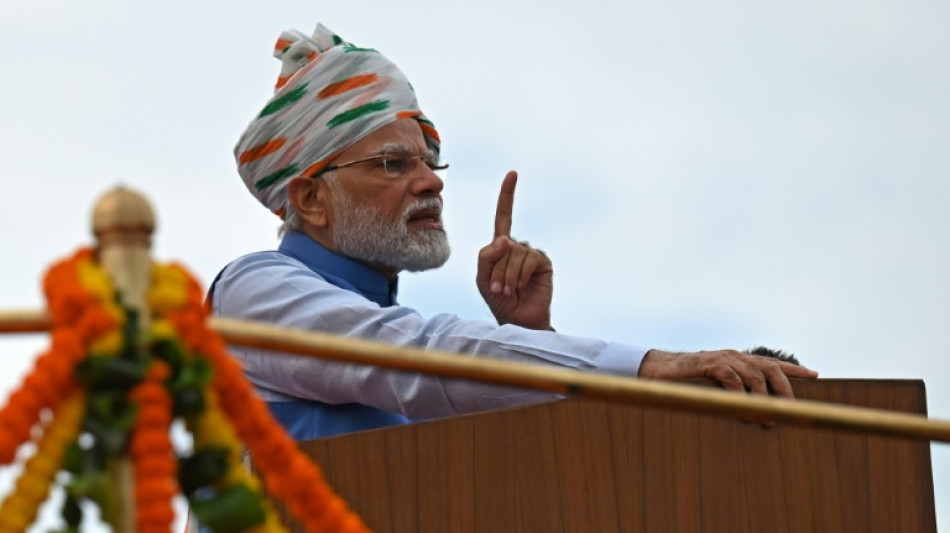
India marked the 75th anniversary of independence on Monday with Prime Minister Narendra Modi giving a speech from Delhi's historic Red Fort, which was decorated with portraits of freedom fighters and guarded by mechanical elephants.
Following a 21-gun salute, reportedly executed using howitzers made domestically for the first time under Modi's "Make In India" industrial strategy, the prime minister said Indians should shed "colonialism in our minds and habits".
"Hundreds of years of colonialism has restricted our sentiments, distorted our thoughts. When we see even the smallest thing related to colonialism in us or around us, we have to be rid of it," Modi said in a 90-minute speech from the ramparts of the fort in the Indian capital.
Wearing a cream-coloured turban speckled with the colours of the Indian flag, Modi also said India should crush the "termite" of corruption and nepotism, follow an "India First" mantra and ensure that "in speech and conduct, we do nothing that lowers a woman's dignity".
"Self-reliant India is the responsibility of every citizen, every government, every unit of society," he said.
The "Jewel in the Crown" of the British Empire became independent in 1947 after two centuries of colonial occupation and exploitation.
With Britain in dire financial straits at the end of World War II -- in which about 90,000 Indian soldiers died -- the country was hurriedly split in two: Muslim-majority Pakistan and a mostly Hindu India.
- Partition -
This precipitated one of the biggest-ever movements of humanity as millions of people, uprooted from areas their families had inhabited for generations, rushed to be on the right side of the new border.
It also unleashed a cataclysm of sectarian violence in which at least a million people were killed. Entire trains full of people were massacred and huge numbers of women were raped.
More blood flowed and millions of others shifted 24 years later when East Pakistan, backed by India with Soviet support, fought a war of independence in 1971 to become Bangladesh.
At Partition, the disputed region of Kashmir was also split between India and Pakistan, with the Himalayan territory the spark for two of the nuclear-armed rivals' three wars and numerous skirmishes since.
India's population has soared from around 340 million to 1.4 billon today, and the country is projected to overtake China as the world's most populous nation this decade.
But while the economy is one of the world's largest -- and fastest-growing -- millions remain mired in poverty and Modi's government is struggling to create jobs for its booming population.
Women are often marginalised and suffer high levels of sexual violence, while the often oppressive and inescapable system of Hindu caste hierarchy still continues to apply in much of the country.
India's waterways and its cities are among the world's most polluted and the country is the third-biggest emitter of greenhouse gases, with its "net zero" target date 48 years from now.
When it comes to religion, independent India's founders strove to ensure that all Indians could practise their faith but that there was a clear separation between state and religion.
But many, particularly among India's about 200 million Muslims, fear that these ideals are under attack by Modi's Hindu-nationalist Bharatiya Janata Party (BJP), many of whose supporters espouse Hindu hegemony.
A.Levy--CPN