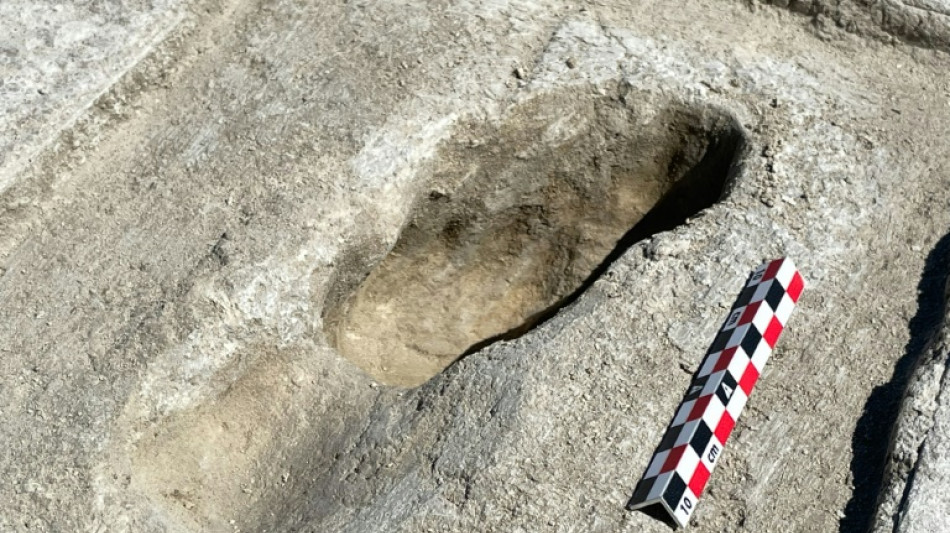
Ice-age footprints shed light on North America's early humans / Photo: Handout - HANDOUT/AFP

 Watts, Pitt, Cruz to light up Spain's top film festival

 Toogood Gold's Table Mountain Sits in the Shadow of a Nevada Gold Rush

 MEXC July–August Security Report: 38.66M USDT in Risk Funds Intercepted, Futures Insurance Fund Hits 792M USDT

 Emporio Armani names Dario Vitale new creative director

 EU to ban social media for under 13s, curb access until 15

 Wildfires push endangered Sumatran elephants to brink: Indonesian NGO

 Bank of Japan set to raise rates under pressure from inflation, US

 EU chief to unveil social media, gaming curbs for under-15s

 'Resident Evil' film brings video game's ethos to the big screen

 i-payout Expands U.S. Money Transmitter Licensing Footprint and Advances European EMI Strategy

 US Senate crypto bill collapses amid partisan deadlock

 OpenAI, Anthropic and Google are working to create an AI standards body

 Protesting shepherds, farmers clash with Romanian police

 Foundation Lets Ledger Users Switch to Open Source Without Starting Over

 EU to propose curbing social media, online games for under 15s

 FX Junction Reaches 40,600 Members and 26 Million Trades

 'We unleashed the beast': the world's fears and hopes about AI

 Hospitality leaders ask Burnham to halve VAT amid rising costs

 Worcestershire invited to nominate groups for 2027 King’s volunteer award

 Berlin's run-down public spaces at heart of election campaign

 'Widow's Bay' and 'The Pitt' win big at Emmy Awards

 Most markets drop as oil extends gains ahead of expected US rate hike

 Sri Lanka's famed beach shack battles demolition

 Vserv targets ₹1,000 crore revenue by 2030 through AI expansion

 India prohibits bank fees on UPI payments up to ₹2,000

Footprints laid down by Ice-Age hunter-gatherers and recently discovered in a US desert are shedding new light on North America's earliest human inhabitants.
Dozens of fossilized prints found in dried-up riverbeds in the western state of Utah reveal more details about how the continent's original occupants lived more than 12,000 years ago -- just as the frozen planet was starting to thaw.
The fossils could have remained unnoticed if not for a chance glance out of a moving car as researchers Daron Duke and Thomas Urban drove through Hill Air Force Base chatting about footprints.
"We were talking about 'what would they look like?'," Duke told AFP. "And he said: Kind of like that out the window.'"
What the two men had found turned out to be 88 distinct prints left by a mixture of adults and children.
"They vary between just looking like discolored patches on the ground and... little pop ups, little pieces of dirt around them or on them. But they look like footprints," Duke said.
What came next was a painstaking few days of very careful digging -- sometimes lying on his belly -- to ensure that what they were looking at was as old as it appeared.
"What I found was bare feet of people... that had stepped in what looks to be shallow water where there was a mud sub layer," Duke explained.
"The minute they pulled their foot out, the sand infilled that and has preserved it perfectly."
Duke, of the Nevada-based Far Western Anthropological Research Group, had been in the area looking for evidence of prehistoric campfires built by the Shoshone, a people whose descendents still live in the western United States.
He had brought Urban over from Cornell University because of his expertise in uncovering evidence of ancient humans -- including the discovery of human tracks in New Mexico's White Sands National Park that are thought to be up to 23,000 years old.
- 'Awestruck' -
The new fossils add to a wealth of other finds from the area, including stone tools, evidence of tobacco use, bird bones and campfire remains, that are starting to provide a more complete record of the Shoshone and their continuous presence in the region beginning 13,000 years ago.
"These are the resident indigenous people of North America, this is where they lived, and this is where they still live today," Urban said.
For him personally, finding the footprints has been a professional high point.
"Once I... realized I was digging a human footprint, I was seeing toes, I was seeing the thing in immaculate condition... I was just kind of awestruck by it," he said.
"Nothing beats the sense of discovery and awe that maybe as an archaeologist, you are actually chasing your whole career."
And sharing the discovery with the distant descendents of the people who made the prints was immensely rewarding, Urban said.
"You realize the same thing is happening -- what the connection is to such a distant past and to something so human, I think it gets to everybody in one way or another eventually."
L.Peeters--CPN