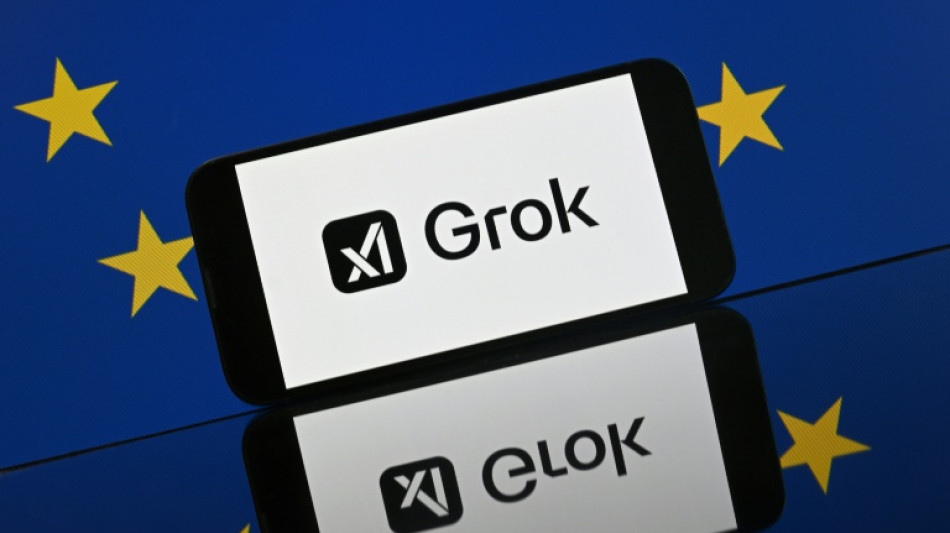
EU moves closer to ban sexualised AI deepfakes / Photo: Nicolas TUCAT - AFP/File

 Watts, Pitt, Cruz to light up Spain's top film festival

 Toogood Gold's Table Mountain Sits in the Shadow of a Nevada Gold Rush

 MEXC July–August Security Report: 38.66M USDT in Risk Funds Intercepted, Futures Insurance Fund Hits 792M USDT

 Emporio Armani names Dario Vitale new creative director

 EU to ban social media for under 13s, curb access until 15

 Wildfires push endangered Sumatran elephants to brink: Indonesian NGO

 Bank of Japan set to raise rates under pressure from inflation, US

 EU chief to unveil social media, gaming curbs for under-15s

 'Resident Evil' film brings video game's ethos to the big screen

 i-payout Expands U.S. Money Transmitter Licensing Footprint and Advances European EMI Strategy

 US Senate crypto bill collapses amid partisan deadlock

 OpenAI, Anthropic and Google are working to create an AI standards body

 Protesting shepherds, farmers clash with Romanian police

 Foundation Lets Ledger Users Switch to Open Source Without Starting Over

 EU to propose curbing social media, online games for under 15s

 FX Junction Reaches 40,600 Members and 26 Million Trades

 'We unleashed the beast': the world's fears and hopes about AI

 Hospitality leaders ask Burnham to halve VAT amid rising costs

 Worcestershire invited to nominate groups for 2027 King’s volunteer award

 Berlin's run-down public spaces at heart of election campaign
 'Widow's Bay' and 'The Pitt' win big at Emmy Awards

 Most markets drop as oil extends gains ahead of expected US rate hike

 Sri Lanka's famed beach shack battles demolition
 Vserv targets ₹1,000 crore revenue by 2030 through AI expansion
 India prohibits bank fees on UPI payments up to ₹2,000

The European Parliament on Thursday approved a ban on artificial intelligence systems generating sexualised deepfakes, following global outrage over non-consensual nudes produced by Elon Musk's chatbot Grok.
The vast majority of EU lawmakers supported the text targeting so-called "nudification" apps as part of proposals to amend the bloc's rules on AI. EU member states have already given their green light.
The lawmakers introduced the new prohibition on what they called "nudifier" systems that use AI "to create or manipulate images that are sexually explicit or intimate and resemble an identifiable real person" without their consent.
But they stressed that AI systems with "effective safety measures preventing users from creating such images" are not affected by the ban.
Now member states and parliament will negotiate on a final text but talks are expected to go smoothly before final adoption.
X, the platform on which Grok is available, in January said it would make changes to stop the creation of sexualised deepfakes of children and women.
The scandal has nevertheless prompted an ongoing EU investigation.
EU lawmakers also backed delaying implementation of high-risk AI rules, concerning models deemed as potentially dangerous to safety, health or citizens' fundamental rights.
Due to come into effect in August 2026 for stand-alone AI systems and a year later for AI tools embedded in other products, the measures might now be pushed back to December 2027 and August 2028 respectively.
P.Kolisnyk--CPN