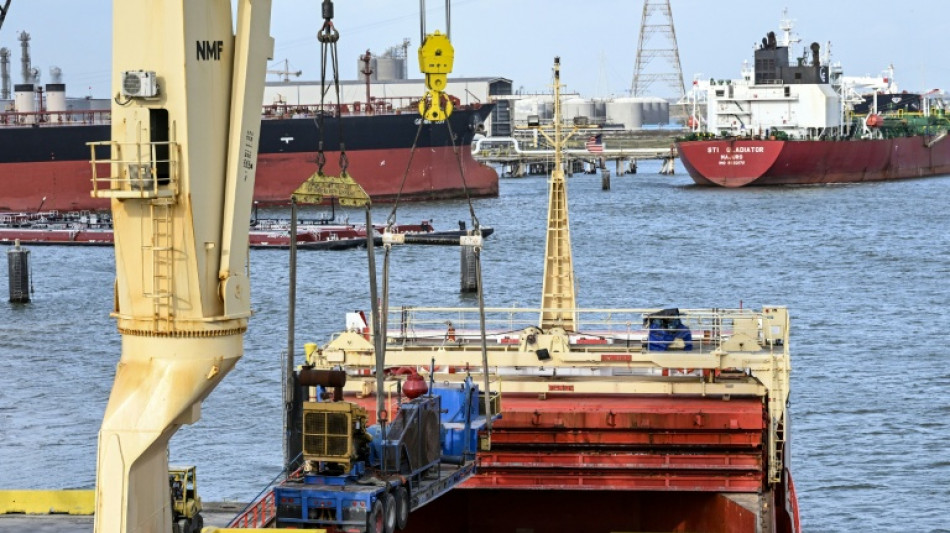
Venezuela oil reserves both entice and repel energy giants / Photo: RONALDO SCHEMIDT - AFP

 Prized Mexican relic returns on loan, two centuries on

 'In our lane': Fed's Warsh defies Trump but still fighting for credibility

 Trump admin makes major cut to endangered species protections

 GM delivers first components for US interceptor missiles

 Travis Scott and Keith Richards feature on GTA VI soundtrack

 King Charles warns tech bosses of 'existential dangers' of AI

 French fishermen block ports over petrol prices

 Micron's Taiwan workers say 68 months' bonus not enough

 Canada's Carney pushes 'new alliance' with EU despite Trump threats

 Beyond Investment Returns: Families Are Measuring Wealth by Freedom, Continuity, and Legacy, According to Nour Private Wealth

 King Charles disputes claims in book by Princess Diana's brother

 Nepal floods among 'most challenging' disasters: WFP

 Kids and social media: what would change under new EU law

 King Charles to call on tech giants for 'reassurances' over AI

 STARPRIME Responds to Diverging Gold Market Demand with AM/PM Fixing and XAU24/7

 Where the US-China tariff row stands ahead of White House summit

 Indonesia cash-for-photos scheme turns animal hunters into protectors

 Bayer to Present How it Rebuilt Global Planning with OMP at Gartner Supply Chain Planning Summit 2026

 US Congress passes sweeping Russia sanctions bill

 US stocks fall, dollar gains after Fed lifts interest rates

 US Fed raises rates to tackle 'too high' inflation in move sure to rile Trump

 US Fed raises rates to battle inflation in move likely to rile Trump

 US House faces test on sweeping Russia sanctions bill

 British PM says to make 'difficult decisions' as inflation rises

 Global fuel price demos: a round-up

President Donald Trump's administration is pushing to open Venezuela's untapped natural resources to US investment but the oil-rich Latin American country's outdated infrastructure ismaking energy giants think twice about going all-in.
Since US forces captured Venezuela's former leader Nicolas Maduro in a stunning raid on January 3, Trump officials have worked closely with Caracas to bang the drum for foreign investment in oil, gas and mining.
The chief executives of energy companies, however, remain divided on the matter.
Mike Wirth, the CEO of Chevron -- the only international company to operate in Venezuela in recent years -- said at the CERAWeek energy conference in Houston this week: "We're seeing signs of progress."
"There's still things that I think need to happen to encourage investment on the scale that people would like to see," he added.
Shell chief Wael Sawan said he was "encouraged," but cautioned "we still have a long way to go" on oil projects.
He said the company was in talks for gas-related endeavors.
While ExxonMobil CEO Darren Woods has previously dismissed Venezuela as "uninvestable," his fellow executive Dan Ammann said a team for the company is assessing options, though he noted it would require "probably hundreds of millions of dollars of investment."
Chevron's Wirth went further, suggesting it would take "tens of billions of dollars" to get Venezuela's oil production up to the three million barrels of oil per day it produced during its peak two decades ago.
- 'Kick the tires' -
Jorge Pinon, a researcher at the University of Texas at Austin's Energy Institute, said oil giants were sending small teams to Venezuela to "kick the tires."
"They're trying to find out what the state of the pipeline is," he told AFP.
"How much money is it going to take to be sure that the existing infrastructure is ready for delivery?"
"Do we have the logistics? Do we have the pipeline? Do we have the wealth? Who owns them? Remember that the Chinese and the Russians still have joint ventures in Venezuela," he continued.
Despite having the largest known oil reserves in the world, years of underinvestment, lack of maintenance and US sanctions have strangled oil production in the South American country.
Under pressure from Washington, Venezuela's interim president Delcy Rodriguez pushed through a major reform of the country's hydrocarbon laws in January, opening up the sector to private and foreign investment.
US Interior Secretary Doug Burgum told industry leaders at CERAWeek on Wednesday: "They (Venezuela) want to be competitive to attract investment from all of you."
- Millions of barrels? -
Nobel Peace Prize laureate Maria Corina Machado told AFP on Tuesday: "The opening of the oil sector, as we're proposing it, has never been seen in the country."
"That is, going 100 percent private, where the state assumes a regulatory role and incentivizes, promotes and protects foreign investment," she said.
Machado said in a speech at CERAWEEK on Wednesday that Venezuela's oil production capacity could reach as high as five million barrels per day.
"And reaching that potential certainly requires a lot of resources, which we estimate above $150 billion in the next 10 years," she added.
"This is the kind of long-cycle, large-scale commitment that the companies in this room are built to make when the right conditions are in place."
Machado said she was willing to participate in Venezuela's next election cycle.
But researcher Pinon warned that Venezuela's hydrocarbons law could be amended by a future government.
Lawmakers could argue that "the last assembly that was there and put these new rules into place was not a legitimate assembly. They were not really elected by the people of Venezuela," he said.
A.Mykhailo--CPN
