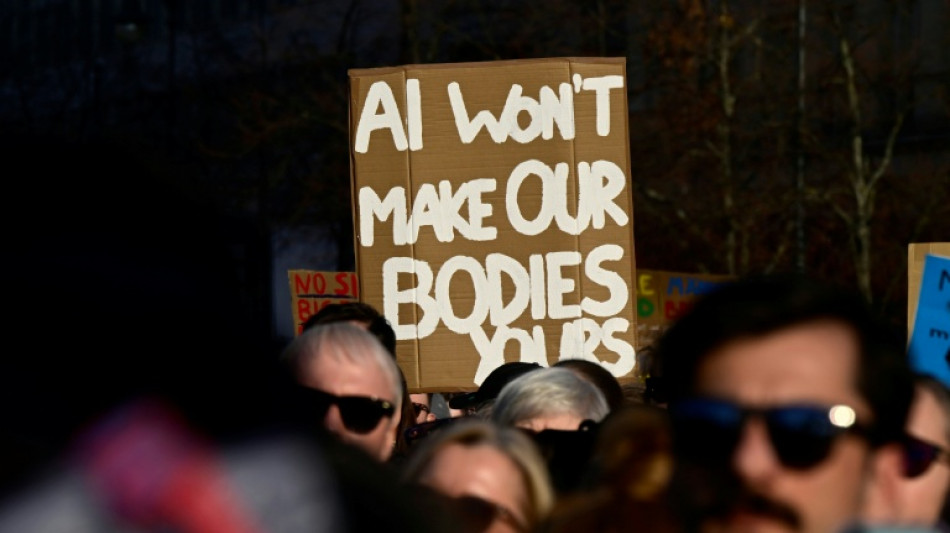
AI making cyber attacks costlier and more effective: Munich Re / Photo: John MACDOUGALL - AFP/File

 Watts, Pitt, Cruz to light up Spain's top film festival

 Toogood Gold's Table Mountain Sits in the Shadow of a Nevada Gold Rush

 MEXC July–August Security Report: 38.66M USDT in Risk Funds Intercepted, Futures Insurance Fund Hits 792M USDT

 Emporio Armani names Dario Vitale new creative director

 EU to ban social media for under 13s, curb access until 15

 Wildfires push endangered Sumatran elephants to brink: Indonesian NGO

 Bank of Japan set to raise rates under pressure from inflation, US

 EU chief to unveil social media, gaming curbs for under-15s

 'Resident Evil' film brings video game's ethos to the big screen

 i-payout Expands U.S. Money Transmitter Licensing Footprint and Advances European EMI Strategy

 US Senate crypto bill collapses amid partisan deadlock

 OpenAI, Anthropic and Google are working to create an AI standards body

 Protesting shepherds, farmers clash with Romanian police

 Foundation Lets Ledger Users Switch to Open Source Without Starting Over

 EU to propose curbing social media, online games for under 15s

 FX Junction Reaches 40,600 Members and 26 Million Trades

 'We unleashed the beast': the world's fears and hopes about AI

 Hospitality leaders ask Burnham to halve VAT amid rising costs

 Worcestershire invited to nominate groups for 2027 King’s volunteer award

 Berlin's run-down public spaces at heart of election campaign

 'Widow's Bay' and 'The Pitt' win big at Emmy Awards

 Most markets drop as oil extends gains ahead of expected US rate hike

 Sri Lanka's famed beach shack battles demolition

 Vserv targets ₹1,000 crore revenue by 2030 through AI expansion
 India prohibits bank fees on UPI payments up to ₹2,000

Artificial intelligence is making cyberattacks increasingly sophisticated and costlier for businesses, reinsurer Munich Re said Wednesday, warning of methods ranging from highly personalised phishing emails to computer-generated, convincing fake identities.
"If cybercrime were a country, it would be the third-largest economy in the world", behind only the United States and China, the reinsurer said in a report.
Citing figures from market analysis firm Statista, Munich Re projected cybercrime will generate global losses of some $14 billion (12.07 bn euros) in 2028.
Martin Kreuzer, head of cyber risks at Munich Re, told AFP that "automation now plays a central role", enabling attackers to operate "efficiently and in a more targeted way".
"They rely on highly personalised phishing emails, automatically generated malware, and synthetic identities that appear deceptively real," he said.
The trend of "agentic AI" means the advent of systems that can "act autonomously, make decisions, and even circumvent defensive mechanisms," according to Kreuzer.
The most widespread cyberattacks are still ransomware, in which hackers lock systems and demand money to release them.
Munich Re's study says that the number of publicly reported attacks of this kind "increased by nearly 50 percent in 2025 and... continue unabated in 2026".
Coordinated attacks via networks of hijacked devices, used to overwhelm systems, also more than doubled in 2025 and are becoming more common thanks to services available for hire.
At a more advanced level, criminals are collaborate with states, concealing the origin of attacks and accelerating their global operations.
"Nation-state actors are among the most professional players in the cyber threat landscape," said Kreuzer.
"Here we are seeing both an evolution of tools and methods, and the emergence of hybrid warfare driven by geopolitical motives," he said, adding that "disinformation is increasingly being used as a weapon".
The study notes that while attacks on large businesses attract most public attention, "the majority of cyber incidents and claims affect micro-companies and SMEs".
Compared with risks from natural catastrophes, for which almost half of all losses were insured in 2025, Kreuzer said that "cyber risk coverage is still far too low, with only a fraction insured".
A.Leibowitz--CPN