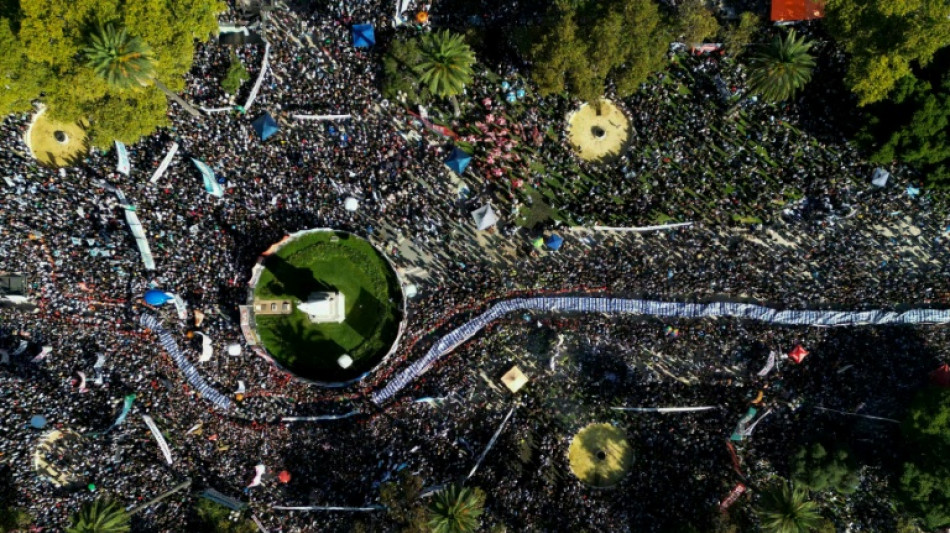
Huge crowd in Buenos Aires marks 50 years since Argentina's coup / Photo: Luis ROBAYO - AFP

 Watts, Pitt, Cruz to light up Spain's top film festival

 Toogood Gold's Table Mountain Sits in the Shadow of a Nevada Gold Rush

 MEXC July–August Security Report: 38.66M USDT in Risk Funds Intercepted, Futures Insurance Fund Hits 792M USDT

 Emporio Armani names Dario Vitale new creative director

 EU to ban social media for under 13s, curb access until 15

 Wildfires push endangered Sumatran elephants to brink: Indonesian NGO

 Bank of Japan set to raise rates under pressure from inflation, US

 EU chief to unveil social media, gaming curbs for under-15s

 'Resident Evil' film brings video game's ethos to the big screen

 i-payout Expands U.S. Money Transmitter Licensing Footprint and Advances European EMI Strategy

 US Senate crypto bill collapses amid partisan deadlock

 OpenAI, Anthropic and Google are working to create an AI standards body

 Protesting shepherds, farmers clash with Romanian police

 Foundation Lets Ledger Users Switch to Open Source Without Starting Over

 EU to propose curbing social media, online games for under 15s

 FX Junction Reaches 40,600 Members and 26 Million Trades

 'We unleashed the beast': the world's fears and hopes about AI

 Hospitality leaders ask Burnham to halve VAT amid rising costs

 Worcestershire invited to nominate groups for 2027 King’s volunteer award

 Berlin's run-down public spaces at heart of election campaign

 'Widow's Bay' and 'The Pitt' win big at Emmy Awards

 Most markets drop as oil extends gains ahead of expected US rate hike

 Sri Lanka's famed beach shack battles demolition

 Vserv targets ₹1,000 crore revenue by 2030 through AI expansion

 India prohibits bank fees on UPI payments up to ₹2,000

A crowd into the tens of thousands gathered in Buenos Aires on Tuesday to mark 50 years since Argentina's military ushered in years of dictatorship with a coup on March 24, 1976.
AFP journalists saw one of the biggest rallies in the capital in years converge on Plaza de Mayo, the city's traditional focal point and home to the Casa Rosada presidential complex.
Other cities also drew crowds after social and political groups called for countrywide demonstrations under the slogans "Memory, Truth and Justice" and "Never again" in memory of the victims.
Valeria Coronel, a 43-year-old teacher, was holding her eight-year-old daughter's hand as they joined the rally.
"Memory gets passed down from generation to generation so that the struggle continues," she told AFP. "That's the legacy I want to leave her."
Some people released white balloons into the sky while others bore banners with slogans including "They didn't defeat us."
Others carried photographs of relatives who never emerged from detention, with some carrying placards saying "We are still looking for you."
The Mothers and Grandmothers of Plaza de Mayo headed up the march as they continued a tradition that began during the dictatorship, when they started gathering in the square to demand information on the whereabouts of their abducted children.
The group has recovered the identities of 140 grandchildren taken from their families as infants or born in captivity. It is estimated that more than 300 remain to be found.
"What do you think -- 140 resolved cases?" said 95-year-old Estela De Carlotto, president of the association.
"Every return of a grandchild is evidence of the atrocities committed by sinister state terrorism: disappearances, murders, theft, abduction of minors and forgery of official documents," added Carlotto, whose own grandson was the 114th to be found.
The 1976 coup overthrew president Isabel Peron, who had replaced her husband Juan Peron after he died in office.
- Memory and political dispute -
Current far-right President Javier Milei's government disputes claims by rights groups that around 30,000 people died or disappeared under the dictatorship, one of Latin America's bloodiest, which ended in 1983.
The government estimates the number of disappeared at officially fewer than 9,000, maintaining that there were excesses committed on both sides in the dictatorship years, and playing down the role of military violence.
On Tuesday, the presidential office released a video denouncing a "biased and revanchist perspective" as a prism through which history of that time has been studied, claiming that the left has used it as an "instrument of manipulation."
The military regime brutally clamped down on resistance from dissidents including a left-wing guerrilla movement, students and labor activists, detaining thousands in camps such as Buenos Aires' infamous ESMA naval school.
Argentine officials last week published almost 500 pages of intelligence documents dating from 1973-1983, including the seven-year period of the military dictatorship.
The long-classified documents range from shopping lists to surveillance records of universities, unions, businesses and political organizations.
"The publication of historical archives strengthens institutional credibility, helps debunk conspiracy theories and demonstrates a commitment to the truth," according to a guide published with the documents.
O.Hansen--CPN