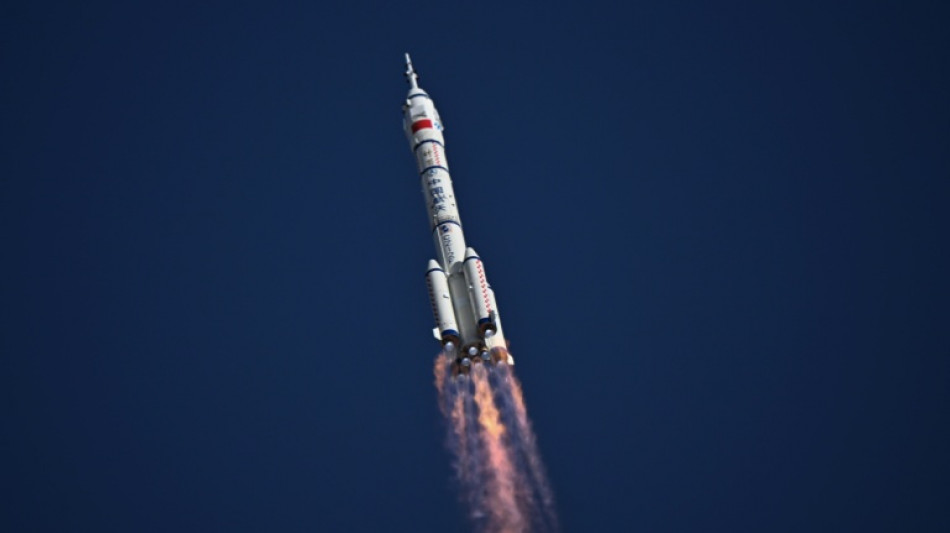
Moon race: how China is challenging the US / Photo: Pedro Pardo - AFP/File

 Watts, Pitt, Cruz to light up Spain's top film festival

 Toogood Gold's Table Mountain Sits in the Shadow of a Nevada Gold Rush

 MEXC July–August Security Report: 38.66M USDT in Risk Funds Intercepted, Futures Insurance Fund Hits 792M USDT

 Emporio Armani names Dario Vitale new creative director

 EU to ban social media for under 13s, curb access until 15

 Wildfires push endangered Sumatran elephants to brink: Indonesian NGO

 Bank of Japan set to raise rates under pressure from inflation, US

 EU chief to unveil social media, gaming curbs for under-15s

 'Resident Evil' film brings video game's ethos to the big screen

 i-payout Expands U.S. Money Transmitter Licensing Footprint and Advances European EMI Strategy

 US Senate crypto bill collapses amid partisan deadlock

 OpenAI, Anthropic and Google are working to create an AI standards body

 Protesting shepherds, farmers clash with Romanian police

 Foundation Lets Ledger Users Switch to Open Source Without Starting Over

 EU to propose curbing social media, online games for under 15s

 FX Junction Reaches 40,600 Members and 26 Million Trades

 'We unleashed the beast': the world's fears and hopes about AI

 Hospitality leaders ask Burnham to halve VAT amid rising costs

 Worcestershire invited to nominate groups for 2027 King’s volunteer award

 Berlin's run-down public spaces at heart of election campaign
 'Widow's Bay' and 'The Pitt' win big at Emmy Awards

 Most markets drop as oil extends gains ahead of expected US rate hike

 Sri Lanka's famed beach shack battles demolition

 Vserv targets ₹1,000 crore revenue by 2030 through AI expansion

 India prohibits bank fees on UPI payments up to ₹2,000

Walking on the Moon by 2030, building a lunar base, and then perhaps on to Mars: after 30 years of honing its expertise, China is challenging the United States' supremacy in spaceflight.
As US space agency NASA prepares for its crewed lunar flyby mission, Artemis II, we take a look at China's ambitions in space:
- What is China's crewed programme? -
China's crewed space programme-- known as Project 921 --was launched on September 21, 1992, aiming to develop its own expertise and space station.
The programme has conducted around 15 crewed missions since the first flight of a Chinese astronaut, Yang Liwei, in 2003.
Blocked from the International Space Station (ISS) in 2011 by the United States, China built its own orbital hub.
The Tiangong, or "Heavenly Palace", space station welcomed its first occupants in 2021.
Three Chinese astronauts -- known as "taikonauts" -- are currently staying there.
The station allows China to accumulate crucial experience in spacewalks, docking, maintenance and effects on the body.
None of China's crewed launches have been fatal, and the programme is following a long-term roadmap rather than a series of isolated projects.
"This effectiveness stems from strong political commitment at the highest level of the state, stable funding... and the integration of the entire industrial chain into the project," said Richard de Grijs, professor of physics and astronomy at Australia's Macquarie University.
"Compared to the Western, and particularly US, approach, where priorities can shift with each political cycle, this model offers clear advantages in terms of predictability and risk management," he told AFP.
While China's space programme has been historically slower, "it won't change course at the whim of its leadership either".
- When will Chinese astronauts land on the Moon? -
The Chinese space agency (CNSA) hopes to put astronauts on the Moon by 2030.
China has already sent several robots to the Moon and brought back lunar samples.
But a crewed mission requires different equipment, which is currently being tested.
China is set to conduct a test flight of its new Mengzhou ("Dream Ship") spacecraft in 2026. Replacing the ageing Shenzhou, it will carry astronauts into lunar orbit.
Engineers are also developing a new ultra-powerful rocket around 90-metres (295-feet) long -- the Long March-10, essential for propelling the spacecraft to the Moon. It made its first low-altitude flight on February 11.
The Lanyue ("Seize the Moon") lander, which will transport the astronauts from orbit to the lunar surface, could also make its maiden flight between 2028 and 2029.
- Does China want a lunar base? -
China hopes to build a basic version of a crewed scientific base, called the International Lunar Research Station (ILRS), by 2035.
The base will be built near the Moon's south pole, where water in the form of ice is believed to be present.
China is collaborating with Russia on the project.
The base is expected to be built with bricks made on-site from lunar soil using 3D printers. Tested on Earth and on Tiangong, the technique is to be tested on the Moon during the uncrewed Chang'e-8 mission, scheduled for around 2028.
The CNSA says it wants to carry out archaeological research into the origin of the Moon, achieve breakthroughs in strategic technologies and exploit lunar resources.
An expanded version of the base is planned for around 2040.
China is also developing a constellation of relay satellites around the Moon to communicate between its far side and Earth
- Is this a race with the United States? -
China never talks about a "Moon race" or competition with the United States.
"They are ambitious for the future of their program and see the Moon as the logical next step, for its own sake, not for any rivalry. I don't think it would change anything for them if America wasn't going," said Jonathan McDowell, astrophysicist and space analyst.
"Having said that," he added, "the establishment of a lunar base by China would be a real challenge to America's ability to establish such a base -- there's only a small amount of suitable area near the lunar south pole."
For now, China lags behind the United States in terms of crewed flights, according to Chen Lan, a specialist in the Chinese space programme.
NASA's Dragon and Orion spacecraft remain superior compared to China's Shenzhou, he noted.
"However, I expect when China realises manned lunar landing by 2030 with the new spaceship and lunar landing vehicle, it will catch up with the US in the human spaceflight field."
- Mars next? -
After 2040, the Chinese lunar base will be used to "validate technology and capabilities for a manned mission to Mars", according to the CNSA.
Chinese space manufacturing companies and scientists have previously pointed to the Red Planet as a potential destination for astronauts.
"But I don't think that there will be serious plans to Mars before completion of the lunar landing and the initial lunar base," Chen said.
P.Petrenko--CPN