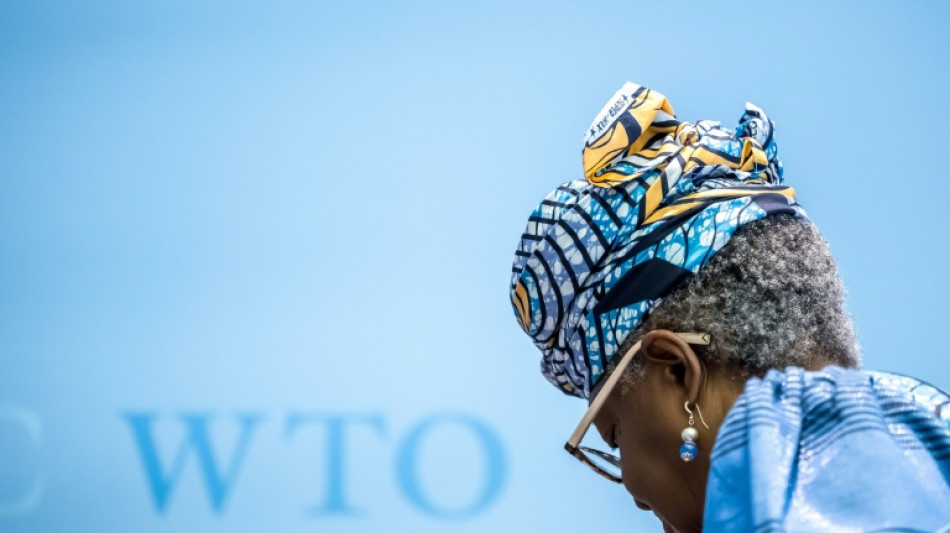
WTO mulls future of global trade under cloud of Mideast war / Photo: Fabrice COFFRINI - AFP

 Prized Mexican relic returns on loan, two centuries on

 'In our lane': Fed's Warsh defies Trump but still fighting for credibility

 Trump admin makes major cut to endangered species protections

 GM delivers first components for US interceptor missiles

 Travis Scott and Keith Richards feature on GTA VI soundtrack

 King Charles warns tech bosses of 'existential dangers' of AI

 French fishermen block ports over petrol prices

 Micron's Taiwan workers say 68 months' bonus not enough

 Canada's Carney pushes 'new alliance' with EU despite Trump threats

 Beyond Investment Returns: Families Are Measuring Wealth by Freedom, Continuity, and Legacy, According to Nour Private Wealth

 King Charles disputes claims in book by Princess Diana's brother

 Nepal floods among 'most challenging' disasters: WFP

 Kids and social media: what would change under new EU law

 King Charles to call on tech giants for 'reassurances' over AI

 STARPRIME Responds to Diverging Gold Market Demand with AM/PM Fixing and XAU24/7

 Where the US-China tariff row stands ahead of White House summit

 Indonesia cash-for-photos scheme turns animal hunters into protectors

 Bayer to Present How it Rebuilt Global Planning with OMP at Gartner Supply Chain Planning Summit 2026

 US Congress passes sweeping Russia sanctions bill

 US stocks fall, dollar gains after Fed lifts interest rates

 US Fed raises rates to tackle 'too high' inflation in move sure to rile Trump

 US Fed raises rates to battle inflation in move likely to rile Trump

 US House faces test on sweeping Russia sanctions bill

 British PM says to make 'difficult decisions' as inflation rises

 Global fuel price demos: a round-up

The World Trade Organization's 166 members appeared deeply divided as ministers gathered in the Cameroonian capital for a key conference starting Thursday, amid global economic turmoil linked to the Middle East war.
Over four days, WTO members will try to revitalise an institution weakened by geopolitical tensions, stalled negotiations and rising protectionism -- against the backdrop of a war that poses a serious threat to international trade.
The atmosphere ahead of the meeting was "tense", a Western diplomatic source told AFP, asking not to be named.
"I think that's because it's tense in the global trading system."
WTO Director-General Ngozi Okonjo-Iweala called Wednesday for the Yaounde meeting to "launch the next chapter of the multilateral trading system".
She slammed "the unilateralism we have been seeing", decrying the "collective failure" of WTO members over the years to confront their concerns and frustrations.
- 'A pivotal moment' -
The WTO ministerial conference, its supreme decision-making body, is usually held every other year.
Ahead of the 14th edition (MC14), a number of countries expressed hope that the conference could mark a turning point for the organisation.
Two years after the WTO's last ministerial conference in Abu Dhabi failed to make meaningful progress on key issues like fisheries and agriculture, member states face even stauncher challenges.
Their main task will be to develop a plan towards reforming a WTO that has proven to be powerless in the face of rising protectionism and largely incapable of negotiating new agreements.
European Trade Commissioner Maros Sefcovic called Monday for "serious" reform of the organisation, insisting that "the level playing field, overcapacity and market policies must be better tackled than in the past".
Britain also said in a recent submission that it believes "the WTO is at a pivotal moment", warning that "without reform it will slide into irrelevance".
Several members are calling for modifying the organisation's decision-making procedures, which have long been limited by a rule requiring consensus among all members.
There are also calls to overhaul rules related to special treatment of developing countries and achieving a level playing field for trade, as well as a push to restore the organisation's crippled dispute settlement system.
But national interests diverge sharply, making any diplomatic breakthrough in Yaounde uncertain, according to experts and diplomats.
"I very much doubt that there would be any actual agreement at MC14 on any of the reform issues," Stuart Harbinson of the European Centre for International Political Economy think-tank in Brussels told AFP.
"The membership is too divided on the substantive issues."
- Trump's return -
Yaounde marks the WTO's first ministerial conference since US President Donald Trump returned to the White House last year, unleashing a barrage of attacks on multilateralism and WTO rules with sweeping tariffs and bilateral trade deals.
"The WTO needs to change if it intends to have any relevance as the international trading system transitions to focus on reciprocity and balance," US Trade Representative Jamieson Greer said on Monday.
Preparatory discussions in Geneva, where the WTO is based, revealed that some countries -- the United States and India in particular -- were not satisfied with the proposed roadmap.
Washington is particularly critical of the WTO's "most-favoured nation" (MFN) principle, which aims to extend any trade advantage granted to one trading partner to all others, in a bid to avoid discrimination.
But China, like other developing countries, has said it wants this rule to "remain the bedrock of the WTO".
"We need a rules-based system, not a power-based system," a Chinese diplomatic source told AFP.
WTO reform has become more urgent with the prolonged paralysis of the organisation's dispute settlement system.
The appeals body has been frozen since 2019 by the United States blocking the appointment of new judges.
For many, however, the stakes in Yaounde go beyond simply adopting a roadmap.
"It's about determining whether the WTO still has a role to play in its core mission, which is to reduce barriers to trade at a time when there's a tendency to increase them,” former WTO chief Pascal Lamy told AFP.
X.Wong--CPN

