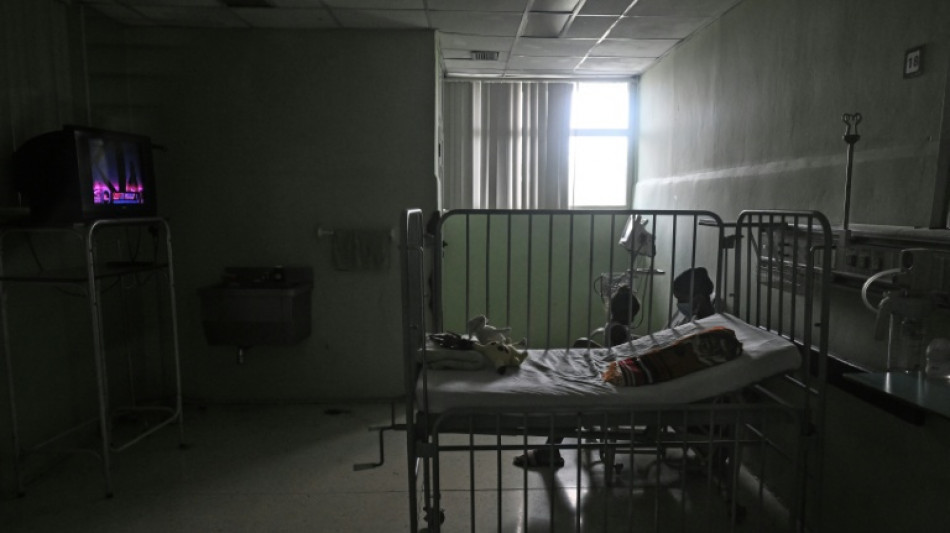
Cuban children's heart hospital makes tough choices amid US blockade / Photo: Yuri CORTEZ - AFP

 Prized Mexican relic returns on loan, two centuries on

 'In our lane': Fed's Warsh defies Trump but still fighting for credibility

 Trump admin makes major cut to endangered species protections

 GM delivers first components for US interceptor missiles

 Travis Scott and Keith Richards feature on GTA VI soundtrack

 King Charles warns tech bosses of 'existential dangers' of AI

 French fishermen block ports over petrol prices

 Micron's Taiwan workers say 68 months' bonus not enough

 Canada's Carney pushes 'new alliance' with EU despite Trump threats

 Beyond Investment Returns: Families Are Measuring Wealth by Freedom, Continuity, and Legacy, According to Nour Private Wealth

 King Charles disputes claims in book by Princess Diana's brother

 Nepal floods among 'most challenging' disasters: WFP

 Kids and social media: what would change under new EU law

 King Charles to call on tech giants for 'reassurances' over AI

 STARPRIME Responds to Diverging Gold Market Demand with AM/PM Fixing and XAU24/7

 Where the US-China tariff row stands ahead of White House summit

 Indonesia cash-for-photos scheme turns animal hunters into protectors

 Bayer to Present How it Rebuilt Global Planning with OMP at Gartner Supply Chain Planning Summit 2026

 US Congress passes sweeping Russia sanctions bill

 US stocks fall, dollar gains after Fed lifts interest rates

 US Fed raises rates to tackle 'too high' inflation in move sure to rile Trump

 US Fed raises rates to battle inflation in move likely to rile Trump

 US House faces test on sweeping Russia sanctions bill

 British PM says to make 'difficult decisions' as inflation rises

 Global fuel price demos: a round-up

Doctors at Cuba's main pediatric heart hospital face wrenching decisions as a US fuel blockade further strains an already fragile health system: which children receive life-saving treatment first -- and which must wait longer.
During a visit by AFP journalists, mothers wearing medical masks were bedside next to children sitting or laying in dim rooms, with the sun providing the only light through the windows.
Universal health care is one of the proud achievements of the Cuban revolution, but the island's hospitals have struggled with shortages and aging equipment for years.
The situation has deteriorated since US President Donald Trump imposed a de facto oil blockade in January, with Cubans enduring daily blackouts that last several hours.
Herminia Palenzuela, a 79-year-old doctor, said the William Soler Pediatric Hospital must now make "very difficult" decisions.
Children with the least serious cases are "at the end of the list and simply wait," she said.
- 'Lucky' so far -
The hospital treats newborns, children, and pregnant women whose fetuses have been diagnosed with severe congenital heart defects.
It has 100 beds, but they are not all used as doctors says they must conserve equipment and medical supplies for the sickest patients.
"Resources are always reserved for that type of patient, because they are the ones who could die at any moment," said Palenzuela, her face etched with anguish.
"We would like to operate more. We would like to do more, but the resources don't allow us to do so," said Palenzuela, who founded the hospital in 1986.
Yaima Sanchez waited in a dimly lit hallway for her nine-year-old son to be seen and given the portable device needed to monitor his heart rate.
"I come here with the faith that the doctors will see me with whatever they have available," said Sanchez, whose son has tachycardia, an abnormally fast heartbeat.
"Sometimes the device isn't there, or it's dead because there are no batteries," she told AFP. "So far, we've been lucky, but you never know."
- 'Dramatic levels' -
With daily blackouts affecting Cubans across the island -- including two nationwide outages last week alone -- the government has prioritized hospitals, which are equipped with generators to ensure they never go dark.
Palenzuela said she can only visit the hospital three times a week. Colleagues walk several kilometers to work every day. A transport system has been set up for health workers, but not all have access to it.
In Havana, nurses and doctors in white lab coats are among people seen hitchhiking along the capital's famous Malecon seafront promenade.
According to the health ministry, more than 96,000 Cubans, including 11,000 children, are waiting for surgeries due to the energy crisis.
The director of the William Soler hospital, Eugenio Selmam, said a US trade embargo in force since 1962 has always made it difficult for Cuba to get medicine and medical equipment.
"It's something we have lived with for decades," Selmam said. "But now, with this new situation, it has reached dramatic levels."
The United Nations, which is in talks with Washington to allow imports of fuel for its aid work in Cuba, has proposed an action plan to keep critical services running in the country.
"If the current situation continues and the country's fuel reserves are exhausted, we do fear a rapid deterioration, with the potential loss of life," the UN's coordinator in Cuba, Francisco Pichon, said Wednesday.
The hospital this week received a shipment of medicine, food and hygiene products from an international humanitarian aid convoy that brought 50 tonnes of supplies to Cuba by sea and air.
"The situation is clearly complicated," said Martina Steinwurzel, a 41-year-old Italian activist and member of the Our America Convoy.
As volunteers and medical staff stacked boxes of donated supplies in a hospital room, Steinwurzel looked around and said: "These are people who have resisted for many years, and now they are living through a siege they have never experienced in their history."
M.P.Jacobs--CPN
