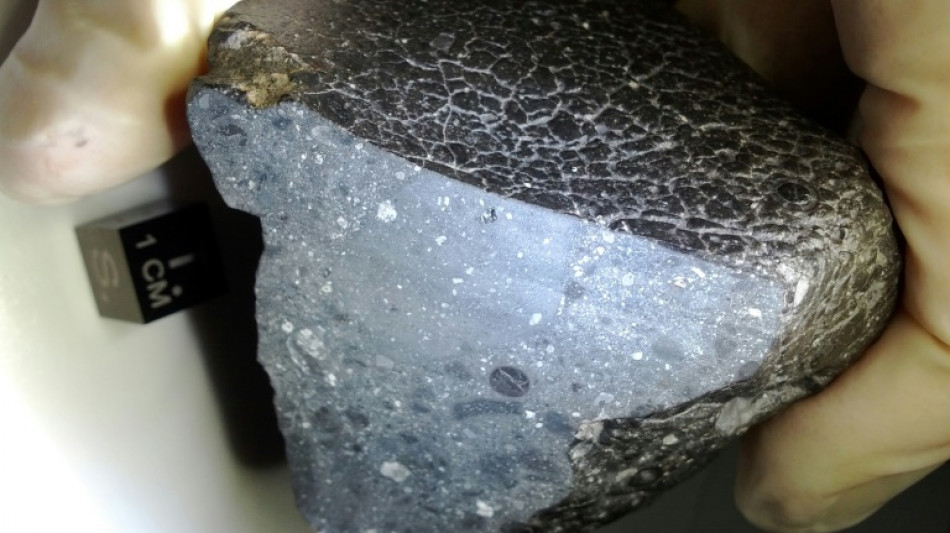
Scientists find oldest Martian meteorite's original home / Photo: - - NASA/AFP/File

 Emporio Armani names Dario Vitale new creative director

 EU to ban social media for under 13s, curb access until 15

 Wildfires push endangered Sumatran elephants to brink: Indonesian NGO

 Bank of Japan set to raise rates under pressure from inflation, US

 EU chief to unveil social media, gaming curbs for under-15s

 'Resident Evil' film brings video game's ethos to the big screen

 i-payout Expands U.S. Money Transmitter Licensing Footprint and Advances European EMI Strategy

 US Senate crypto bill collapses amid partisan deadlock

 OpenAI, Anthropic and Google are working to create an AI standards body

 Protesting shepherds, farmers clash with Romanian police

 Foundation Lets Ledger Users Switch to Open Source Without Starting Over

 EU to propose curbing social media, online games for under 15s

 FX Junction Reaches 40,600 Members and 26 Million Trades

 'We unleashed the beast': the world's fears and hopes about AI

 Hospitality leaders ask Burnham to halve VAT amid rising costs

 Worcestershire invited to nominate groups for 2027 King’s volunteer award

 Berlin's run-down public spaces at heart of election campaign

 'Widow's Bay' and 'The Pitt' win big at Emmy Awards

 Most markets drop as oil extends gains ahead of expected US rate hike

 Sri Lanka's famed beach shack battles demolition

 Vserv targets ₹1,000 crore revenue by 2030 through AI expansion

 India prohibits bank fees on UPI payments up to ₹2,000

 Brazil's Amazon defender Raoni has cancer

 Trump rejects AI slowdown concerns as UN urges coordinated controls

 Higher wages draw migrant workers to Kashmir despite attacks

Scientists announced Tuesday they had found the crater from which the oldest known Martian meteorite was originally blasted towards Earth, a discovery that could provide clues into how our own planet was formed.
The meteorite NWA 7034, nicknamed Black Beauty, has fascinated geologists since it was discovered in the Sahara Desert in 2011.
It fits easily in the hand, weighing just over 300 grams (10.6 ounces), and contains a mix of materials including zircons, which date back nearly 4.5 billion years.
"That makes it one of the oldest rocks studied in the history of geology," Sylvain Bouley, a planetary scientist at France's Paris-Saclay University, told AFP.
Its journey dates back to the solar system's infancy, "about 80 million years after the planets began forming", said Bouley, who co-authored a new study on the meteorite.
Tectonic plates long ago covered up Earth's ancient crust, meaning that "we have lost this primitive history of our planet", Bouley said.
But Black Beauty could offer "an open book on a planet's first moments", he added.
To open that book, a team of researchers at Australia's Curtin University set out to find the meteorite's original home on Mars.
They knew that it was likely an asteroid hitting the red planet that sent Black Beauty shooting up into space.
The impact "had enough force to eject the rocks at very high speed -- more than five kilometres (three miles) a second -- to escape the Martian gravity", Curtin's Anthony Lagain, the lead author of the study in Nature Communications, told AFP.
Such a crater would have to be massive -- at least three kilometres in diameter.
The problem? The pockmarked surface of Mars has around 80,000 craters at least that big.
- Following the clues -
But the researchers had a clue: by measuring Black Beauty's exposure to cosmic rays, they knew it was dislodged from its first home around five million years ago.
"So, we were looking for a crater that was very young and large," Lagain said.
Another clue was that its composition showed it had suddenly heated up around 1.5 million years ago -- likely by the impact of a second asteroid.
The team then created an algorithm and used a supercomputer to trawl through images of 90 million craters taken by a NASA satellite.
That narrowed it down to 19 craters, allowing the researchers to rule out the remaining suspects.
They found that Black Beauty was dug up from its first home by an asteroid that struck around 1.5 billion years ago, forming the 40-kilometre Khujirt crater.
Then a few million years ago, another asteroid hit not far away, creating the 10-kilometre Karratha crater and shooting the Black Beauty towards Earth.
The region in Mars' southern hemisphere is rich in the elements potassium and thorium, just like Black Beauty.
Another factor was that Black Beauty is the only Martian meteorite that is highly magnetised.
"The region where Karratha was found is the most magnetised on Mars," Lagain said.
Known as the Terra Cimmeria—Sirenum province, it is "a relic of the early crustal processes on Mars, and thus, a region of high interest for future missions," the study said.
Bouley pointed to a "bias" in the currently planned missions to Mars in favour of searching for signs of water and life.
But to understand how planets first form would answer some fundamental questions, Lagain said, including "how Earth became such an exceptional planet in the Universe".
Y.Ibrahim--CPN