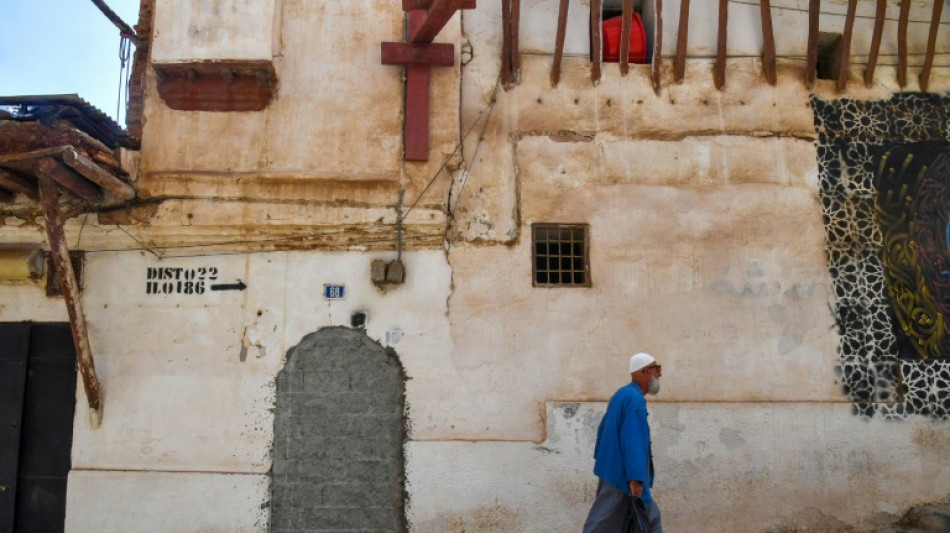
Renovate the Casbah: Efforts speed up to restore historic Algiers district / Photo: RYAD KRAMDI - AFP

 Emporio Armani names Dario Vitale new creative director

 EU to ban social media for under 13s, curb access until 15

 Wildfires push endangered Sumatran elephants to brink: Indonesian NGO

 Bank of Japan set to raise rates under pressure from inflation, US

 EU chief to unveil social media, gaming curbs for under-15s

 'Resident Evil' film brings video game's ethos to the big screen

 i-payout Expands U.S. Money Transmitter Licensing Footprint and Advances European EMI Strategy

 US Senate crypto bill collapses amid partisan deadlock

 OpenAI, Anthropic and Google are working to create an AI standards body

 Protesting shepherds, farmers clash with Romanian police

 Foundation Lets Ledger Users Switch to Open Source Without Starting Over

 EU to propose curbing social media, online games for under 15s

 FX Junction Reaches 40,600 Members and 26 Million Trades

 'We unleashed the beast': the world's fears and hopes about AI

 Hospitality leaders ask Burnham to halve VAT amid rising costs

 Worcestershire invited to nominate groups for 2027 King’s volunteer award

 Berlin's run-down public spaces at heart of election campaign

 'Widow's Bay' and 'The Pitt' win big at Emmy Awards

 Most markets drop as oil extends gains ahead of expected US rate hike
 Sri Lanka's famed beach shack battles demolition

 Vserv targets ₹1,000 crore revenue by 2030 through AI expansion

 India prohibits bank fees on UPI payments up to ₹2,000
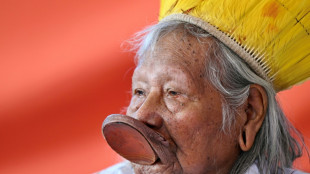 Brazil's Amazon defender Raoni has cancer

 Trump rejects AI slowdown concerns as UN urges coordinated controls
 Higher wages draw migrant workers to Kashmir despite attacks

A UNESCO-listed rabbit warren of 16th-century battlements and Ottoman palaces, the Casbah of the Algerian capital is falling into disrepair, but efforts to save it have been accelerating.
The densely populated district, about a kilometre (just under a mile) across, perches above the Bay of Algiers and has been the site of key moments in the North African country's history.
Some buildings weakened by earthquakes, floods or fires are still propped up with scaffolding, but a plan launched in 2012 is seeking to rehabilitate the area.
Work to restore the Casbah had first started right after Algeria's independence from France in 1962.
That was some six years after a battle between French colonial forces and the urban guerrillas of the National Liberation Front (FLN), later immortalised in Gillo Pontecorvo's 1966 film "The Battle of Algiers", shot on location in the Casbah.
Efforts to restore the buildings involved "several plans and several stakeholders", said Aissa Mesri of Archimed, a firm working on studies of the Casbah and monitoring the work.
"Restoration operations were started and then halted for financial, technical or legal reasons related to ownership," he added, lamenting the lack of a "clear vision" for a "Casbah project".
The 2012 plan was adopted with a budget of 170 million euros (now $170 million).
The project aims to restore the Casbah's "authentic face", protect it in the long term and keep at least some of its residents in their homes.
- Battle of Algiers heroine -
The state-run project has already restored a number of prominent buildings, including part of the citadel, which includes the Dey's palace, mosque and ammunition store, partially open to visitors since November 2020.
The mosque has been decorated with earthenware, marble and Arabic screen printing.
A cluster of four houses that once served as a refuge for key independence war figures, including militant Djamila Bouhired, a heroine of the Battle of Algiers, has been renovated.
The Ketchaoua mosque, closed since 2008 after being seriously damaged by a powerful earthquake five years earlier, has also been restored.
The Ottoman-era mosque was reopened in April 2018 after 37 months of works, funded entirely by the Turkish government.
Before the start of the restoration plan, Algerian authorities had launched emergency work to "consolidate buildings that were in danger of collapsing", said Mehdi Ali Pacha, head of an architectural firm specialising in heritage work.
"The shoring up of more than 300 buildings was carried out in 2008 and 2013," added the architect, whose agency has conducted studies on the restoration.
- 'Residents a problem' -
Restoration work on the many small traditional houses in the Casbah is sometimes hindered by residents who refuse to grant access to architects or work crews.
"The residents remain a problem. There are some small old houses that have been emptied and walled up by the town hall.
"There, there is no problem, we can work.
"When the houses are inhabited, the study is done as best as possible with difficulties of access," bemoaned Ali Pacha.
In late 2018, the rehabilitation of the Casbah was at the heart of a controversy, both in France and Algeria, after Algerian authorities decided to entrust a development plan to French architect Jean Nouvel.
Some 400 people, mainly architects, planners and academics, asked Nouvel to withdraw from the project.
The petitioners were concerned that a French architect could propose transformations of a major site of the Battle of Algiers.
The venture was eventually abandoned.
Currently, seven restoration projects of historical buildings are underway, according to Fatima Larbi, architect at the Algiers public works department, quoted by the official news agency APS.
"The aim is to revive the Casbah and enhance it," said Ali Pacha.
D.Avraham--CPN