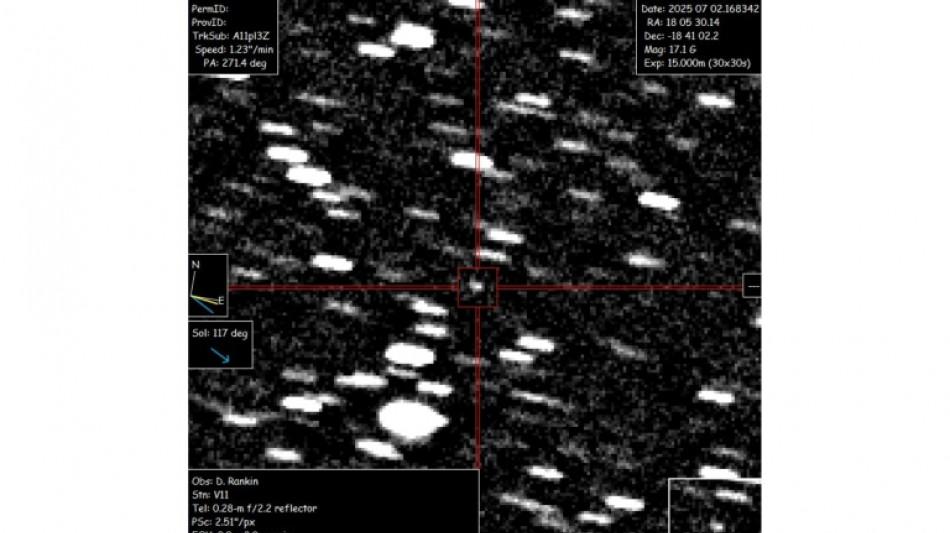
Third-ever confirmed interstellar object blazing through Solar System / Photo: David RANKIN - David Rankin, Saguaro Observatory/AFP

 UK-Sudanese author pens book to give children 'African history of Africa'

 US Congress passes sweeping Russia sanctions bill

 US stocks fall, dollar gains after Fed lifts interest rates

 US Fed raises rates to tackle 'too high' inflation in move sure to rile Trump

 US Fed raises rates to battle inflation in move likely to rile Trump

 US House faces test on sweeping Russia sanctions bill

 British PM says to make 'difficult decisions' as inflation rises

 Global fuel price demos: a round-up

 Leverate Launches MCP for Traders to Connect AI Assistants With Trading Platforms

 MEXC Launches $1M "Discover Your Wall Street DNA" Campaign to Help Traders Find Their Market Fit

 Stocks edge higher ahead of US Fed rate call

 BASIS.pro Expands On-Chain Infrastructure with XDC Network Partnership and Zypher DAO as Auto Earn Goes Live

 Pickle-flavoured tart? AI inspires Japan's convenience stores

 EU chief hosts Canada's Carney in push to 'deepen' alliance

 Meta chief pushes back on AI slowdown calls

 US Fed to deliver rate decision with markets betting on hike

 i-payout Expands U.S. Money Transmitter Licensing Footprint and Advances European EMI Strategy

 US Senate crypto bill collapses amid partisan deadlock

 OpenAI, Anthropic and Google are working to create an AI standards body

 Protesting shepherds, farmers clash with Romanian police

 Foundation Lets Ledger Users Switch to Open Source Without Starting Over

 EU to propose curbing social media, online games for under 15s

 FX Junction Reaches 40,600 Members and 26 Million Trades

 'We unleashed the beast': the world's fears and hopes about AI

 Hospitality leaders ask Burnham to halve VAT amid rising costs

Astronomers on Wednesday confirmed the discovery of an interstellar object racing through our Solar System -- only the third ever spotted, though scientists suspect many more may slip past unnoticed.
The visitor from the stars, designated 3I/Atlas by the International Astronomical Union's Minor Planet Center, is likely the largest yet detected. It has been classified as a comet.
"The fact that we see some fuzziness suggests that it is mostly ice rather than mostly rock," Jonathan McDowell, an astronomer at the Harvard-Smithsonian Center for Astrophysics, told AFP.
Originally known as A11pl3Z before it was confirmed to be of interstellar origin, the object poses no threat to Earth, said Richard Moissl, head of planetary defense at the European Space Agency.
"It will fly deep through the Solar System, passing just inside the orbit of Mars," but will not hit our neighboring planet, he told AFP.
Excited astronomers are still refining their calculations, but the object appears to be zooming more than 60 kilometres (37 miles) a second.
This would mean it is not bound by the Sun's orbit, unlike those asteroids and comets that remain within the solar system.
Its trajectory also "means it's not orbiting our star, but coming from interstellar space and flying off to there again," Moissl said.
"We think that probably these little ice balls get formed associated with star systems," added McDowell. "And then as another star passes by, tugs on the ice ball, frees it out. It goes rogue, wanders through the galaxy, and now this one is just passing us."
The NASA-funded ATLAS survey in Hawaii first discovered the object on Tuesday, US astronomer David Rankin wrote on the social media platform Bluesky.
Professional and amateur astronomers across the world then searched through past telescope data, tracing its trajectory back to at least June 14.
The object is currently estimated to be roughly 10-20 kilometers wide, Moissl said, which would make it the largest interstellar interloper ever detected. But the object could be smaller if it is made out of ice, which reflects more light.
"It will get brighter and closer to the Sun until late October and then still be observable (by telescope) until next year," Moissl said.
- Our third visitor -
This marks only the third time humanity has detected an object entering the solar system from the stars.
The first, 'Oumuamua, was discovered in 2017. It was so strange that at least one prominent scientist became convinced it was an alien vessel -- though this has since been dismissed by further research.
Our second interstellar visitor, 2I/Borisov, was spotted in 2019.
Mark Norris, an astronomer at the UK's University of Central Lancashire, told AFP that the new object appears to be "moving considerably faster than the other two extrasolar objects that we previously discovered."
The object is currently roughly around the distance from Jupiter away from Earth, Norris said.
He lamented that he would not be able to observe the object on his telescope on Wednesday night, because it is currently only visible in the Southern Hemisphere.
Norris pointed to modelling estimating that there could be as many as 10,000 interstellar objects drifting through the Solar System at any given time, though most would be smaller than the newly discovered object.
If true, this suggests that the newly online Vera C. Rubin Observatory in Chile could soon be finding these dim interstellar visitors every month, Norris said.
Moissl said it is not feasible to send a mission into space to intercept the new object.
Still, these visitors offer scientists a rare chance to study something outside of our Solar System.
For example, if we detected precursors of life such as amino acids on such an object, it would give us "a lot more confidence that the conditions for life exist in other star systems," Norris said.
D.Philippon--CPN