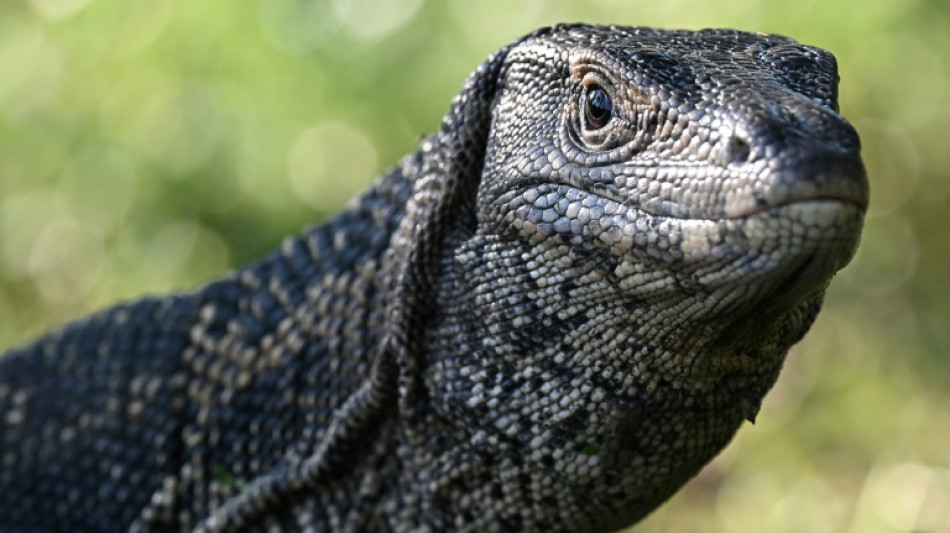
Ancient reptile tracks rewrite when animals conquered land / Photo: Lillian SUWANRUMPHA - AFP/File

 Where the US-China tariff row stands ahead of White House summit

 Indonesia cash-for-photos scheme turns animal hunters into protectors

 Argentine judge orders suspension of Falklands oil project

 US Fed raises rates to tackle 'too high' inflation, irking Trump

 Turkey releases 106 protesters, jails more LGBTQ activists

 Candidate for UN chief calls for AI regulation akin to nuclear weapons

 'We're losing control,' AI pioneer Yoshua Bengio tells AFP

 IR-MED and Dice Technologies Announce collaboration to Evaluate and Advance Pressure-Injury Prevention Platform in Japan

 Watts, Pitt, Cruz to light up Spain's top film festival

 Toogood Gold's Table Mountain Sits in the Shadow of a Nevada Gold Rush

 MEXC July–August Security Report: 38.66M USDT in Risk Funds Intercepted, Futures Insurance Fund Hits 792M USDT

 Emporio Armani names Dario Vitale new creative director

 EU to ban social media for under 13s, curb access until 15

 Wildfires push endangered Sumatran elephants to brink: Indonesian NGO

 Bank of Japan set to raise rates under pressure from inflation, US

 EU chief to unveil social media, gaming curbs for under-15s

 'Resident Evil' film brings video game's ethos to the big screen

 GA-ASI Mojave First UAS To Complete Battlefield Short Field Ops

 Sanders, Bannon warn of AI dangers in rare US left-right alignment

 Empty benches as schools reopen in Venezuela's quake-hit Guaira

 Tiny English village holds 'independence' vote over asylum seeker housing

 US Treasury chief says to meet Chinese counterpart at weekend

 BingX Evolves into a Multi-Asset Trading Platform, Connecting Users to Global Opportunities

 International Trading Institute Expands Professional Trader Development Beyond the Master’s in Trading

 Lake Energy Secures $80 Million for U.S. Renewable Energy Expansion

After a brief rain in part of the ancient supercontinent of Gondwana 350 million years ago, a reptile pressed its small claws into the still-wet ground.
Its tracks, which have been discovered in Australia, mean it is the oldest-known vertebrate animal to have permanently abandoned the oceans for dry land, a study suggested on Wednesday.
It also significantly pushes back the date for when these four-limbed pioneers made this important evolutionary step that would eventually lead to humans conquering the globe.
The tracks were found by amateur archaeologists on a 30-centimetre-wide sandstone slab in a mountainous area of the southeastern Australian state of Victoria.
First there was a single footprint of an unknown animal which has "raindrop pockmarks all over it," Per Ahlberg, a palaeontologist at Sweden's Uppsala University, told AFP.
This suggests it was made before the brief shower, said the senior author of a new Nature study describing the discovery.
Then there were two sets of tracks from after the rain.
The second set of tracks suggest this reptile ancestor "was in more of a hurry", he added.
"You see the claws making long scratches on the ground."
- 'Keyholes' into 'lost world' -
The researchers cannot determine whether both sets of tracks were made by the same individual animal, but Ahlberg thinks this is unlikely.
The animal was 60-80 centimetres long and would have looked "quite lizard-like", he added.
That the animal had claws is a clear sign it was an amniote, a group of animals which today includes mammals, birds and reptiles.
Its ancestor tetrapods -- notable for their four limbs -- split into two groups, amniotes and amphibians.
While amphibians had to return to water to lay their eggs, amniotes evolved to have eggs strong enough to survive on land, shedding its last connection to water life.
The discovery indicates that amniotes existed 35 to 40 million years earlier than previously thought, during the turn of the Devonian and Carboniferous periods, the study said.
This suggests the "water-to-land-dwelling transition" may have taken place in just 50 million years, much quicker than had been believed, Stuart Sumida of California State University commented in Nature.
That would be just the latest twist in the tale of how animals rose from the ocean to dominate the land.
"The only way to ever understand it is to look through these tiny little keyholes that we find into this strange, dark, lost world," Ahlberg said.
Y.Ibrahim--CPN