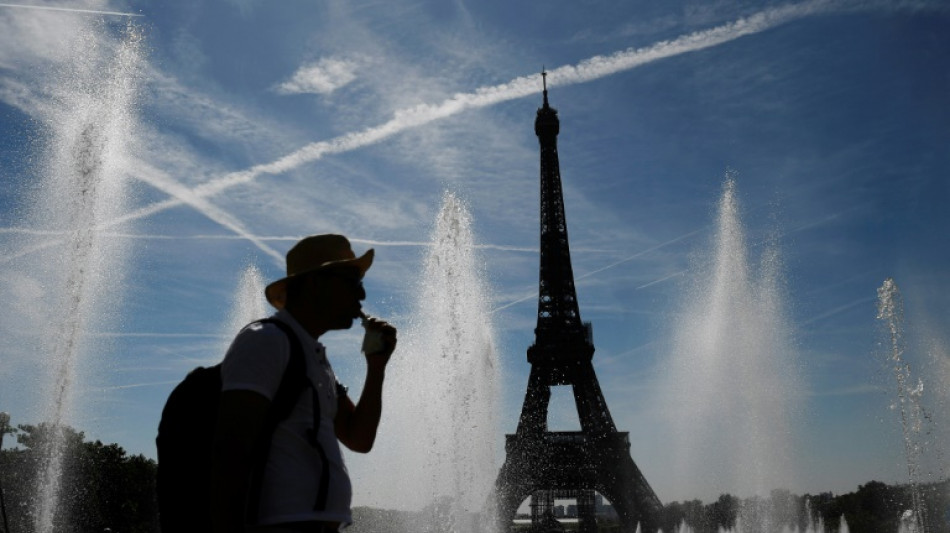
Record early heatwave sweeps France as fires flare in Spain / Photo: JULIEN DE ROSA - AFP

 Emporio Armani names Dario Vitale new creative director

 EU to ban social media for under 13s, curb access until 15

 Wildfires push endangered Sumatran elephants to brink: Indonesian NGO

 Bank of Japan set to raise rates under pressure from inflation, US

 EU chief to unveil social media, gaming curbs for under-15s

 'Resident Evil' film brings video game's ethos to the big screen

 i-payout Expands U.S. Money Transmitter Licensing Footprint and Advances European EMI Strategy

 US Senate crypto bill collapses amid partisan deadlock

 OpenAI, Anthropic and Google are working to create an AI standards body

 Protesting shepherds, farmers clash with Romanian police

 Foundation Lets Ledger Users Switch to Open Source Without Starting Over

 EU to propose curbing social media, online games for under 15s

 FX Junction Reaches 40,600 Members and 26 Million Trades

 'We unleashed the beast': the world's fears and hopes about AI

 Hospitality leaders ask Burnham to halve VAT amid rising costs

 Worcestershire invited to nominate groups for 2027 King’s volunteer award

 Berlin's run-down public spaces at heart of election campaign
 'Widow's Bay' and 'The Pitt' win big at Emmy Awards

 Most markets drop as oil extends gains ahead of expected US rate hike

 Sri Lanka's famed beach shack battles demolition

 Vserv targets ₹1,000 crore revenue by 2030 through AI expansion

 India prohibits bank fees on UPI payments up to ₹2,000

 Brazil's Amazon defender Raoni has cancer

 Trump rejects AI slowdown concerns as UN urges coordinated controls

 Higher wages draw migrant workers to Kashmir despite attacks

French officials urged caution Thursday as a record pre-summer heatwave spread across the country from Spain, where authorities were fighting forest fires on a sixth day of sweltering temperatures.
The Meteo France weather service said it was the earliest hot spell ever to hit the country, worsening a drought caused by an unusually dry winter and spring, and raising the risk of wildfires.
Spain, which has already seen its hottest May since the beginning of this century, was sweating under temperatures forecast as high as 43 degrees Celsius (109 Fahrenheit) and no relief is expected before Sunday, the Aemet weather service said.
At least three forest fires erupted in Catalonia, including one near Baldomar around 140 kilometres (87 miles) northeast of Barcelona, that has burned nearly 1,000 hectares (2,470 acres) but could grow to 20,000 hectares before it is contained, the regional government said.
No evacuations have yet been ordered but people are being urged to remain in their homes.
Neighbouring Portugal saw its hottest May since 1931, with most scientists attributing the early season heat across Europe to global warming caused by greenhouse gas emissions.
Scientists say heat waves have become more likely due to climate change. As global temperatures rise over time, heat waves are predicted to become more frequent and intense and last longer, and their impacts more widespread.
- 'Worst I've ever seen' -
The heatwave crossed the Pyrenees into southern France on Tuesday and was set to hit most of the country by Saturday, when thermometers could reach 39C in Paris.
Most of France was on heatwave alert, including 12 departments at the highest level in the southwest, where the education ministry advised parents to keep younger students at home if possible on Friday.
"Be alert! Hydrate, stay in cool areas, and stay in touch with those close to you," Prime Minister Elisabeth Borne said on Twitter.
Officials in Paris and other cities have also issued alerts over ozone pollution, which occurs when intense sunlight transforms carbon emissions into smog.
Paris police chief Didier Lallement has cut speed limits for the region by 10 km/h (6.2 mph) for Friday.
"I'm 86 years old, I was born here, but I think this is the worst heatwave I've ever seen," Jacqueline Bonnaud told AFP at a shaded park in the southern city of Toulouse.
Surging use of air-conditioners and fans was forcing France to import electricity from neighbouring countries, grid operator RTE said, since many of the country's nuclear reactors are offline to evaluate potential corrosion risks or for maintenance.
- 'Infrastructure suffers' -
The intense heat is also lowering river levels, meaning some nuclear plants must reduce output because water used for cooling reactors is too hot to be returned to waterways without endangering plants and wildlife.
Spain, Italy and other countries have recently limited the use of air-conditioners to save energy, and French Energy Minister Agnes Pannier-Runacher told France 2 television that she was considering the same.
"Saturday will be the peak, with temperatures of 35 to 39 degrees across most of the country," Tristan Amm, a Meteo France forecaster, told AFP.
Schools have stocked up on water and several have moved end-of-year exams to north-facing rooms, while some departments in the south have said classes will be cancelled on Friday afternoon.
Rail operator SNCF has warned of potential delays as trains are forced to slow because the heat has deformed tracks or damaged electrical equipment.
"Our infrastructure suffers" in the heat, said SNCF regional director Thierry Rose, noting that track-level temperatures in Bordeaux had hit 52 Celsius (126 Fahrenheit) on Wednesday.
H.Meyer--CPN