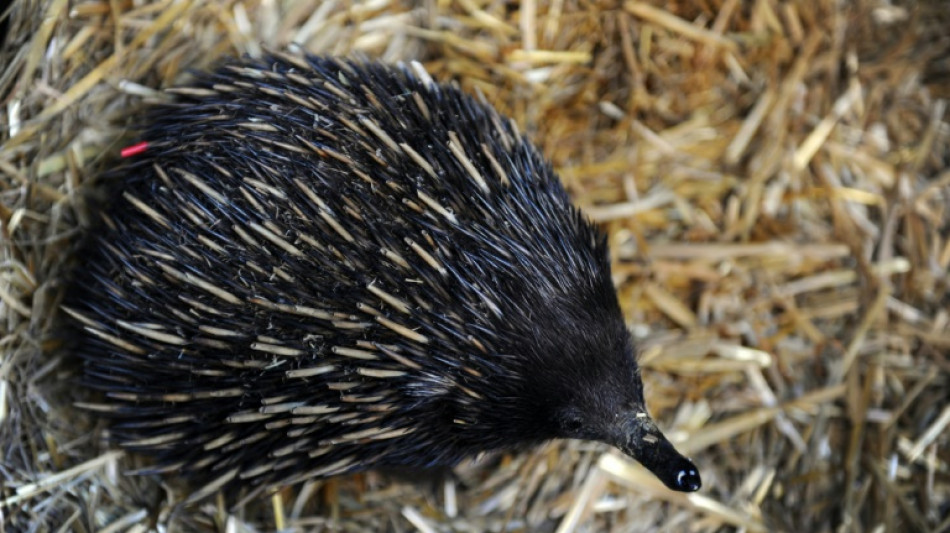
Study sheds light on origin of Australia's odd echidna / Photo: ROMEO GACAD - AFP

 Where the US-China tariff row stands ahead of White House summit

 Indonesia cash-for-photos scheme turns animal hunters into protectors

 Argentine judge orders suspension of Falklands oil project

 US Fed raises rates to tackle 'too high' inflation, irking Trump

 Turkey releases 106 protesters, jails more LGBTQ activists

 Candidate for UN chief calls for AI regulation akin to nuclear weapons

 'We're losing control,' AI pioneer Yoshua Bengio tells AFP

 IR-MED and Dice Technologies Announce collaboration to Evaluate and Advance Pressure-Injury Prevention Platform in Japan

 Watts, Pitt, Cruz to light up Spain's top film festival

 Toogood Gold's Table Mountain Sits in the Shadow of a Nevada Gold Rush

 MEXC July–August Security Report: 38.66M USDT in Risk Funds Intercepted, Futures Insurance Fund Hits 792M USDT

 Emporio Armani names Dario Vitale new creative director

 EU to ban social media for under 13s, curb access until 15

 Wildfires push endangered Sumatran elephants to brink: Indonesian NGO

 Bank of Japan set to raise rates under pressure from inflation, US

 EU chief to unveil social media, gaming curbs for under-15s

 'Resident Evil' film brings video game's ethos to the big screen

 GA-ASI Mojave First UAS To Complete Battlefield Short Field Ops

 Sanders, Bannon warn of AI dangers in rare US left-right alignment

 Empty benches as schools reopen in Venezuela's quake-hit Guaira

 Tiny English village holds 'independence' vote over asylum seeker housing

 US Treasury chief says to meet Chinese counterpart at weekend

 BingX Evolves into a Multi-Asset Trading Platform, Connecting Users to Global Opportunities

 International Trading Institute Expands Professional Trader Development Beyond the Master’s in Trading

 Lake Energy Secures $80 Million for U.S. Renewable Energy Expansion

Australia's burrowing echidna evolved from a water-dwelling ancestor in an "extremely rare" biological event, scientists said Tuesday in a new study of the peculiar egg-laying mammals.
With powerful digging claws, protective spikes and highly sensitive beaks, echidnas are well suited to a life shuffling through the forest undergrowth.
But a team of Australian and international scientists believe many of the echidna's unusual traits were first developed millions of years ago when its ancestors splashed through the water.
"We're talking about a semiaquatic mammal that gave up the water for a terrestrial existence," said paleontologist Suzanne Hand, from the University of New South Wales.
"While that would be an extremely rare event, we think that's what happened with echidnas."
Echidnas and another Australian oddity, the semi-aquatic platypus, are believed to have evolved from a common ancestor called Kryoryctes cadburyi that lived in Australia more than 100 million years ago.
Researchers studied the single known bone fragment left by this ancestor, which was discovered among a trove of fossils at Dinosaur Cove in southern Australia some 30 years ago.
Platypus bones were similar to this ancient ancestor, Hand said, with a thick and heavy structure that provided ballast for diving.
Echidnas, in comparison, had very thin bone walls that made it easier to walk on land, Hand said.
This indicated echidnas were descended from a water-dwelling ancestor but had evolved to live on land, the research found.
It was far more common for prehistoric mammals to go from land to water, Hand said, pointing towards seals, whales, dolphins and dugongs.
The researchers said these findings appeared to be supported by other echidna traits.
Echidnas have backward-facing hind feet that help them shift mounds of soil when burrowing.
These feet may have first developed as rudders helping the echidna's ancestor navigate fast-moving waterways, Hand said.
Echidnas also have a "diving reflex" when submerged in water, which tells their body to conserve oxygen helping them hold their breath for longer.
Echidnas and platypus are monotremes, a rare group of mammals that lay eggs instead of live young.
"We're hoping we'll discover other ancestral monotremes that will help unravel the early history of this most fascinating group of mammals," said study co-author Michael Archer.
The research was published in peer-reviewed journal PNAS.
Y.Ibrahim--CPN
