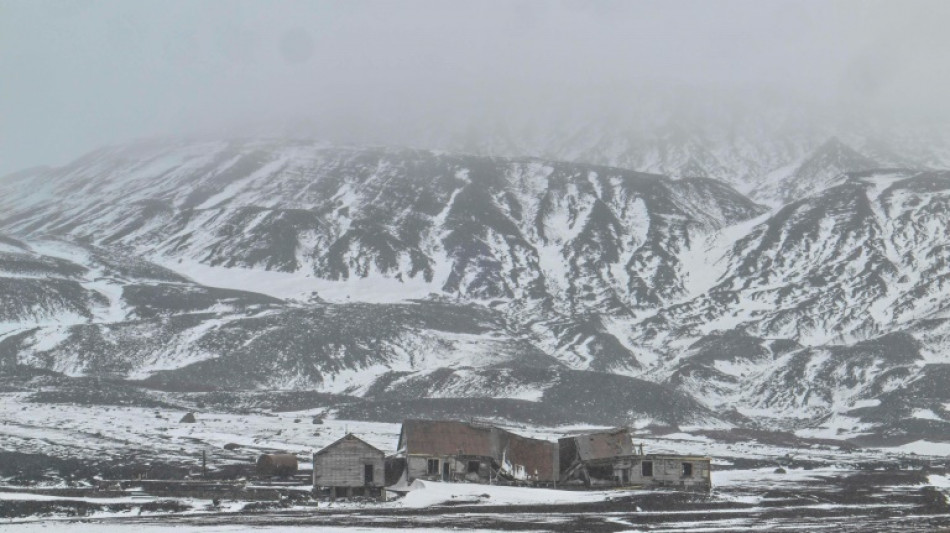
Ice and fire: Antarctic volcano may hold clues to life on Mars / Photo: JUAN BARRETO - AFP/File

 Crisis-wracked Volkswagen warns of 10-bn-euro hit to profits

 Shakira to cap off world tour with Madrid 12-gig run

 Isolated Syrian-Druze city shortages

 UNESCO can be 'moderator' in AI debate: chief to AFP

 Russia seizes assets of Nestle, French firms

 Anthropic says AI systems moving towards building themselves

 Asian stocks boosted by falling oil, yen weakens after BoJ rate hike

 Afghan medical students in Pakistan hope court stops college expulsions

 Australia to detain tourists who overstay visa, minister says

 Asian stocks track Wall St rally as oil prices drop

 Prized Mexican relic returns on loan, two centuries on

 'In our lane': Fed's Warsh defies Trump but still fighting for credibility

 Trump admin makes major cut to endangered species protections

 GM delivers first components for US interceptor missiles

 Travis Scott and Keith Richards feature on GTA VI soundtrack

 King Charles warns tech bosses of 'existential dangers' of AI

 French fishermen block ports over petrol prices

 Micron's Taiwan workers say 68 months' bonus not enough

 Canada's Carney pushes 'new alliance' with EU despite Trump threats

 Beyond Investment Returns: Families Are Measuring Wealth by Freedom, Continuity, and Legacy, According to Nour Private Wealth

 King Charles disputes claims in book by Princess Diana's brother

 Nepal floods among 'most challenging' disasters: WFP

 Kids and social media: what would change under new EU law

 King Charles to call on tech giants for 'reassurances' over AI

 STARPRIME Responds to Diverging Gold Market Demand with AM/PM Fixing and XAU24/7

On Deception Island in Antarctica, steam rises from the beaches, and glaciers dot the black slopes of what is actually an active volcano -- a rare clash of ice and fire that provides clues to scientists about what life could look like on Mars.
The horseshoe-shaped isle in the South Shetland Islands is the only place in the world where ships can sail into the caldera of an active volcano.
In the waters here, some 420 kilometers (260 miles) from Chile's Port Williams, fish, krill, anemones and sea sponges survive, while unique species of lichen and moss grow on the surface in an ecosystem of extreme contrasts.
The island, uninhabited by people, is home to perhaps the world's largest colony of chinstrap penguins, seabirds, seals and sea lions.
The volcano has been active for thousands of years, with the most recent eruptions -- in 1967, 1969 and 1970 -- devastating British and Chilean bases and forcing the evacuation of an Argentine base.
Yet life always returns and thrives on an island where water temperatures in steam vents, or fumaroles, have been measured at around 70 degrees Celsius (158 degrees Fahrenheit), even as air temperatures can plummet to -28 degrees.
It is "similar to Mars because there what we have is a planet with (a past of) immense volcanic activity ... where currently there are very cold conditions," Spanish planetary geologist Miguel de Pablo told AFP.
"It is the best possible approximation that we can make to understand Mars without stepping on" that planet, added de Pablo.
- A rich history -
The analysis of rocks on Deception Island complements the work of engineers, scientists and astronomers who study Mars from afar.
In 2023, researchers with the US space agency NASA concluded that Mars once had a climate with cyclical seasons, conducive to the development of life, according to evidence found on the red planet by the Curiosity rover.
Scientists believe an immense volcanic eruption changed the planet's atmosphere and led to the appearance of oceans and rivers that later evaporated.
Even though temperatures on Mars are far lower now -- estimated by NASA at about -153 degrees Celsius -- "Antarctic conditions can help us understand if the conditions for the development of life could, or could have, existed on Mars," said de Pablo.
Another Mars rover, Perseverance, landed on the planet in February 2021 to look for signs of past microbial life.
The multitasking rover will collect 30 rock and soil samples in sealed tubes to be sent back to Earth sometime in the 2030s for lab analysis.
The South Shetlands are claimed by Britain, Chile and Argentina but are not administered by any one country. The 1959 Antarctic Treaty states they shall be used "for peaceful purposes" and guarantees "freedom of scientific investigation."
Deception Island, first visited by British sealers in 1820, has a rich history, with abandoned scientific bases and an old whaling station rusting in the icy air.
Wilson Andres Rios, a researcher and captain of a Colombian navy frigate conducting a scientific expedition in Antarctica, said the hunting of seals and whales from the island in the early 20th century was "indiscriminate."
In 1931, a Norwegian whaling station on the island closed when the price of whale oil slumped.
Then, in 1944, Britain established a base there as part of a secret wartime mission to occupy Antarctic territories.
After several evictions and eruptions, the island is now dedicated to scientific research.
And, under the scientists' wary eyes, thousands of tourists now arrive on cruises.
That phenomenon, said Natalia Jaramillo, scientific coordinator of the Colombian expedition, is "worryingly increasing."
S.F.Lacroix--CPN