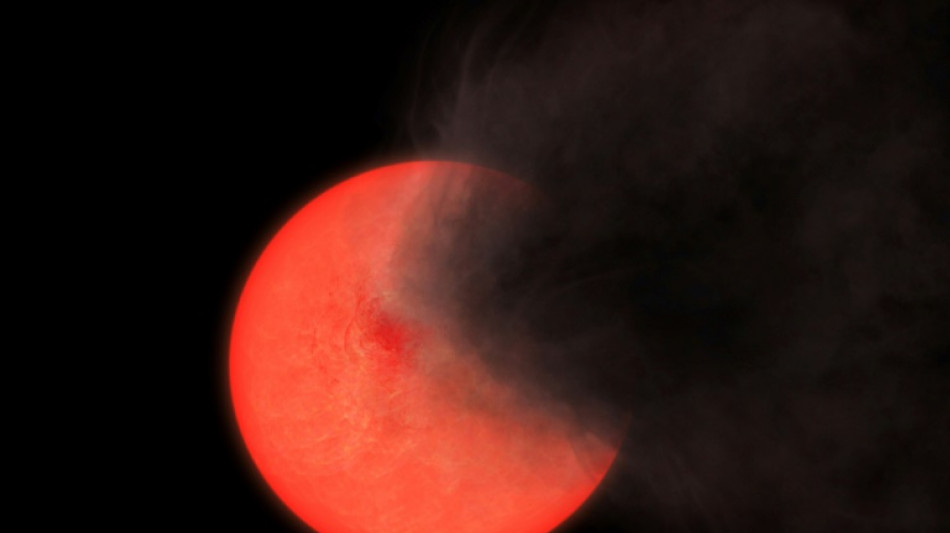
'Old smokers': Strange new type of star discovered in Milky Way / Photo: Philip Lucas - University of Hertfordshire/AFP

 Warren Buffett steps down as Berkshire Hathaway chairman

 Isolated Syrian-Druze city blames Damascus for shortages

 Kerry James Marshall: American 'blackness' painter celebrated in Europe

 Infantino 'must go', says German FA vice-president

 Japan's busiest rail station tests robot bins

 Backpackers fret over Australian visa crackdown

 Bank of Japan hikes rates to 31-year high to battle inflation

 AI doomsday warnings unlikely to slow IPOs but questions linger

 In Brazil's Amazon, the hunt for oil fuels hopes and fears

 Baby orangutans in India expose 'frightening' scale of trafficking

 Oversight Board blasts 'inadequate' Meta safeguards for AI deepfakes

 Harry makes first public appearance since return to UK

 Princess Diana's brother makes new explosive claims against Charles

 Trump admin overhauls key protection for endangered species

 Mbappe draws political fire over Ceuta t-shirt controversy

 Third malaria death in Germany from outbreak tied to Frankfurt airport

 AtlasClear Holdings Reports Preliminary Fiscal 2026 Revenue of Approximately $20.1 Million, Up 85%; Revenue Plus Interest Income of Approximately $21.9 Million

 'Another arrow to the quiver': World Bank posts record private capital mobilization

 Ireland to boycott Eurovision 2027 over Gaza

 India's Tata Sons reappoints N. Chandrasekaran as chairman

 Germany urges EU action against China to defend carmakers

 Japan eyes changing prostitution law to punish sex buyers

 Modi pitches India as global chipmaking hub

 Ukraine plans record defence spending in 2027

 NASA scan discovers new, 'once in a century' Moon crater

Nearing the end of their life, they sit quietly for long periods of time, barely noticeable, before suddenly puffing out a cloud of smoke.
A mysterious new type of star nicknamed "old smoker" has been discovered hiding in the heart of our Milky Way galaxy, astronomers revealed on Friday.
The "peculiar" puffing behaviour of these stars has never been seen before in such red giants, astrophysicist Philip Lucas told AFP.
The international team of scientists behind the discovery had not been looking for such old stars during their 10-year survey, which took in hundreds of millions of stars across the sky.
Instead they were using the VISTA telescope in the Chilean Andes to search for newborn stars -- called proto-stars -- which are prone to frequent, exuberant eruptions.
They spotted 32 proto-stars, "the largest number anyone has ever found before in one batch", said Lucas, a professor at the UK's University of Hertfordshire and lead author of a new study.
But lingering in the background was a "nice surprise", he added.
- 'We don't fully understand' -
The old smokers were puffing right in the centre of the Milky Way, a densely packed and metal-rich region called the Nuclear Stellar Disc.
"What was surprising about this new discovery is that we're seeing stars that were just sitting doing nothing at all," Lucas said.
Then abruptly the stars would become between 40 to 100 times dimmer, sometimes so faint that the telescope's infrared vision could barely spot them.
A couple of years later, seemingly without warning, they would return to their former brightness.
"Everything we have been able to learn about them suggests that this is a case of stars throwing off puffs of smoke -- for reasons that we don't fully understand," Lucas said.
Those smoke puffs are thought to temporarily obscure the stars from our sight.
There are many more "heavy elements" -- anything heavier than hydrogen and helium -- in this region of the galaxy, which could create more dust in the star's atmosphere, Lucas said.
Exactly what puffs that dust out remains a mystery.
But if this theory is correct, then the amount of matter being thrown off by these stars could play a significant role in how heavy elements are spread throughout our galaxy -- and beyond, he said.
Lucas emphasised that these were just early best-guesses.
"We're just sort of scrabbling around trying to see what makes the most sense," he said.
The researchers spotted at least 21 old smokers but suspect there are many more out there.
The study was published in the Monthly Notices of the Royal Astronomical Society.
C.Peyronnet--CPN