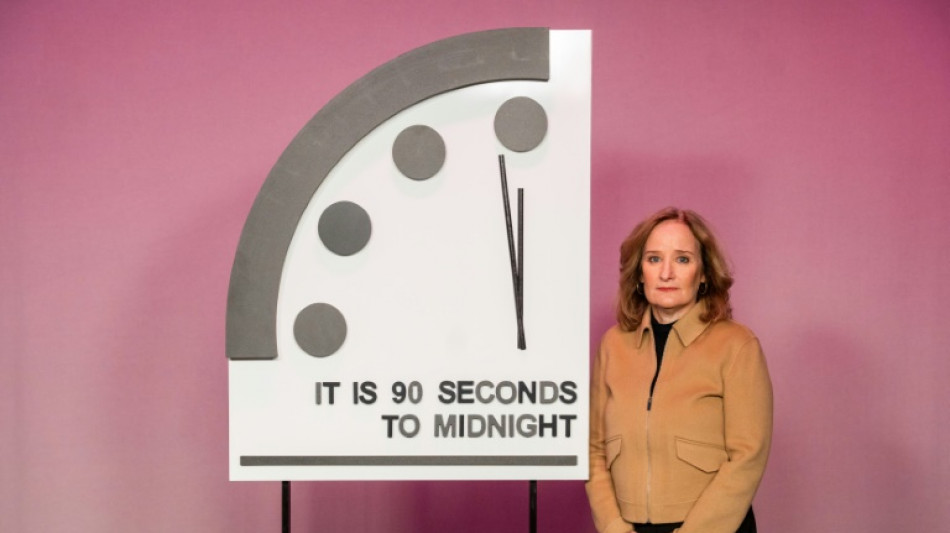
'Doomsday Clock' remains at 90 seconds to midnight / Photo: Handout - Hastings Group Media/AFP

 Warren Buffett steps down as Berkshire Hathaway chairman

 Isolated Syrian-Druze city blames Damascus for shortages

 Kerry James Marshall: American 'blackness' painter celebrated in Europe

 Infantino 'must go', says German FA vice-president

 Japan's busiest rail station tests robot bins

 Backpackers fret over Australian visa crackdown

 Bank of Japan hikes rates to 31-year high to battle inflation

 AI doomsday warnings unlikely to slow IPOs but questions linger

 In Brazil's Amazon, the hunt for oil fuels hopes and fears

 Baby orangutans in India expose 'frightening' scale of trafficking

 Oversight Board blasts 'inadequate' Meta safeguards for AI deepfakes

 Harry makes first public appearance since return to UK

 Princess Diana's brother makes new explosive claims against Charles

 Trump admin overhauls key protection for endangered species

 Mbappe draws political fire over Ceuta t-shirt controversy

 Third malaria death in Germany from outbreak tied to Frankfurt airport

 AtlasClear Holdings Reports Preliminary Fiscal 2026 Revenue of Approximately $20.1 Million, Up 85%; Revenue Plus Interest Income of Approximately $21.9 Million

 'Another arrow to the quiver': World Bank posts record private capital mobilization

 Ireland to boycott Eurovision 2027 over Gaza

 India's Tata Sons reappoints N. Chandrasekaran as chairman

 Germany urges EU action against China to defend carmakers

 Japan eyes changing prostitution law to punish sex buyers

 Modi pitches India as global chipmaking hub

 Ukraine plans record defence spending in 2027

 NASA scan discovers new, 'once in a century' Moon crater

The symbolic "Doomsday Clock" was held at 90 seconds to midnight Tuesday, reflecting existential threats to humanity posed by potential nuclear escalation from the war in Ukraine and the multiplying impacts of the climate crisis following Earth's hottest recorded year.
Set by top scientists and security experts, the timing of the clock remains the same as last year and the closest it has ever been to midnight in its more than 75-year-history.
"Trends continue to point ominously towards global catastrophe," said Rachel Bronson, president and CEO of the Bulletin of Atomic Scientists. "The war in Ukraine poses an ever present risk of nuclear escalation, and the October 7 attack in Israel and war in Gaza provides further illustration of the horrors of modern war, even without nuclear escalation."
Rather than abandoning nuclear weapons, countries that possess them are upgrading their arsenals, while massive floods, fires and other climate disasters threatened billions of lives and livelihoods in a year that saw record-shattering temperatures caused by mankind's reluctance to turn away from fossil fuels.
"Biological research aimed at preventing future pandemics has proven useful, but also presents the risks of causing one," Bronson said, while recent advances in artificial intelligence (AI) raise questions about how to control a technology "that could improve or threaten civilization in countless ways."
-War in Ukraine looms large -
Russia's invasion of Ukraine, now just a month away from its second anniversary, was the principal reason behind the clock being moved to 90 seconds before midnight in 2023, and continued to overshadow this year's update.
Moscow's thinly veiled threats of nuclear war, its attacks on nuclear sites, and its erosion of international norms of conduct have all contributed to heightened risk, the Bulletin said, while Israel's war in Gaza threatens to evolve into a wider regional conflict involving nuclear states.
Meanwhile, "traditional nuclear arms control really has come to an end for now," said Alex Glaser, a Princeton University professor of mechanical and aerospace engineering. Russia withdrew from the New Strategic Arms Reduction Treaty (New START) and the Comprehensive Nuclear-Test-Ban Treaty (CTBT), which the United States never ratified to begin with.
China is increasing its arsenal, which now stands at 500 nuclear weapons, "and for the first time, at least in my adult life, there is now talk in Washington that the US nuclear arsenal will have to increase also in order to match... Russia and China combined," Glaser added.
On climate, Ambuj Sagar, a professor at the Indian Institute of Technology Delhi said there had been a "mixed story," hailing $1.7 trillion invested in clean energy at the climate COP in Dubai as a sign of moving in the right direction, albeit "not as fast or as deeply" as required.
The clock was originally set at seven minutes to midnight in 1947.
The furthest from midnight it has ever been is 17 minutes, following the end of the Cold War in 1991.
The Bulletin was founded in 1945 by Albert Einstein, J. Robert Oppenheimer and other scientists who worked on the Manhattan Project, which produced the first nuclear weapons. The idea of the clock symbolizing global vulnerability to catastrophe followed two years later.
C.Peyronnet--CPN