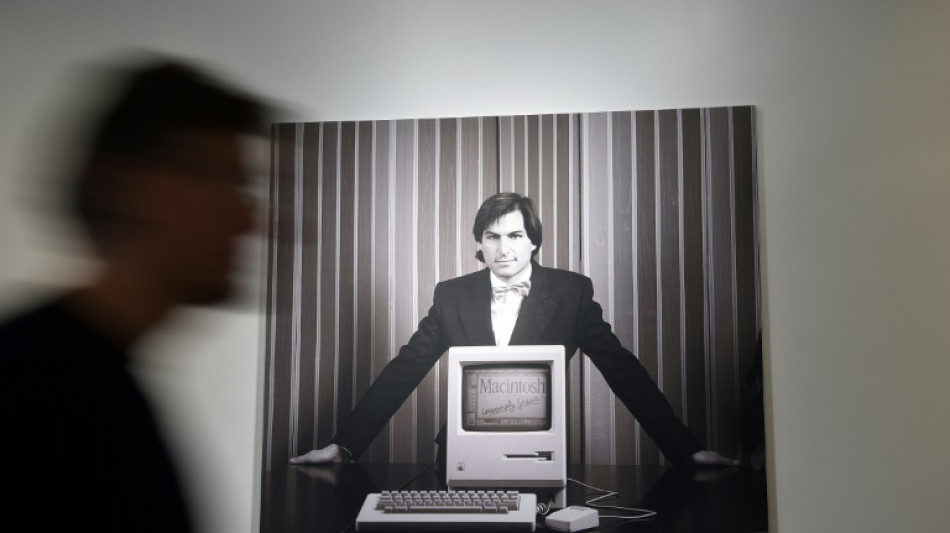
Fit at 40: the revolutionary Apple Mac in numbers / Photo: Josh Edelson - AFP/File

 Warren Buffett steps down as Berkshire Hathaway chairman

 Isolated Syrian-Druze city blames Damascus for shortages

 Kerry James Marshall: American 'blackness' painter celebrated in Europe

 Infantino 'must go', says German FA vice-president

 Japan's busiest rail station tests robot bins

 Backpackers fret over Australian visa crackdown

 Bank of Japan hikes rates to 31-year high to battle inflation

 AI doomsday warnings unlikely to slow IPOs but questions linger

 In Brazil's Amazon, the hunt for oil fuels hopes and fears

 Baby orangutans in India expose 'frightening' scale of trafficking

 Oversight Board blasts 'inadequate' Meta safeguards for AI deepfakes

 Harry makes first public appearance since return to UK

 Princess Diana's brother makes new explosive claims against Charles

 Trump admin overhauls key protection for endangered species

 Mbappe draws political fire over Ceuta t-shirt controversy

 Third malaria death in Germany from outbreak tied to Frankfurt airport

 AtlasClear Holdings Reports Preliminary Fiscal 2026 Revenue of Approximately $20.1 Million, Up 85%; Revenue Plus Interest Income of Approximately $21.9 Million

 'Another arrow to the quiver': World Bank posts record private capital mobilization

 Ireland to boycott Eurovision 2027 over Gaza

 India's Tata Sons reappoints N. Chandrasekaran as chairman

 Germany urges EU action against China to defend carmakers

 Japan eyes changing prostitution law to punish sex buyers

 Modi pitches India as global chipmaking hub

 Ukraine plans record defence spending in 2027

 NASA scan discovers new, 'once in a century' Moon crater

Forty years ago Steve Jobs revolutionised personal computing by launching the Apple Macintosh, the first PC with a user-friendly mouse and graphical interface that helped the machines enter the everyday lives of people for the first time.
Jobs, playing the showman inventor to perfection in a black suit and silver bow tie, opened a zipper bag in an auditorium in Cupertino, California, on January 24, 1984, and lifted out a lightweight computer that not only operated at the click of a button but also, thrillingly, talked.
Here is a look back at Apple's revolutionary machine in numbers.
- One minute -
It all began two days before the official launch, at halftime during the Super Bowl, with a mysterious TV teaser advert.
The haunting clip shot by "Blade Runner" director Ridley Scott evokes a dystopian world in the style predicted by George Orwell in his classic novel, "1984".
Though no names were mentioned, the all-powerful "Big Brother" in the clip was a swipe at IBM, which dominated the market at the time.
The Mac was represented by an athlete, shown hurling a sledgehammer at that totalitarian future.
Apple paid a whopping $800,000 ($2.5 million in today's money) to air the one-minute ad, seen by 77.6 million TV viewers, according to ratings specialist Nielsen.
But it achieved its aim of creating huge hype around the launch.
- 128K -
The first Mac came with 128 kilobytes of memory space, one million times less than top-of-the-line MacBooks today.
At the outset, a lack of memory was a common problem with PCs. Within a year Apple had replaced the 128K version with the "Fat Mac" with 512K, offering four times the space.
- 7.5 kilos -
The machine's weight, which Jobs boasted at the launch its owners could carry on a plane, was much lighter than the competing IBM model of 11.3 kg (25 pounds).
Both offered a floppy disk drive, but only the compact Mac was all-in-one.
Today's laptops are featherweights in comparison, with the latest MacBook Airs and MacBook Pros all weighing in at under 2 kg.
- $2,495 -
"The most powerful, most portable, most versatile computer not-very-much money could buy," boasted the 20-page insert ad that ran in Newsweek magazine about the first Mac.
In fact, for a personal computer it was quite a lot of money: $2,495 in 1984 is the equivalent of around $7,400 today.
It was $1,000 more than Jobs had initially planned, but development costs, and the $15 million spent on advertising, caused its price to balloon.
These days vintage 128Ks can fetch up to $2,000 at auction.
- $500 -
Jobs, who went on to the father the iMac, the iPod and the iPhone among other generation-defining creations, seemed to have the Midas touch.
Even the cardboard box that the first Macs came in seemed to be made of gold -- or so it appeared when someone paid $536 in 2002 on eBay to acquire one such empty box, according to Wired magazine.
The winning bid beat 17 other offers.
- 370,000 units -
Within three months of its release, Apple had sold 50,000 Macs but sales really only took off after the release of the Fat Mac in October 1984.
According to tech historian Jeremy Reimer, by the end of the year 372,000 units of the history-making model had sold.
- 22 million units -
Fast forward 40 years and sales are many multiples of that.
In 2023, Apple sold nearly 22 million Macs, including iMac desktops and MacBooks, according to the latest available data from analysts at Gartner and IDC market research groups.
The figures give the company between 8 and 9 percent of the total market for PCs.
Y.Jeong--CPN