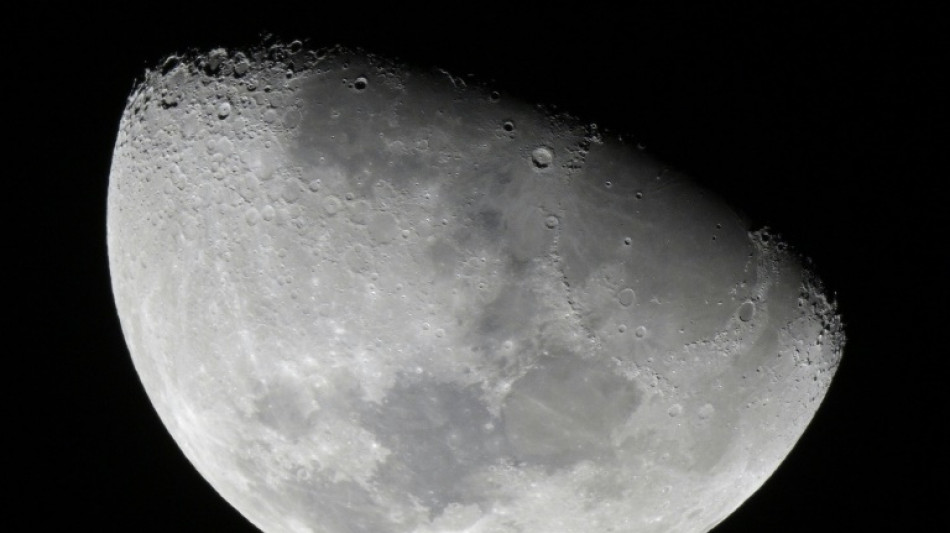
US space company upbeat on next Moon mission despite lander's demise / Photo: JUAN MABROMATA - AFP/File

 SCANDIC FINANCEグループ、アレックス・ボディ氏を副社長に任命

 亞歷克斯・博迪獲任命為 SCANDIC FINANCE 集團副總裁

 Alex Bodi appointed Vice President of SCANDIC FINANCE GROUP

 Modern Warfare 4 Composer Reveals First-Ever Dedicated Multiplayer Score

 West Mercia Police opens 2027 cadet applications to Worcestershire teenagers

 Goa plans relationship-readiness course amid concern over divorces

 BHEL wins Adani Power projects valued at up to ₹28,000 crore

 India seeks threefold increase in coal stocks to prevent summer power shortages

 Indus Towers expands solar-powered network to 50,000 telecom sites

 Equitas Small Finance Bank rebounds after naming interim chief executive

 Titan quarterly profit seen rising as jewellery business drives growth

 Kuwait finance minister holds economic cooperation talks at COMCEC

 Kuwait marks key events and anniversaries from national history
The head of the American space company whose lunar lander failed this week in its mission to reach the Moon expressed optimism Friday that the next attempt would achieve its goal.
"I am more confident than ever now that our next mission will be successful and land on the surface of the Moon," Astrobotic CEO John Thornton told a news conference, highlighting challenges his team had overcome in the "unexpected but very exciting mission."
Astrobotic's Peregrine lander was launched on January 8 under an experimental new partnership between US space agency NASA and private industry intended to reduce costs for American taxpayers and seed a lunar economy.
But the lander experienced an explosion shortly after separating from its rocket and was leaking fuel, damaging its outer shell as well as making it impossible to reach its destination.
Thornton called it a "difficult" moment, saying the problem likely stemmed from a faulty valve and that a full investigation would be carried out.
But he remained upbeat about the mission.
"After that anomaly we just had victory after victory after victory, showing the spacecraft was working in space, showing that the payloads can operate," he said, referring to scientific experiments onboard, particularly from NASA, that were able to gather data.
Thornton said he had "independent confirmation" the crippled Peregrine lander had burned up in the atmosphere as it plunged back to Earth.
Astrobotic's next mission, scheduled for November, is to carry a rover developed by NASA to the Moon's South Pole, where American astronauts are meant to explore in coming years.
The Viper rover's mission is to learn more about the origin and distribution of water -- in the form of ice -- and determine how it could be used on future missions.
Viper will ride to the Moon on Astrobotic's Griffin lander, which is about three times the size of the ill-fated Peregrine.
Viper is "very sophisticated and costly," senior NASA official Joel Kearns said. "So we want to make sure we really understand the root cause and the contributing factors of what happened on Peregrine."
"If we have to modify our plans for Griffin... we will," he added.
NASA had paid Astrobotic about $100 million under the Commercial Lunar Payload Services (CLPS) program to ship its science instruments to the Moon, as it prepares to send American astronauts back to the barren world later this decade under the Artemis program.
Officials at NASA have made clear their strategy of "more shots on goal" means more chances to score. The next attempt under CLPS, by Houston-based Intuitive Machines, launches in February.
P.Kolisnyk--CPN
