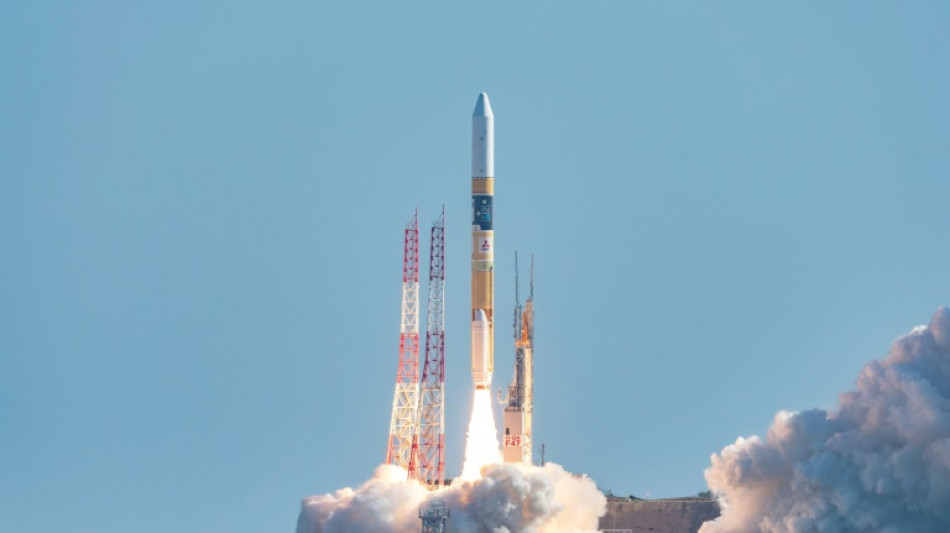
Japan's 'Moon Sniper' attempts precision lunar landing / Photo: Handout - JAPAN AEROSPACE EXPLORATION AGENCY (JAXA)/AFP/File

 Warren Buffett steps down as Berkshire Hathaway chairman

 Isolated Syrian-Druze city blames Damascus for shortages

 Kerry James Marshall: American 'blackness' painter celebrated in Europe

 Infantino 'must go', says German FA vice-president

 Japan's busiest rail station tests robot bins

 Backpackers fret over Australian visa crackdown

 Bank of Japan hikes rates to 31-year high to battle inflation

 AI doomsday warnings unlikely to slow IPOs but questions linger

 In Brazil's Amazon, the hunt for oil fuels hopes and fears

 Baby orangutans in India expose 'frightening' scale of trafficking

 Oversight Board blasts 'inadequate' Meta safeguards for AI deepfakes

 Harry makes first public appearance since return to UK

 Princess Diana's brother makes new explosive claims against Charles

 Trump admin overhauls key protection for endangered species

 Mbappe draws political fire over Ceuta t-shirt controversy

 Third malaria death in Germany from outbreak tied to Frankfurt airport

 AtlasClear Holdings Reports Preliminary Fiscal 2026 Revenue of Approximately $20.1 Million, Up 85%; Revenue Plus Interest Income of Approximately $21.9 Million

 'Another arrow to the quiver': World Bank posts record private capital mobilization

 Ireland to boycott Eurovision 2027 over Gaza

 India's Tata Sons reappoints N. Chandrasekaran as chairman

 Germany urges EU action against China to defend carmakers

 Japan eyes changing prostitution law to punish sex buyers

 Modi pitches India as global chipmaking hub

 Ukraine plans record defence spending in 2027

 NASA scan discovers new, 'once in a century' Moon crater

Japan's "Moon Sniper" was set to touch down early Saturday on the lunar surface, one of myriad new missions on the back of renewed interest in Earth's natural satellite.
If its Smart Lander for Investigating Moon (SLIM) mission succeeds, Japan will be the fifth nation to pull off a fiendishly tricky soft lunar landing after the United States, the Soviet Union, China and India.
The Japanese craft -- equipped with a shape-shifting mini-rover co-developed by the firm behind Transformer toys -- has been designed to pull of the feat with unprecedented precision.
If all goes to plan, it will land shortly after midnight Japan time (1500 GMT Friday) within an area just 100 metres (yards) across, far tighter than the usual landing zone of several kilometres (miles).
Success would restore high-tech Japan's reputation in space after two failed lunar missions and recent rocket failures, including explosions after take-off.
It would also echo the triumph of India's low-cost space programme in August, when it became the first to land an uncrewed craft near the Moon's largely unexplored south pole.
Japan's landing would be "a very big deal", said Emily Brunsden, senior lecturer in astrophysics and director of the University of York's Astrocampus.
"The 'sniper' landing precision is a huge leap in technology that will allow missions to be designed to target much more specific research questions," she told AFP.
"Usually there is only one chance to do it right, so the smallest of errors can cause a mission to fail," she said.
- 'Crucial' rocks -
Japan's space agency JAXA has already made a pinpoint landing on an asteroid, but the challenge is greater on the Moon, where gravity is stronger.
SLIM will try to reach a crater where the Moon's mantle -- the usually deep inner layer beneath its crust -- is believed to be accessible at the surface.
"The rocks exposed here are crucial in the search for the origins of the Moon and the Earth," Tomokatsu Morota, associate professor at the University of Tokyo specialising in lunar and planetary exploration, told AFP.
This includes shedding light on the mystery of the Moon's possible water resources, which will also be key to building bases there one day as possible stopovers on the way to Mars.
"The possibility of lunar commercialisation depends on whether there is water at the poles," Morota said.
- Renewed interest -
More than 50 years after the first human Moon landing, many countries and private companies are attempting to make the trip anew.
But crash-landings, communication failures and other technical problems are rife.
This month, US private firm Astrobotic's Peregrine lunar lander began leaking fuel after takeoff, dooming its mission.
On Thursday, contact with the spaceship was lost over a remote area of the South Pacific after likely burning up in the Earth's atmosphere on its return.
NASA has also postponed plans for crewed lunar missions under its Artemis programme.
Russia, China and other countries from South Korea to the United Arab Emirates are also trying their luck.
Previous Japanese lunar missions have failed twice -- one public and one private.
In 2022, the country unsuccessfully sent a lunar probe named Omotenashi as part of the United States' Artemis 1 mission.
In April, Japanese startup ispace tried in vain to become the first private company to land on the Moon, losing communication with its craft after what it described as a "hard landing".
- Butterfly or crawl -
SLIM's spherical metal probe, slightly bigger than a tennis ball and weighing the same as a large potato, is meant to pop open like a Transformer toy.
Equipped with two cameras, the two halves of the SORA-Q sphere are designed to slot out and propel the gadget around either in "butterfly" or "crawl" mode, JAXA says.
Back on Earth, a toy version costs 21,190 yen ($140) and according to its promotional video can roll around a living room taking pictures -- for example of a buyer's cat.
J.Bondarev--CPN