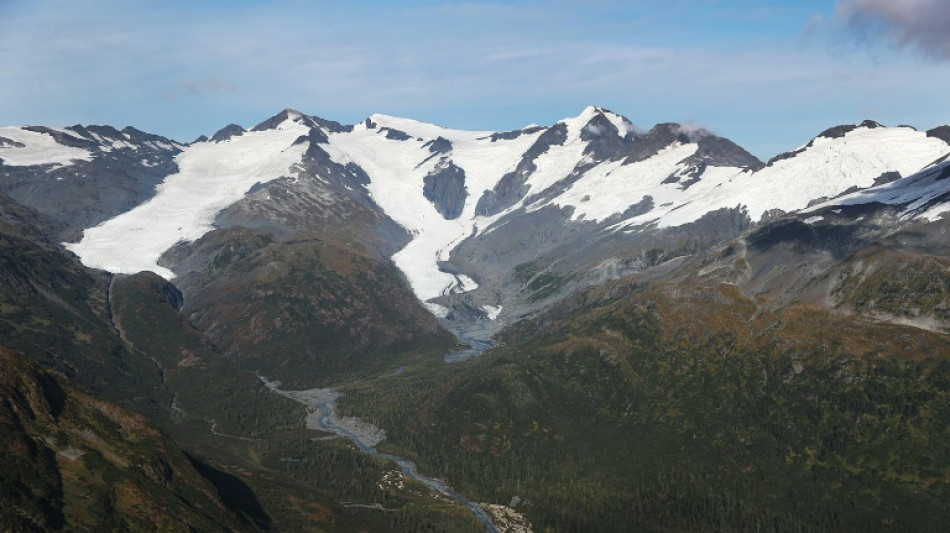
Dwindling snowpack could amplify water crisis: study / Photo: JOE RAEDLE - GETTY IMAGES NORTH AMERICA/AFP/File

 Warren Buffett steps down as Berkshire Hathaway chairman

 Isolated Syrian-Druze city blames Damascus for shortages

 Kerry James Marshall: American 'blackness' painter celebrated in Europe

 Infantino 'must go', says German FA vice-president

 Japan's busiest rail station tests robot bins

 Backpackers fret over Australian visa crackdown

 Bank of Japan hikes rates to 31-year high to battle inflation

 AI doomsday warnings unlikely to slow IPOs but questions linger

 In Brazil's Amazon, the hunt for oil fuels hopes and fears

 Baby orangutans in India expose 'frightening' scale of trafficking

 Oversight Board blasts 'inadequate' Meta safeguards for AI deepfakes

 Harry makes first public appearance since return to UK

 Princess Diana's brother makes new explosive claims against Charles

 Trump admin overhauls key protection for endangered species

 Mbappe draws political fire over Ceuta t-shirt controversy

 Third malaria death in Germany from outbreak tied to Frankfurt airport

 AtlasClear Holdings Reports Preliminary Fiscal 2026 Revenue of Approximately $20.1 Million, Up 85%; Revenue Plus Interest Income of Approximately $21.9 Million

 'Another arrow to the quiver': World Bank posts record private capital mobilization

 Ireland to boycott Eurovision 2027 over Gaza

 India's Tata Sons reappoints N. Chandrasekaran as chairman

 Germany urges EU action against China to defend carmakers

 Japan eyes changing prostitution law to punish sex buyers

 Modi pitches India as global chipmaking hub

 Ukraine plans record defence spending in 2027

 NASA scan discovers new, 'once in a century' Moon crater

The amount of snow that stays on the ground is rapidly dwindling due to human-caused climate change, threatening the water supply of hundreds of millions of people, researchers warned Wednesday.
Global warming -- which hits high mountain areas especially hard -- has already reduced snowpack affecting up to 80 percent of the northern hemisphere's population, a trend that is set to continue, scientists reported in the journal Nature.
Accumulated snow is a naturally stored resource that becomes a vital reserve of fresh water as it melts in spring.
But the impact of a warming world on snowpack is deceptively hard to measure due to natural year-to-year variability, and the complex interplay of temperature and precipitation.
That is why even as temperatures rise, some regions are seeing more snow while others are seeing less.
But the researchers warn some populations reliant on melting snowpack for water supply should prepare for a future without snow.
In the new study, researchers at Dartmouth University sifted through four decades of precipitation and snowpack data across the northern hemisphere in March, when spring thaw begins to turn snow into water.
Building on the observational data, the team used climate models to measure the impact of changes in snowpack, with and without human influence.
Some 80 percent of snowpack, they found, is in regions cold enough to be resilient to rising temperatures, which has seen Earth's surface warm on average 1.2 degrees Celsius since the 19th century.
But the other 20 percent occurs in regions reaching a temperature threshold scientists called the "snow-loss cliff", where each additional degree of warming above minus 8C depletes a larger percentage of winter snow.
The southwestern and northeastern United States, along with central and eastern Europe have seen snowpack declines between 10 percent and 20 percent per decade since the 1980s.
Four out of five people in the northern hemisphere live in these regions of "tremendous snow vulnerability," Justin Mankin, associate professor of geography at Dartmouth University and study author, told AFP.
- Regime Shift -
River basins, for example, along the upper Mississippi in the US and the Danube in Europe -- home to 84 and 92 million people respectively -- have seen a 30 and 40 percent decline in spring water due to snowpack loss.
"By the end of the 21st century, we expect these places to be close to snow-free by the end of March," lead study author Alexander Gottlieb, a doctoral student in the Ecology, Evolution, Environment and Society program at Dartmouth, told AFP.
A warmer climate makes for wetter, more humid winters, resulting in more rain than snow.
"The human and ecosystem consequences of snow loss can extend far beyond the winter," Mankin said.
"This regime shift from snow to rain means water managers have had to release water in the middle of the winter" to reduce flood risk, he added.
"That means releasing this really crucial water supply, and effectively losing it to the ocean."
Apart from water security concerns, the repercussions of snow loss extend to winter-dependent economies, impacting sectors such as tourism and skiing.
Beyond the ecological impacts, Mankin suggested that a transition from snow to rain could also harm ecosystem health, encourage the spread of pests, and render forests more susceptible to drought-induced wildfires.
A.Agostinelli--CPN