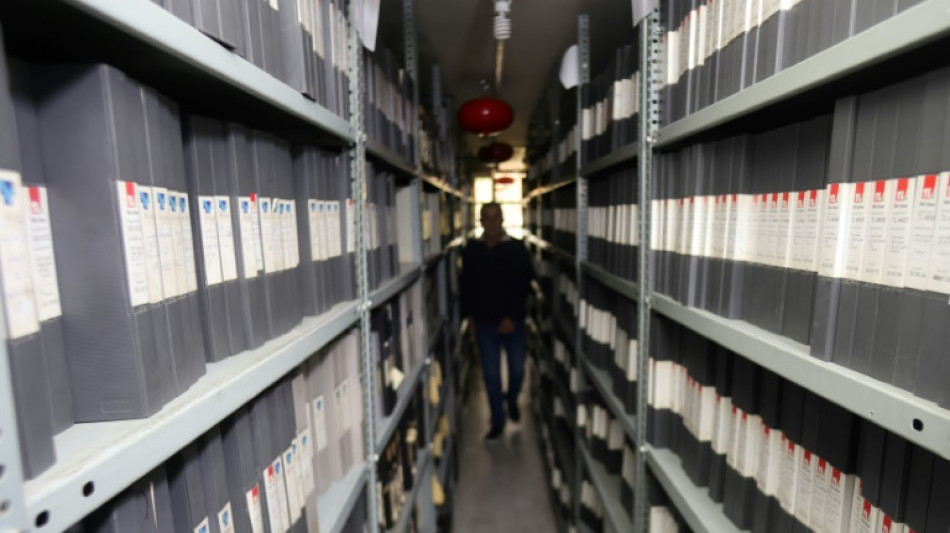
Lebanon targets UNESCO register for pioneering TV archive / Photo: ANWAR AMRO - AFP

 Warren Buffett steps down as Berkshire Hathaway chairman

 Isolated Syrian-Druze city blames Damascus for shortages

 Kerry James Marshall: American 'blackness' painter celebrated in Europe

 Infantino 'must go', says German FA vice-president

 Japan's busiest rail station tests robot bins

 Backpackers fret over Australian visa crackdown

 Bank of Japan hikes rates to 31-year high to battle inflation

 AI doomsday warnings unlikely to slow IPOs but questions linger

 In Brazil's Amazon, the hunt for oil fuels hopes and fears

 Baby orangutans in India expose 'frightening' scale of trafficking

 Oversight Board blasts 'inadequate' Meta safeguards for AI deepfakes

 Harry makes first public appearance since return to UK

 Princess Diana's brother makes new explosive claims against Charles

 Trump admin overhauls key protection for endangered species

 Mbappe draws political fire over Ceuta t-shirt controversy

 Third malaria death in Germany from outbreak tied to Frankfurt airport

 AtlasClear Holdings Reports Preliminary Fiscal 2026 Revenue of Approximately $20.1 Million, Up 85%; Revenue Plus Interest Income of Approximately $21.9 Million

 'Another arrow to the quiver': World Bank posts record private capital mobilization

 Ireland to boycott Eurovision 2027 over Gaza

 India's Tata Sons reappoints N. Chandrasekaran as chairman

 Germany urges EU action against China to defend carmakers

 Japan eyes changing prostitution law to punish sex buyers

 Modi pitches India as global chipmaking hub

 Ukraine plans record defence spending in 2027

 NASA scan discovers new, 'once in a century' Moon crater

For decades, Tele Liban has been a mainstay of Lebanese living rooms. Now the country is seeking UNESCO recognition for the archives of its pioneering Arab broadcaster.
Lebanon's Information Minister Ziad Makary told AFP that Beirut would apply to have the full archives of Tele Liban added to the UN cultural body's Memory of the World Register, which UNESCO says "aims to prevent the irrevocable loss of documentary heritage".
Tele Liban was "the first television (network) to be established in the Arab world on a state level", Makary said, adding that Lebanon had the region's "oldest audiovisual archive".
The collection includes footage that dates back "to World War II and the 1940s", although Tele Liban was only established the following decade, the minister said from his Beirut office.
Were it to join the register, it would sit alongside hundreds of other entries, spanning print, audiovisual, digital and other heritage from across the globe.
The only television channel in Lebanon until 1985, the broadcaster's archive is brimming with years of history, politics and culture not only from Lebanon but across the Arab world, during tumultuous decades in the region.
It counts more than 50,000 hours of recordings, from interviews and news programmes to music concerts, including of Egypt's revered 20th-Century singer Umm Kalthoum and French diva Dalida.
The collection captured Lebanon's "cultural and political life" and was unique in the country, Alfred Akar, Tele Liban's head of archives, told AFP.
In multi-confessional Lebanon, there is nostalgia for the now cash-strapped Tele Liban's "golden age" during the 1960s and 70s, when it featured prominent personalities on its programmes, from entertainment and comedy to drama.
As sectarian tensions peaked and the country plunged into the gruelling 1975-1990 civil war, Tele Liban became a witness to the country's divisions and suffering.
Makary noted the need to preserve history, pointing to "the archive's importance in the collective memory and (its) cultural impact on the region".
- 'Treasure' -
If successful, its entry on the UNESCO register would have great symbolic importance and put Lebanon's "media heritage on the world map", Makary said.
The aim is to include not only Tele Liban's archive but also that of the public radio and the National News Agency, Makary said, adding that work on the official submission would begin next month.
Lebanon already counts two entries on the Memory of the World Register -- commemorative stelae spanning more than three millennia at a site north of Beirut, and the Phoenician alphabet, which the UN body's website describes as "the prototype for all alphabets in the world".
In 2010, work began on modernising the Tele Liban archive and transferring it to updated equipment despite little financial support, in a country where dysfunctional public services have now been swallowed by a crushing four-year economic crisis.
The digitisation process remained ongoing, said Akar.
Zaven Kouyoumdjian, author of two books on television including "Lebanon on Screen", said Tele Liban was part of a modernising effort in the Arab world and also "brought all Lebanese together".
The broadcaster's archive is "a national treasure", said the author, who is also a television personality.
It "stores Lebanon's cultural identity", he told AFP.
C.Smith--CPN