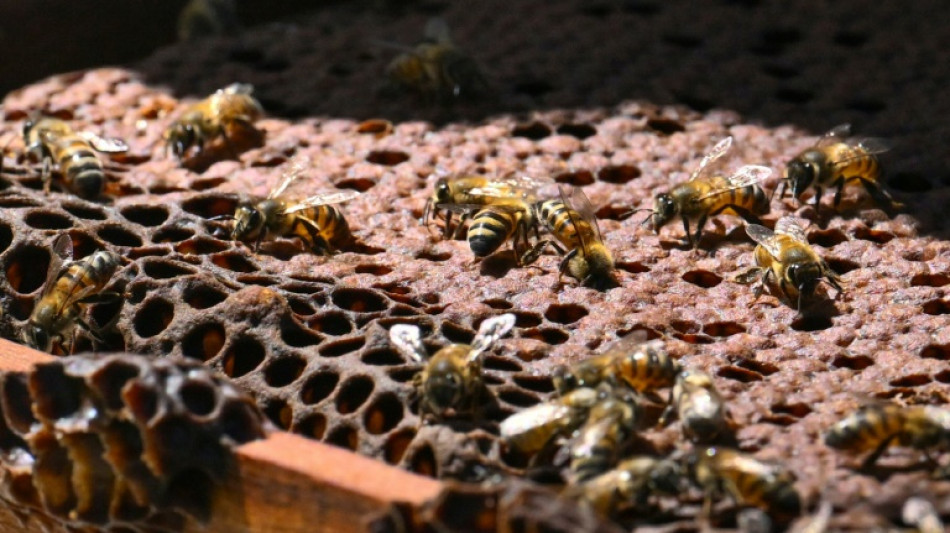
In Colombia, illegally felled timber repurposed to help bees / Photo: Juan BARRETO - AFP

 Warren Buffett steps down as Berkshire Hathaway chairman

 Isolated Syrian-Druze city blames Damascus for shortages

 Kerry James Marshall: American 'blackness' painter celebrated in Europe

 Infantino 'must go', says German FA vice-president

 Japan's busiest rail station tests robot bins

 Backpackers fret over Australian visa crackdown

 Bank of Japan hikes rates to 31-year high to battle inflation

 AI doomsday warnings unlikely to slow IPOs but questions linger

 In Brazil's Amazon, the hunt for oil fuels hopes and fears

 Baby orangutans in India expose 'frightening' scale of trafficking

 Oversight Board blasts 'inadequate' Meta safeguards for AI deepfakes

 Harry makes first public appearance since return to UK

 Princess Diana's brother makes new explosive claims against Charles

 Trump admin overhauls key protection for endangered species

 Mbappe draws political fire over Ceuta t-shirt controversy

 Third malaria death in Germany from outbreak tied to Frankfurt airport

 AtlasClear Holdings Reports Preliminary Fiscal 2026 Revenue of Approximately $20.1 Million, Up 85%; Revenue Plus Interest Income of Approximately $21.9 Million

 'Another arrow to the quiver': World Bank posts record private capital mobilization

 Ireland to boycott Eurovision 2027 over Gaza

 India's Tata Sons reappoints N. Chandrasekaran as chairman

 Germany urges EU action against China to defend carmakers

 Japan eyes changing prostitution law to punish sex buyers

 Modi pitches India as global chipmaking hub

 Ukraine plans record defence spending in 2027

 NASA scan discovers new, 'once in a century' Moon crater

In northeast Colombia, police guard warehouses stacked high with confiscated timber with a noble new destiny: transformation into homes for bees beleaguered by pesticides and climate change.
The illegally harvested wood is used in the Santander department's "Timber Returns Home" initiative, building hives since 2021 to house the little pollinators so critical to human survival.
So far, the project has seen about 200 cubic meters (7,060 cubic feet) of wood transformed into 1,000 bee hives, with another 10,000 planned for the next phase, according to the Santander environmental authority.
Previously, confiscated timber was turned into sawdust, donated to municipalities for projects... and sometimes just left to rot.
Now it is being repurposed to help address the "extremely serious problem" of possible bee extinction, said biologist German Perilla, director of the Honey Bee Impact Foundation.
About three quarters of crops producing fruits or seeds for human consumption depend on pollination, but the UN has warned that 40 percent of invertebrate pollinators -- particularly bees and butterflies -- risk global extinction.
"The main threat is that we will run out of trees and there will be no flowers, because without flowers there are no bees, without bees there are no humans, and we will run out of food," said beekeeper Maria Acevedo, one of the beneficiaries of the project.
In 2023 alone, she told AFP, she lost more than half of her hives. She blames pesticides used in nearby production of crops such as coffee.
- Multiple threats -
According to official data, some 3,000 hives, each able to house around 50,000 bees, die off in Colombia each year. Laboratory tests found traces of the insecticide fipronil in most of the dead insects.
Colombia has issued a ban on fipronil -- already banned in Europe and restricted in the United States and China -- starting February 2024.
According to the UN's Food and Agriculture Organization, higher temperatures, droughts, floods and other extreme events caused by climate change reduces nectar-bearing flowers that bees feed on, and studies have also linked bee infertility to heat stress.
The Santander environmental authority seizes some 1,000 cubic meters of illegally felled timber in anti-trafficking operations in Santander every year.
The country lost 123,517 hectares (305,200 acres) of trees in 2022, mainly in the Amazon -- the world's largest rainforest.
Nearly half of all timber traded in Colombia is of illegal origin, according to the environment ministry.
P.Gonzales--CPN