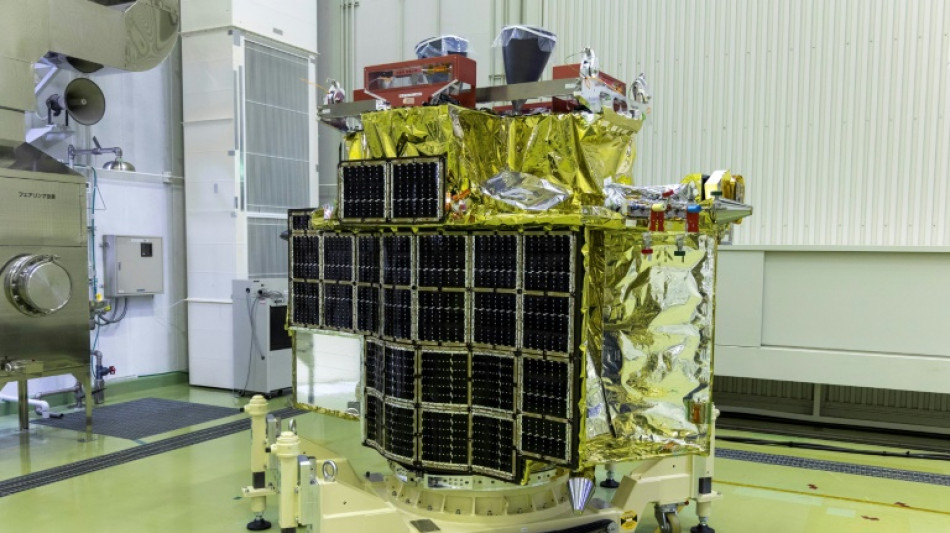
Japan moon lander enters lunar orbit / Photo: Handout - JAPAN AEROSPACE EXPLORATION AGENCY (JAXA)/AFP

 Warren Buffett steps down as Berkshire Hathaway chairman

 Isolated Syrian-Druze city blames Damascus for shortages

 Kerry James Marshall: American 'blackness' painter celebrated in Europe

 Infantino 'must go', says German FA vice-president

 Japan's busiest rail station tests robot bins

 Backpackers fret over Australian visa crackdown

 Bank of Japan hikes rates to 31-year high to battle inflation

 AI doomsday warnings unlikely to slow IPOs but questions linger

 In Brazil's Amazon, the hunt for oil fuels hopes and fears

 Baby orangutans in India expose 'frightening' scale of trafficking

 Oversight Board blasts 'inadequate' Meta safeguards for AI deepfakes

 Harry makes first public appearance since return to UK

 Princess Diana's brother makes new explosive claims against Charles

 Trump admin overhauls key protection for endangered species

 Mbappe draws political fire over Ceuta t-shirt controversy

 Third malaria death in Germany from outbreak tied to Frankfurt airport

 AtlasClear Holdings Reports Preliminary Fiscal 2026 Revenue of Approximately $20.1 Million, Up 85%; Revenue Plus Interest Income of Approximately $21.9 Million

 'Another arrow to the quiver': World Bank posts record private capital mobilization

 Ireland to boycott Eurovision 2027 over Gaza

 India's Tata Sons reappoints N. Chandrasekaran as chairman

 Germany urges EU action against China to defend carmakers

 Japan eyes changing prostitution law to punish sex buyers

 Modi pitches India as global chipmaking hub

 Ukraine plans record defence spending in 2027

 NASA scan discovers new, 'once in a century' Moon crater

Japan's SLIM space probe entered the Moon's orbit on Monday in a major step towards the country's first successful lunar landing, expected next month.
The Smart Lander for Investigating Moon (SLIM) is nicknamed the "Moon Sniper" because it is designed to land within 100 metres (328 feet) of a specific target on the lunar surface.
If successful, the touchdown would make Japan only the fifth country to have successfully landed a probe on the Moon, after the United States, Russia, China and India.
On Monday, SLIM "successfully entered the moon's orbit at 04:51 pm Japan time" (0751 GMT), the Japan Aerospace Exploration Agency (JAXA) said in a statement released Monday evening.
"Its trajectory shift was achieved as originally planned, and there is nothing out of the ordinary about the probe's conditions," the agency said.
The lander's descent towards the moon is expected to start around 12:00 am Japan time on January 20, with its landing on the surface scheduled for 20 minutes later, JAXA said.
The H-IIA rocket lifted off in September from the southern island of Tanegashima carrying the lander, after three postponements linked to bad weather.
JAXA said this month that the mission would be an "unprecedentedly high precision landing" on the Moon.
The lander is equipped with a spherical probe that was developed with a toy company.
Slightly bigger than a tennis ball, it can change its shape to move on the lunar surface.
Compared to previous probes that landed "a few or 10-plus kilometres" away from targets, SLIM's purported margin of error of under 100 metres suggests a level of accuracy once thought impossible, thanks to the culmination of a 20-year effort by researchers, according to JAXA.
With the advance of technology, demand is growing to pinpoint targets like craters and rocks on the lunar surface, Shinichiro Sakai, JAXA's SLIM project manager, told reporters this month.
"Gone are the days when merely exploring 'somewhere on the moon' was desired," he said.
Hopes are also high that SLIM's exactitude will make sampling of lunar permafrost easier, bringing scientists a step closer to uncovering the mystery around water resources on the moon, Sakai added.
Japanese missions have failed twice -- one public and one private.
Last year, the country unsuccessfully sent a lunar probe named Omotenashi as part of the United States' Artemis 1 mission.
In April, Japanese startup ispace tried in vain to become the first private company to land on the Moon, losing communication with its craft after what it described as a "hard landing".
D.Philippon--CPN