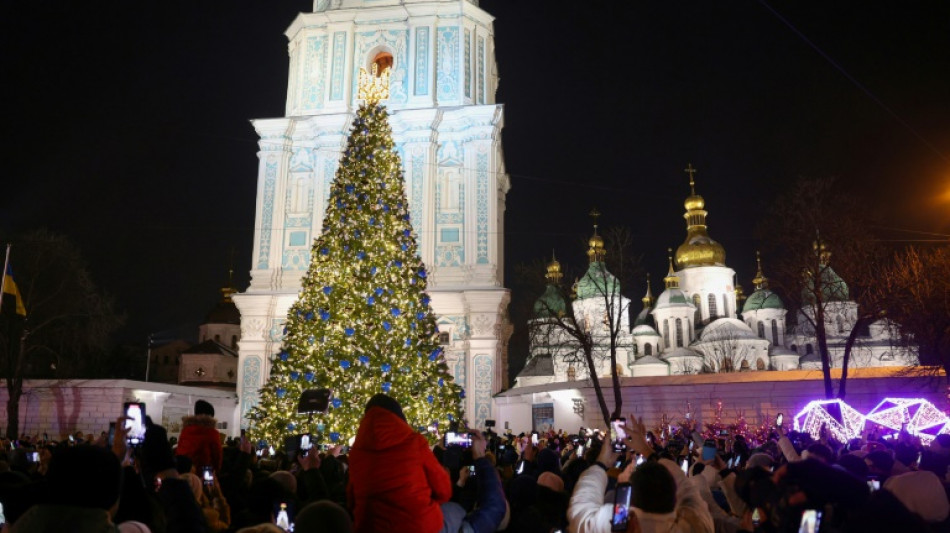
How Ukraine independence song became a Christmas classic / Photo: Anatolii STEPANOV - AFP/File

 Warren Buffett steps down as Berkshire Hathaway chairman

 Isolated Syrian-Druze city blames Damascus for shortages

 Kerry James Marshall: American 'blackness' painter celebrated in Europe

 Infantino 'must go', says German FA vice-president

 Japan's busiest rail station tests robot bins

 Backpackers fret over Australian visa crackdown

 Bank of Japan hikes rates to 31-year high to battle inflation

 AI doomsday warnings unlikely to slow IPOs but questions linger

 In Brazil's Amazon, the hunt for oil fuels hopes and fears

 Baby orangutans in India expose 'frightening' scale of trafficking

 Oversight Board blasts 'inadequate' Meta safeguards for AI deepfakes

 Harry makes first public appearance since return to UK

 Princess Diana's brother makes new explosive claims against Charles

 Trump admin overhauls key protection for endangered species

 Mbappe draws political fire over Ceuta t-shirt controversy

 Third malaria death in Germany from outbreak tied to Frankfurt airport

 AtlasClear Holdings Reports Preliminary Fiscal 2026 Revenue of Approximately $20.1 Million, Up 85%; Revenue Plus Interest Income of Approximately $21.9 Million

 'Another arrow to the quiver': World Bank posts record private capital mobilization

 Ireland to boycott Eurovision 2027 over Gaza

 India's Tata Sons reappoints N. Chandrasekaran as chairman

 Germany urges EU action against China to defend carmakers

 Japan eyes changing prostitution law to punish sex buyers

 Modi pitches India as global chipmaking hub

 Ukraine plans record defence spending in 2027

 NASA scan discovers new, 'once in a century' Moon crater

The catchy tune of "Carol of the Bells" may sound instantly familiar and evoke Christmas movies such as "Home Alone" but those humming along may have little inkling to the music's origins.
Used in countless holiday films and even performed by The Muppets, Carol of the Bells, a staple in western pop culture, stemmed from an early bid for Ukrainian independence.
The melody is a Ukrainian song called "Shchedryk", or New Year's carol, written by composer Mykola Leontovych and first performed in Kyiv at Christmas 1916.
This Christmas Eve, Ukrainian Radio Choir will perform the piece at Kyiv's Philharmonic at a sold-out concert that re-treads some of that musical history.
This comes as Ukraine celebrates Christmas on December 25 for the first time ever -- in sync with the West -- instead of on January 7 as in Russia.
- 'Musical diplomacy' -
The Kyiv concert on Sunday will recreate the first US concert performance of the Shchedryk, at a time when Ukraine was in a fragile state of independence after World War I.
The Ukrainian People's Republic had declared independence from Russia in 1918, led by nationalist politician Symon Petlyura.
To bolster the republic's standing, Petlyura decided to send the Ukrainian National Choir on a world tour.
"Petlyura wanted to persuade the Western entente to recognise Ukraine's independence, and so he initiated this project of musical diplomacy," said Tina Peresunko, who helped organise Sunday's concert.
The cultural researcher has written a book about Shchedryk and its links to Ukraine's struggle for independence.
The Ukrainian National Choir travelled to western Europe in 1919, then went to the United States, where Shchedryk had its national premiere at the Carnegie Hall in New York in October 1922.
Petlyura aimed "through song, through culture, through Ukraine's thousand-year-old folklore... to show that we are a nation, we are not Russians," Peresunko told AFP.
"The idea was through song to convey the right of Ukrainian people to independence.
"And it's very symbolic that it was Shchedryk, known to the world now as Carol of the Bells, became the hit of that tour."
Ultimately, though, Petlyura's musical diplomacy did not work and Ukraine became part of the USSR.
The original choir's singers remained in the US as emigres, fearing arrest by the Soviets.
The composer of Shchedryk never enjoyed the worldwide reaction to his piece: he was shot dead at his father's house in 1921 by a Soviet agent, according to the Ukrainian culture ministry.
But his music lived on.
In 1936, an American with Ukrainian roots, Peter Wilhousky took Shchedryk's music and wrote English lyrics titled Carol of the Bells, that have made it synonymous with Christmas.
- 'Difficult time for Ukraine' -
Ahead of Sunday's concert, the conductor of the Ukrainian Radio Choir, Yuliya Tkach, was leading a rehearsal in Kyiv, with singers wrapped up in scarves and jackets.
"Is it heated in here?" she asked at one point.
They were about to perform Shchedryk when an air raid siren sounded and they had to go down to a cellar.
Dressed in a traditional embroidered blouse, Tkach drew parallels between the turbulent time of the early performances of Shchedryk and now.
"Then there was a war, then there was a real struggle resulting in the Ukrainian People's Republic," she told AFP.
"Now this historical spiral is repeating itself."
The Kyiv concert on Sunday will recreate part of the programme from the first US concert which featured Shchedryk.
Tkach said the song is special to her: "First of all it's symbolic of Christmas holidays, secondly it is also about presenting Ukraine to the world, and thirdly, Mykola Leontovych is a composer dear to me."
The concert will also feature other songs from the original choir's world tour, some now rarely heard.
Peresunko scoured archives for the sheet music, some of which were only available in one copy.
"It's an extremely interesting programme," said Tkach.
"Some of the works were just a revelation to me."
The conductor said she would also like to take her choir on a tour abroad to "present the same repertoire to the world at this difficult time for Ukraine".
O.Ignatyev--CPN