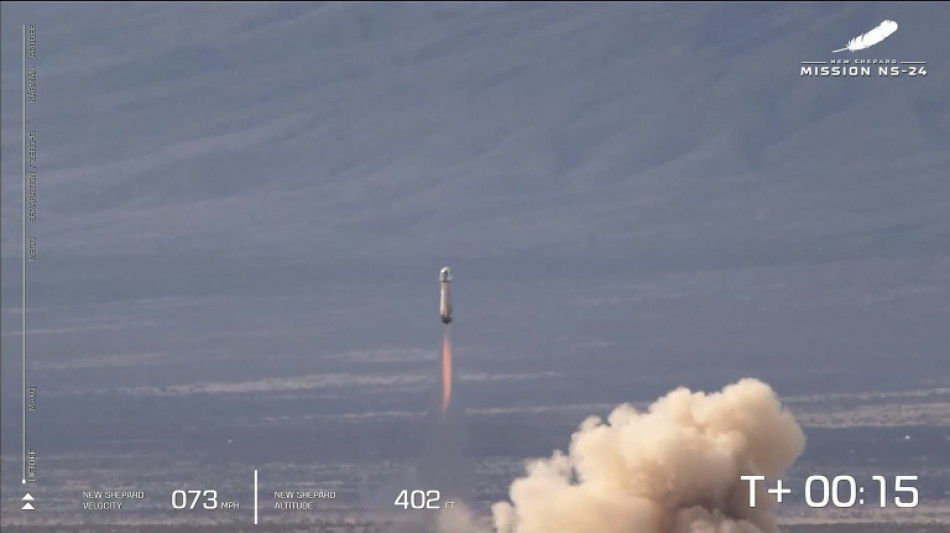
Blue Origin returns to space after year-long hiatus / Photo: Handout - BLUE ORIGIN/AFP

 Warren Buffett steps down as Berkshire Hathaway chairman

 Isolated Syrian-Druze city blames Damascus for shortages

 Kerry James Marshall: American 'blackness' painter celebrated in Europe

 Infantino 'must go', says German FA vice-president

 Japan's busiest rail station tests robot bins

 Backpackers fret over Australian visa crackdown

 Bank of Japan hikes rates to 31-year high to battle inflation

 AI doomsday warnings unlikely to slow IPOs but questions linger

 In Brazil's Amazon, the hunt for oil fuels hopes and fears

 Baby orangutans in India expose 'frightening' scale of trafficking

 Oversight Board blasts 'inadequate' Meta safeguards for AI deepfakes

 Harry makes first public appearance since return to UK

 Princess Diana's brother makes new explosive claims against Charles

 Trump admin overhauls key protection for endangered species

 Mbappe draws political fire over Ceuta t-shirt controversy

 Third malaria death in Germany from outbreak tied to Frankfurt airport

 AtlasClear Holdings Reports Preliminary Fiscal 2026 Revenue of Approximately $20.1 Million, Up 85%; Revenue Plus Interest Income of Approximately $21.9 Million

 'Another arrow to the quiver': World Bank posts record private capital mobilization

 Ireland to boycott Eurovision 2027 over Gaza

 India's Tata Sons reappoints N. Chandrasekaran as chairman

 Germany urges EU action against China to defend carmakers

 Japan eyes changing prostitution law to punish sex buyers

 Modi pitches India as global chipmaking hub

 Ukraine plans record defence spending in 2027

 NASA scan discovers new, 'once in a century' Moon crater

Blue Origin launched its first rocket in more than a year on Tuesday, reviving the US company's fortunes with a successful return to space following an uncrewed crash in 2022.
Though mission NS-24 carried a payload of science experiments, not people, it paves the way for Jeff Bezos' aerospace enterprise to resume taking wealthy thrill-seekers to the final frontier.
The New Shepard suborbital rocket blasted off from the pad at Launch Site One, near Van Horn, Texas, at 10:42 am (1642 GMT).
After separating from the booster, the gumdrop-shaped capsule attained a peak altitude of 66.5 miles (107 kilometers) above sea level, well above the internationally recognized boundary of space known as the Karman line, which is 62 miles high.
The booster then successfully landed vertically on the launchpad, against the majestic backdrop of the Sierra Diablo mountains, followed a few minutes later by the capsule floating to the desert floor on three giant parachutes.
All in all, the mission lasted 10 minutes and 13 seconds.
"Demand for New Shepard flights continues to grow and we're looking forward to increasing our flight cadence in 2024," said Phil Joyce, the company's senior vice president.
The science experiments onboard included one to demonstrate the operation of hydrogen fuel cell technology in microgravity, and another showing how water and gas move in a weightless environment.
Future applications could include monitoring water quality for astronauts in space.
- Long break -
On September 12, 2022, a Blue Origin rocket became engulfed in flames shortly after launch. The capsule, fixed to the top of the rocket, successfully initiated an emergency separation sequence and floated safely to the ground on parachutes.
The accident prompted a year-long probe by the Federal Aviation Administration (FAA), which found it was caused by the failure of an engine nozzle that experienced higher-than-expected operating temperatures.
The regulator issued a set of corrective actions for Blue Origin to undertake before it could resume flying, including the redesign of certain engine parts. It confirmed Sunday that it had approved Blue Origin's application to fly again.
In all, Blue Origin has carried out six crewed flights -- some passengers were paying customers and others were guests -- since July 2021, when Bezos himself took part in the first.
While Blue Origin has been grounded, rival Virgin Galactic -- the company founded by British billionaire Richard Branson -- has pressed on, with five commercial flights this year.
The two companies compete in the emerging space tourism sector, operating in suborbital space.
- Reusable rocket, no carbon emissions -
While Blue Origin launches a small rocket vertically, Virgin Galactic uses a large carrier plane to gain altitude and then drop off a smaller, rocket-powered spaceplane that completes the journey to space.
In both cases, passengers enjoy a few minutes of weightlessness and can view the curvature of the Earth through large windows.
Virgin Galactic tickets were sold for between $200,000-$450,000; Blue Origin does not publicly disclose its ticket prices.
Blue Origin can boast of the fact that nearly all of its rocket platform is re-used, including the booster, capsule, engine, landing gear and parachutes.
Its engine meanwhile is fueled by liquid oxygen and hydrogen, meaning the only byproduct during flight is water vapor, with no carbon emissions.
Blue Origin is also developing a heavy rocket for commercial purposes called New Glenn, with the maiden flight planned for next year.
This rocket, which measures 98 meters (320 feet) high, is designed to carry payloads of as much as 45 metric tons into low Earth orbit.
X.Cheung--CPN