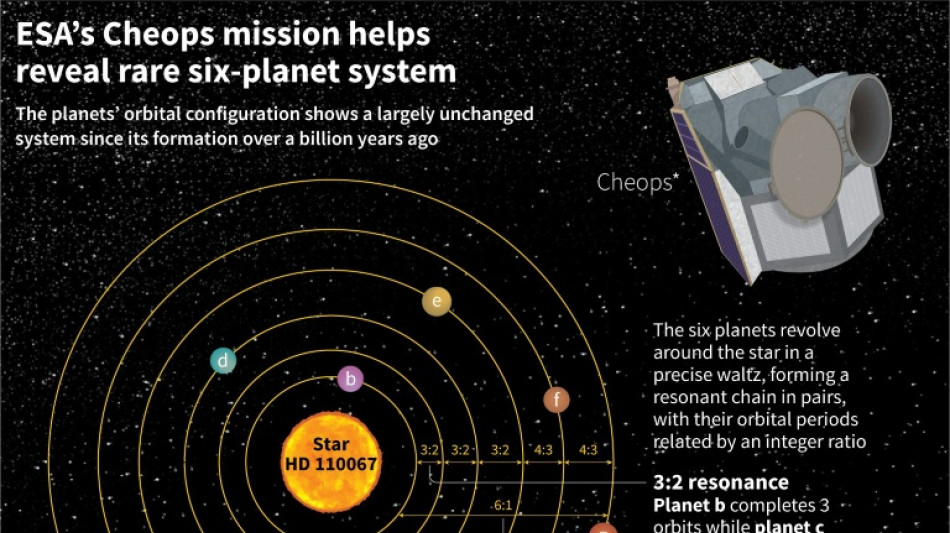
Six exoplanets discovered in synchronised dance around star / Photo: Julia Han JANICKI, Paz PIZARRO - AFP

 Isolated Syrian-Druze city blames Damascus for shortages

 Kerry James Marshall: American 'blackness' painter celebrated in Europe

 Infantino 'must go', says German FA vice-president

 Japan's busiest rail station tests robot bins

 Backpackers fret over Australian visa crackdown

 Bank of Japan hikes rates to 31-year high to battle inflation

 AI doomsday warnings unlikely to slow IPOs but questions linger

 In Brazil's Amazon, the hunt for oil fuels hopes and fears

 Baby orangutans in India expose 'frightening' scale of trafficking

 Oversight Board blasts 'inadequate' Meta safeguards for AI deepfakes

 Harry makes first public appearance since return to UK

 Princess Diana's brother makes new explosive claims against Charles

 Trump admin overhauls key protection for endangered species

 Mbappe draws political fire over Ceuta t-shirt controversy

 Third malaria death in Germany from outbreak tied to Frankfurt airport

 AtlasClear Holdings Reports Preliminary Fiscal 2026 Revenue of Approximately $20.1 Million, Up 85%; Revenue Plus Interest Income of Approximately $21.9 Million

 'Another arrow to the quiver': World Bank posts record private capital mobilization

 Ireland to boycott Eurovision 2027 over Gaza

 India's Tata Sons reappoints N. Chandrasekaran as chairman

 Germany urges EU action against China to defend carmakers

 Japan eyes changing prostitution law to punish sex buyers

 Modi pitches India as global chipmaking hub

 Ukraine plans record defence spending in 2027

 NASA scan discovers new, 'once in a century' Moon crater

 Most stocks rise as Fed hikes and indicates drive to curb inflation

Six exoplanets have been spotted in a perfectly synchronised dance around a nearby star, offering clues about the formation of our own Solar System, astronomers said on Wednesday.
The six planets orbit the bright star HD 110067 around 100 light years away from Earth. The star is visible from the Northern Hemisphere as part of the Coma Berenices constellation.
The planets are so close to their star that all six would all fit into the orbit of Mercury and our Sun, Adrien Leleu, a researcher at the University of Geneva, told AFP.
All of the very hot planets are somewhere between the size of Earth and Neptune, said Leleu, the co-author of a new study published in the journal Nature.
All six have a similar make-up to Neptune -- "a rocky body covered with a thick envelope of gas," he added.
None of these "sub-Neptunes" are thought to be far away enough from their star to host liquid water, a key ingredient for supporting life.
While not habitable, they are remarkable in another way: all six planets are precisely synchronised with each other in their orbit.
NASA's Transiting Exoplanet Survey Satellite (TESS) first discovered two exoplanets orbiting the star in 2020.
The satellite, known as the exoplanet hunter, spotted the pair by measuring the change in brightness when they passed over their host star.
The planet closest to the star orbits around it in just nine days.
However there were some indications that other planets could be passing over the star, which astronomers suspected were orbiting over a longer period.
HESS is designed to scan the sky for a few weeks, so was not the best hunter for planets with longer orbits.
So the European Space Agency's Cheops satellite, which can target a star for much longer, was brought into the chase.
Over time, Cheops managed to spot four more planets.
- In lockstep -
The planets carry out a delicate dance called "orbital resonance" in which the gravity of each keeps the others in rhythm.
In the time that the first planet carries out three trips around its star, the second planet does two revolutions. When the second planet goes around three times, the third planet has done two orbits, and so on.
The last planet completes one orbit in the time it takes the first to do six -- proof that they are all connected by a "resonance chain," Leleu said.
More than 5,000 exoplanets, planets outside our Solar System, have been discovered since the first was spotted in 1995 -- but this system is the first to have so many planets acting in such harmony.
But in theory this is how all planets start off, said the study's lead author Rafael Luque of the University of Chicago.
The HD 110067 system is believed to have remained virtually unchanged since its birth at least four billion years ago.
However the planets of our home Solar System, which is not much older, do not orbit in sync, Leleu said.
This could be because of "frequent chaotic events" after the birth of the Solar System, such as the formation of giant plants like Jupiter and Saturn, which could have destabilised the orbits of the smaller planets, Luque said.
It also could have been because of some giant meteorite, he added.
The astronomers hope that the new system will help understand the history of our Solar System -- and how it lost its rhythm.
X.Cheung--CPN