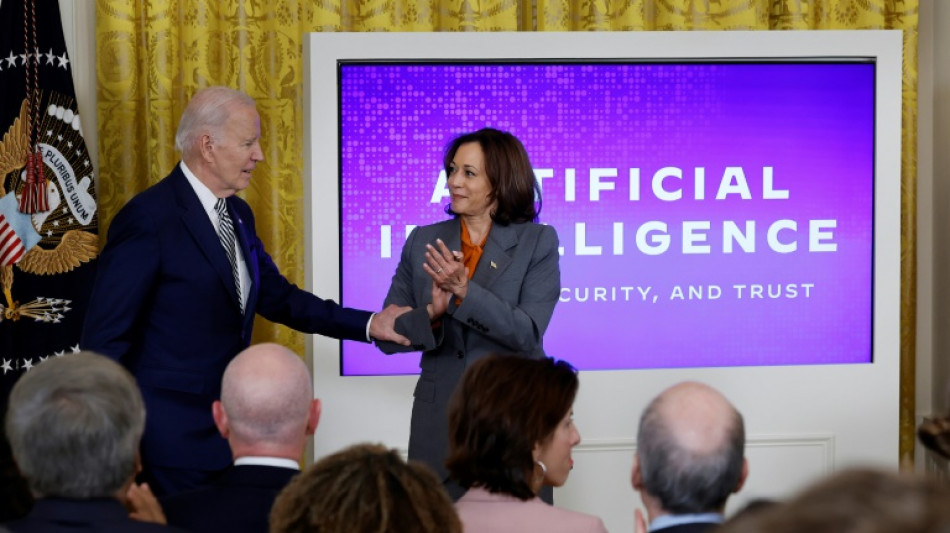
Biden unveils AI order aiming to 'lead the way' on safety / Photo: CHIP SOMODEVILLA - GETTY IMAGES NORTH AMERICA/AFP

 Germany urges EU action against China to defend carmakers

 Japan eyes changing prostitution law to punish sex buyers

 Modi pitches India as global chipmaking hub

 Ukraine plans record defence spending in 2027

 NASA scan discovers new, 'once in a century' Moon crater

 Most stocks rise as Fed hikes and indicates drive to curb inflation

 UK-Sudanese author pens book to give children 'African history of Africa'

 US Congress passes sweeping Russia sanctions bill

 US stocks fall, dollar gains after Fed lifts interest rates

 US Fed raises rates to tackle 'too high' inflation in move sure to rile Trump

 US Fed raises rates to battle inflation in move likely to rile Trump

 US House faces test on sweeping Russia sanctions bill

 British PM says to make 'difficult decisions' as inflation rises

 Global fuel price demos: a round-up

 Leverate Launches MCP for Traders to Connect AI Assistants With Trading Platforms

 MEXC Launches $1M "Discover Your Wall Street DNA" Campaign to Help Traders Find Their Market Fit

 Stocks edge higher ahead of US Fed rate call

 BASIS.pro Expands On-Chain Infrastructure with XDC Network Partnership and Zypher DAO as Auto Earn Goes Live

 Pickle-flavoured tart? AI inspires Japan's convenience stores

 EU chief hosts Canada's Carney in push to 'deepen' alliance

 Meta chief pushes back on AI slowdown calls

 US Fed to deliver rate decision with markets betting on hike

 i-payout Expands U.S. Money Transmitter Licensing Footprint and Advances European EMI Strategy

 US Senate crypto bill collapses amid partisan deadlock

 OpenAI, Anthropic and Google are working to create an AI standards body

President Joe Biden issued an executive order Monday on regulating artificial intelligence, aiming for the United States to "lead the way" in global efforts to manage the technology's risks.
The "landmark" order directs federal agencies to set new safety standards for AI systems and requires developers to share their safety test results and other critical information with the US government, according to a White House statement.
"To realize the promise of AI and avoid the risk we need to govern this technology," Biden said before signing the executive order at the White House.
"There's no other way around it in my view; it must be governed."
The US will continue to work closely with allies on international rules for AI, Biden added during a ceremony with Vice President Kamala Harris.
The executive action relies on the Cold War-era Defense Production Act, which gives the federal government certain control over companies when national security is at stake.
The law was used early in Biden's tenure to speed up the federal response to the coronavirus pandemic.
The Executive Order on Safe, Secure, and Trustworthy Artificial Intelligence will also address risks to critical infrastructure and seek to protect against AI being used to develop dangerous biological materials.
With the rapid development of generative AI systems such as ChatGPT, the order also requires the development of new "guidance for content authentication and watermarking to clearly label AI-generated content."
Federal agencies will be required to use those tools "to make it easy for Americans to know that the communications they receive from their government are authentic."
- Global regulations -
Biden vowed that the US would lead the way in seizing the promise and managing the risks.
It faces competition from the European Union, which is seeking to set up an AI regulatory framework before the year's end, having already outpaced American regulators with landmark rules on data privacy and safety.
Harris is set to lead a US delegation to the UK this week for a global gathering on AI, alongside other foreign politicians, tech industry figures and academics.
The gathering -- which will focus on growing fears about the implications of so-called frontier AI -- will also be attended by UK Prime Minister Rishi Sunak, EU chief Ursula von der Leyen and UN Secretary-General Antonio Guterres.
Several tech companies, including US behemoths Microsoft and Google, have already pledged to submit their AI systems to government review.
Despite the lofty ambitions of the new executive order, the White House admitted that "more action will be required" on AI and pledged to "pursue bipartisan legislation" in Congress, where Republicans control the lower chamber.
While leaving the signing ceremony, US Senate majority leader Chuck Schumer said he was working with a bipartisan group and expected legislation to be ready in a matter of months to "cement" what Biden has done with the order.
Biden touted the executive order as "bold action," but called on Congress to pass legislation regulating AI; data privacy, and online marketing to children.
At a recent TED AI conference in San Francisco, Google DeepMind co-founder and chief artificial general intelligence scientist Shane Legg said the implications and consequences of this new technology are not fully understood.
"If I had a magic wand and I could slow things down, I would use the magic wand," Legg said during an on-stage conversation with TED curator Chris Anderson.
"We regulate powerful technologies all the time in the interest of society, and I think this is a very important thing that we should be looking at."
bur-aue-des-gc/st
L.K.Baumgartner--CPN