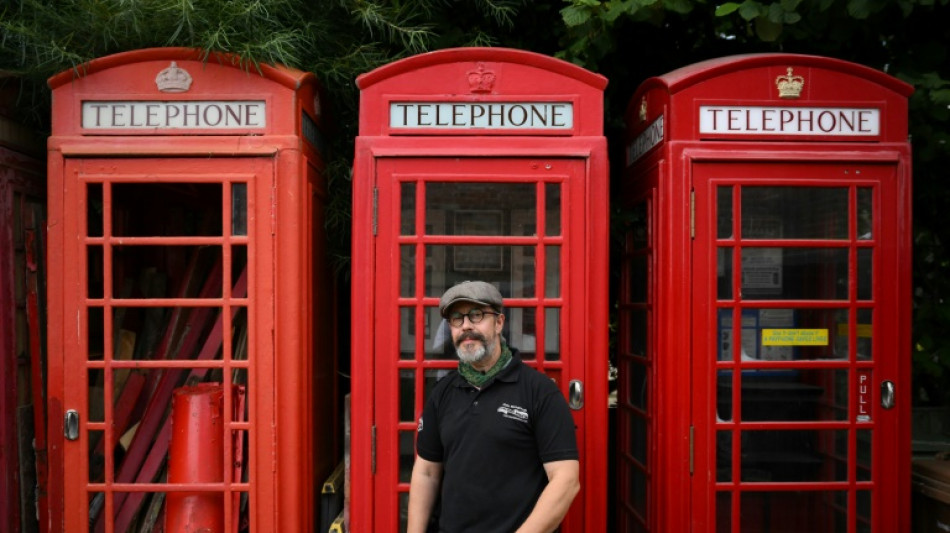
Britain's iconic red phone boxes get new lease of life / Photo: Daniel LEAL - AFP

 Germany urges EU action against China to defend carmakers

 Japan eyes changing prostitution law to punish sex buyers

 Modi pitches India as global chipmaking hub

 Ukraine plans record defence spending in 2027

 NASA scan discovers new, 'once in a century' Moon crater

 Most stocks rise as Fed hikes and indicates drive to curb inflation

 UK-Sudanese author pens book to give children 'African history of Africa'

 US Congress passes sweeping Russia sanctions bill

 US stocks fall, dollar gains after Fed lifts interest rates

 US Fed raises rates to tackle 'too high' inflation in move sure to rile Trump

 US Fed raises rates to battle inflation in move likely to rile Trump

 US House faces test on sweeping Russia sanctions bill

 British PM says to make 'difficult decisions' as inflation rises

 Global fuel price demos: a round-up

 Leverate Launches MCP for Traders to Connect AI Assistants With Trading Platforms

 MEXC Launches $1M "Discover Your Wall Street DNA" Campaign to Help Traders Find Their Market Fit

 Stocks edge higher ahead of US Fed rate call

 BASIS.pro Expands On-Chain Infrastructure with XDC Network Partnership and Zypher DAO as Auto Earn Goes Live

 Pickle-flavoured tart? AI inspires Japan's convenience stores

 EU chief hosts Canada's Carney in push to 'deepen' alliance

 Meta chief pushes back on AI slowdown calls

 US Fed to deliver rate decision with markets betting on hike

 i-payout Expands U.S. Money Transmitter Licensing Footprint and Advances European EMI Strategy

 US Senate crypto bill collapses amid partisan deadlock

 OpenAI, Anthropic and Google are working to create an AI standards body

In a workshop packed with historic memorabilia, from rusty petrol pumps to vintage enamel signs, Carl Burge skillfully applied the finishing touches to the red British telephone box he was restoring.
"They're iconic," said Burge, 54, who has been working on revitalising the tired, ageing phone kiosks for over 20 years.
Emblematic of the UK worldwide, these sturdy red pillars first rolled out in the 1920s have endured everything from vandalism to the country's famously wet weather over the ensuing decades.
"If you were to send a postcard with nothing written on there apart from a picture of a telephone box and send it anywhere in the world, chances are 95 percent of people will say: that's England," he added.
The number of phone boxes in Britain peaked in the 1990s at around 100,000, though many were not the famous red designs.
While less used now with the widespread use of mobile phones, around 20,000 working public payphones remain nationwide.
Redundant red and other phone boxes are increasingly being adopted by local communities and converted into facilities such as mini libraries, visitor information stands and defibrillators.
Some are even rented out by small businesses, like the tiramisu shop called "Walkmisu" in central London.
Daniele Benedettini has set up shop inside two red boxes on the edge of Russell Square, selling the famous Italian dessert and coffee.
"I think it was a really cool idea to use something really English traditional with something very Italian," Benedettini told AFP.
- 'Real gem' -
The cost of running a business from a phone box has also proved lower than opening a regular shop, he added.
The 29-year-old, who rents the boxes from a private owner, said they were his first business before also opening a cafe nearby.
The phone boxes have been renovated inside and fitted with shelves, a fridge and coffee machine but outside they remain largely the same, as they have stood for decades, apart from some posters on the windows.
Burge said that restoring a telephone box takes an average of six weeks, starting with the "painstaking" process of stripping it down to the "bare bones".
"You don't know what you are going to find under that paint. You might find a real gem," he added.
Burge has seen many phone boxes come through his workshop in the town of King's Lynn, eastern England, and says they are often broken, missing glass from the window panes or their wooden doors are rotting.
Once the box's cast-iron frame is stripped of all internal and external components, it is sandblasted to remove paint, rust and any other impurities.
The next step is applying body filler and sanding out any imperfections in a laborious process that is done by hand and which can take several days to complete.
Finally the telephone box is spray painted with the "Post Office Red" colour, laminated glass is installed and the door is fitted with a new hardwood outer frame.
- 'Enthusiasm' -
Burge, who worked in the motor trade for 20 years, turned his passion for collecting British memorabilia into a full-time business called "Remember When UK".
He spotted his first phone box while driving past a property that was going on sale. He bought it off the owners, restored it and kept it in his front garden.
Burge later sold the phone box but said he "missed it" and thought he would like to refurbish another one.
One turned into many, and now Burge is working on restoring several telephone boxes at a time.
Among them is an example of the famous K2, which was Britain's first red colour telephone box introduced in 1926 and designed by British architect Giles Gilbert Scott, who is also known for his work on London's Battersea Power Station and other public buildings.
But even after two decades in the trade, Burge said he hasn't lost his passion for the work that he does.
"I'm getting a little bit older now. Everything seems to be getting a little bit heavier. But I think my enthusiasm level is on par with where it was 22 years ago," he said.
"If anything, it's probably more," he added.
video-acl/jj/acc/giv
X.Wong--CPN