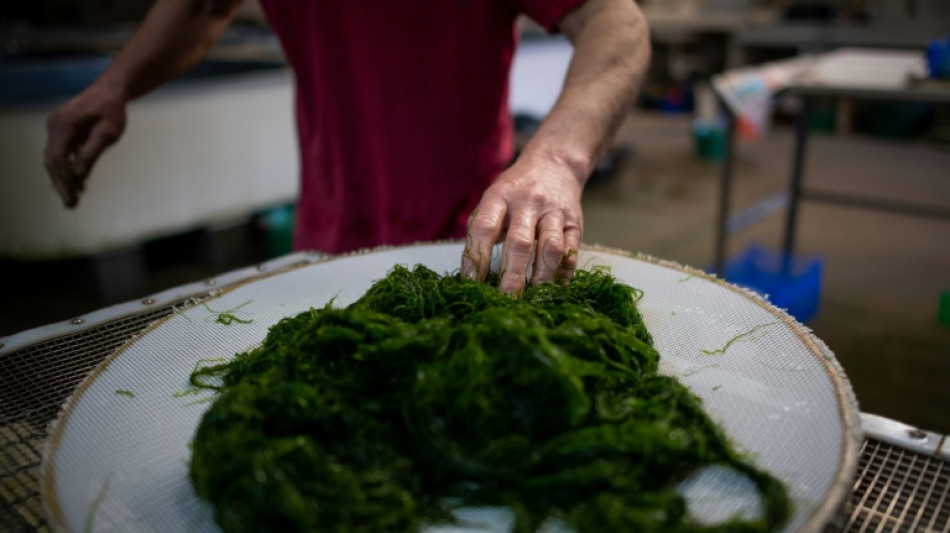
Back on the menu? Europeans once ate seaweed, research shows / Photo: LOIC VENANCE - AFP/File

 Germany urges EU action against China to defend carmakers

 Japan eyes changing prostitution law to punish sex buyers

 Modi pitches India as global chipmaking hub

 Ukraine plans record defence spending in 2027

 NASA scan discovers new, 'once in a century' Moon crater

 Most stocks rise as Fed hikes and indicates drive to curb inflation

 UK-Sudanese author pens book to give children 'African history of Africa'

 US Congress passes sweeping Russia sanctions bill

 US stocks fall, dollar gains after Fed lifts interest rates

 US Fed raises rates to tackle 'too high' inflation in move sure to rile Trump

 US Fed raises rates to battle inflation in move likely to rile Trump

 US House faces test on sweeping Russia sanctions bill

 British PM says to make 'difficult decisions' as inflation rises

 Global fuel price demos: a round-up

 Leverate Launches MCP for Traders to Connect AI Assistants With Trading Platforms

 MEXC Launches $1M "Discover Your Wall Street DNA" Campaign to Help Traders Find Their Market Fit

 Stocks edge higher ahead of US Fed rate call

 BASIS.pro Expands On-Chain Infrastructure with XDC Network Partnership and Zypher DAO as Auto Earn Goes Live

 Pickle-flavoured tart? AI inspires Japan's convenience stores

 EU chief hosts Canada's Carney in push to 'deepen' alliance

 Meta chief pushes back on AI slowdown calls

 US Fed to deliver rate decision with markets betting on hike

 i-payout Expands U.S. Money Transmitter Licensing Footprint and Advances European EMI Strategy

 US Senate crypto bill collapses amid partisan deadlock

 OpenAI, Anthropic and Google are working to create an AI standards body

Europeans now rarely eat seaweed, but it was an important part of their diet until the late Middle Ages, archaeologists said Tuesday, calling for the eco-friendly aquatic plant to be put back on the menu.
Seaweed, a healthy and sustainable source of protein, is a staple food in some Asian countries such as Japan. But it has long been shunned by traditional Western diets -- with a few exceptions, such as the Welsh dish laverbread.
It was previously thought that since the rise of farming, Europeans had mostly used seaweed as fuel, fertiliser or to feed livestock. It was only eaten to stave off hunger during famine, so the thinking went.
But a new study published in the journal Nature Communications found that Europeans were gobbling up seaweed millennia after that point, and suggested the continent re-embrace the nutritious food.
To find out about ancient seaweed consumption, a UK-led team of researchers analysed dental plaque extracted from the teeth of 74 different people who lived thousands of years ago at 28 sites ranging from Scotland to Spain.
Using a mass spectrometry technique to identify organic compounds, they found evidence that the teeth had chowed down on several different aquatic plants.
Red seaweed was eaten both in Scotland's northern Orkney islands around 5,000 years ago and at Casa Corona in southern Spain 8,000 years ago, the study found.
Freshwater aquatic plants, such as the pondweed Potamogeton, were commonly eaten in Portugal, Scotland and Lithuania, it added.
Karen Hardy, an archaeologist at Scotland's University of Glasgow and the study's lead author, told AFP that aquatic plants were "very likely eaten over a much more wide timescale than we found".
Europeans were previously believed to have turned their noses up at seaweed following the introduction of agriculture more than 10,000 years ago.
However, research in this field has focused on agricultural production, so may have missed out on seaweed, which is easy to find and eat.
The authors of the study said seaweed has the potential to be a locally sourced, low-emission option that does not require the mass farming of the meals normally seen on Europe's plates.
"It's very healthy, it's nutritious, it's available, it's renewable," Hardy said.
"People ate it in the past in Europe," she said, adding hopefully that maybe they will again.
D.Avraham--CPN