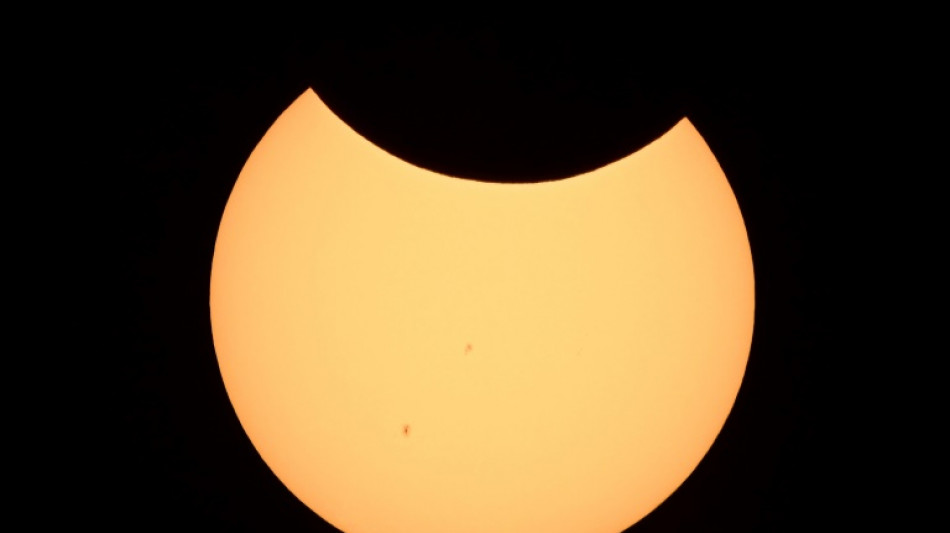
Skygazers watch 'Ring of Fire' eclipse over Western Hemisphere / Photo: Patrick T. Fallon - AFP

 Isolated Syrian-Druze city blames Damascus for shortages

 Kerry James Marshall: American 'blackness' painter celebrated in Europe

 Infantino 'must go', says German FA vice-president

 Japan's busiest rail station tests robot bins

 Backpackers fret over Australian visa crackdown

 Bank of Japan hikes rates to 31-year high to battle inflation

 AI doomsday warnings unlikely to slow IPOs but questions linger

 In Brazil's Amazon, the hunt for oil fuels hopes and fears

 Baby orangutans in India expose 'frightening' scale of trafficking

 Oversight Board blasts 'inadequate' Meta safeguards for AI deepfakes

 Harry makes first public appearance since return to UK

 Princess Diana's brother makes new explosive claims against Charles

 Trump admin overhauls key protection for endangered species

 Mbappe draws political fire over Ceuta t-shirt controversy

 Third malaria death in Germany from outbreak tied to Frankfurt airport

 AtlasClear Holdings Reports Preliminary Fiscal 2026 Revenue of Approximately $20.1 Million, Up 85%; Revenue Plus Interest Income of Approximately $21.9 Million

 'Another arrow to the quiver': World Bank posts record private capital mobilization

 Ireland to boycott Eurovision 2027 over Gaza

 India's Tata Sons reappoints N. Chandrasekaran as chairman

 Germany urges EU action against China to defend carmakers

 Japan eyes changing prostitution law to punish sex buyers

 Modi pitches India as global chipmaking hub

 Ukraine plans record defence spending in 2027

 NASA scan discovers new, 'once in a century' Moon crater

 Most stocks rise as Fed hikes and indicates drive to curb inflation

Skygazers across the Americas turned their faces upwards Saturday for a rare celestial event: an annular solar eclipse.
A crowd wearing protective eyewear gathered in Albuquerque, New Mexico, one of many across the western United States to be watching as the Moon began passing between the Sun and Earth at its furthest point from our planet.
Since it is so distant, it will not cover the Sun completely, creating a "ring of fire" effect.
In the course of just a few hours the most striking "path of the annularity" will cross a handful of major cities, including Albuquerque as well as Eugene, Oregon and San Antonio, Texas, with partial eclipse phases lasting an hour or two before and after.
At any given location, it will be visible from between 30 seconds and five minutes -- but people are urged to take safety precautions and use solar viewing glasses, and never regular sunglasses, to preserve their vision.
"Do NOT look at the Sun through a camera lens, telescope, binoculars, or any other optical device while wearing eclipse glasses or using a handheld solar viewer —- the concentrated solar rays will burn through the filter and cause serious eye injury," NASA says.
Next the eclipse will cross Mexico and Central America, then into South America through Colombia and northern Brazil before ending at sunset in the Atlantic Ocean.
For those not lucky enough to be in the path of this special astronomical transit, NASA was live streaming the event on nasa.gov/nasatv/ from 11:30am to 1:15 pm eastern time (1530 to 1715 GMT) from Albuquerque, as well as Carville, Texas and White Sands, New Mexico.
- Sounding rockets -
The event also serves as a dress rehearsal before a total eclipse set for April 2024.
Both eclipses are going to be "absolutely breathtaking for science," said Madhulika Guhathakurta, a heliophysics program scientist.
Solar eclipses have a noticeable effect on the upper atmosphere, such as the ionosphere, which is full of charged particles and responsible for reflecting and refracting radio waves.
"Although the atmospheric effects of solar eclipses have been studied for over 50 years, many unanswered questions remain," said Guhathakurta.
To study these effects, NASA will launch three rockets from the White Sands Missile Range in New Mexico to gather data on the electric and magnetic fields, electron density and temperature.
A total eclipse took place in 2017 in the United States. After next April's total eclipse, there will not be another until 2044, while the next annular eclipse will be in 2046.
Y.Ponomarenko--CPN