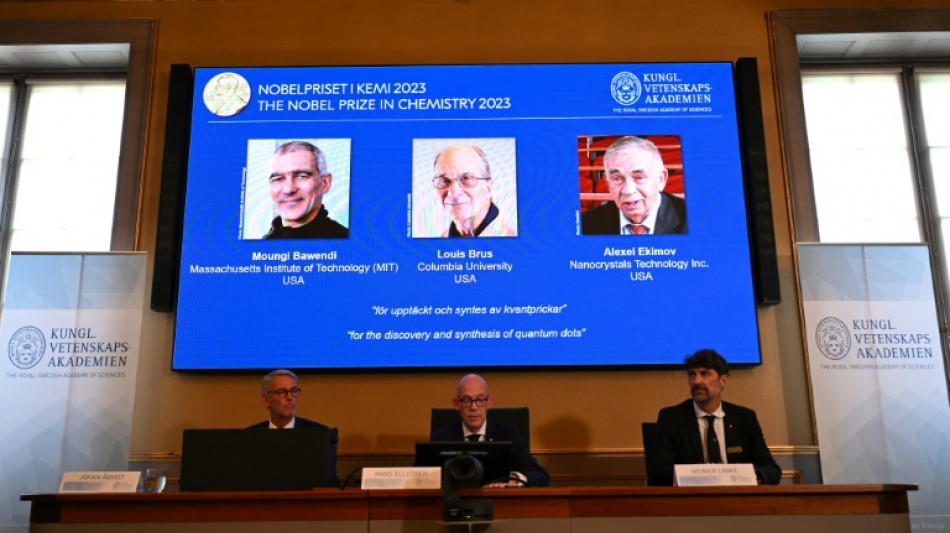
Three giants of chemistry connected by the quantum realm / Photo: Jonathan NACKSTRAND - AFP

 Modi pitches India as global chipmaking hub

 Ukraine plans record defence spending in 2027

 NASA scan discovers new, 'once in a century' Moon crater

 Most stocks rise as Fed hikes and indicates drive to curb inflation

 UK-Sudanese author pens book to give children 'African history of Africa'

 US Congress passes sweeping Russia sanctions bill

 US stocks fall, dollar gains after Fed lifts interest rates

 US Fed raises rates to tackle 'too high' inflation in move sure to rile Trump

 US Fed raises rates to battle inflation in move likely to rile Trump

 US House faces test on sweeping Russia sanctions bill

 British PM says to make 'difficult decisions' as inflation rises

 Global fuel price demos: a round-up

 Leverate Launches MCP for Traders to Connect AI Assistants With Trading Platforms

 MEXC Launches $1M "Discover Your Wall Street DNA" Campaign to Help Traders Find Their Market Fit

 Stocks edge higher ahead of US Fed rate call

 BASIS.pro Expands On-Chain Infrastructure with XDC Network Partnership and Zypher DAO as Auto Earn Goes Live

 Pickle-flavoured tart? AI inspires Japan's convenience stores

 EU chief hosts Canada's Carney in push to 'deepen' alliance

 Meta chief pushes back on AI slowdown calls

 US Fed to deliver rate decision with markets betting on hike

 i-payout Expands U.S. Money Transmitter Licensing Footprint and Advances European EMI Strategy

 US Senate crypto bill collapses amid partisan deadlock

 OpenAI, Anthropic and Google are working to create an AI standards body

 Protesting shepherds, farmers clash with Romanian police

 Foundation Lets Ledger Users Switch to Open Source Without Starting Over

This year's Nobel Chemistry winners are pioneers in the nanoworld.
During the 1980s, Alexi Ekimov, 78, and Louis Brus, 80, working independently and on opposite sides of the Iron Curtain, succeeding in creating "quantum dots" -- nanoparticles that are found today in next generation TV screens and are being used to illuminate tumors in the body.
A decade later, 62-year-old Moungi Bawendi revolutionized methods to manufacture them with precision and at scale, paving the way for their applications.
Here's the rundown on the 2023 Nobel Prize in Chemistry winners.
- Perseverance -
Bawendi was born in 1961 in Paris, France to a Tunisian father and French mother.
His family emigrated to the United States when he was 10 years old, and though he excelled at science in high school, he flunked his very first college chemistry class at Harvard.
"It could easily have destroyed me, my first experience with an F, the lowest grade in my class by far," he told reporters.
But he persevered, earning his undergraduate degree and later his PhD at the University of Chicago. He would later join Brus at Bell Laboratories, then finally the Massachusetts Institute of Technology (MIT), where he remains today as a professor.
"I'm especially honored to share this with Louis Brus, who was my postdoctoral mentor... I tried to emulate his scholarship and mentoring style as a professor myself," he said.
Bawendi built upon the work of his co-laureates and in 1993 succeeded in vastly improving the methods to create quantum dots, finding just the right solvent and temperature to grow nanocrystals to specific sizes.
- Colored glass experiments -
Ekimov and Brus grew up in the post-war era. Ekimov was born in 1945 in the former USSR, and graduated from Leningrad State University.
Ekimov was fascinated by colored glass and the fact that a single substance could yield many colors. By experimenting with temperatures and heating times of molten glass, he found he was able to vary the size of the particles produced and that the smaller the particles were, the bluer the light they emitted.
He published his findings in a Soviet science journal 1981, and was the first person to intentionally create quantum dots -- particles predicted by physics theory in the early 20th century but not until then demonstrated in reality.
At the same time, Brus worked at the legendary Bell Laboratories in the United States -- then a hotbed for scientific discovery -- on experiments that involved chopping up particles to provide a larger surface area and faster chemical reactions.
During his work, he noticed that the particles' optical and other properties shifted the smaller they became, something that could only be explained by quantum mechanics.
- Sputnik generation -
"I am a member of the Sputnik generation, raised after WWII as the United States dramatically expanded science and technology in response to the Cold War" he wrote in an autobiographical account after receiving the 2008 Kavli Prize.
Gifted from an early age in mathematics and science, he grew up in the suburbs of Kansas City, where he says he "developed an affinity for tools and machines by working after school and on weekends in the local hardware store."
He initially thought he would follow his father into business. But after receiving his doctorate in 1969 from Columbia University in New York, he served in the United States Navy, and became a researcher in a laboratory in Washington.
Then, in 1972, he began working for Bell Labs, where he remained for 23 years.
He is now a professor at Columbia University and a firm believer in the power of science.
"Scientists struggle daily with their experiments, and tend to lose sight of the enormous collective progress of science and technology over the decades," he wrote.
"Science has created a far better existence for mankind despite war, economic collapse and natural disaster."
O.Hansen--CPN