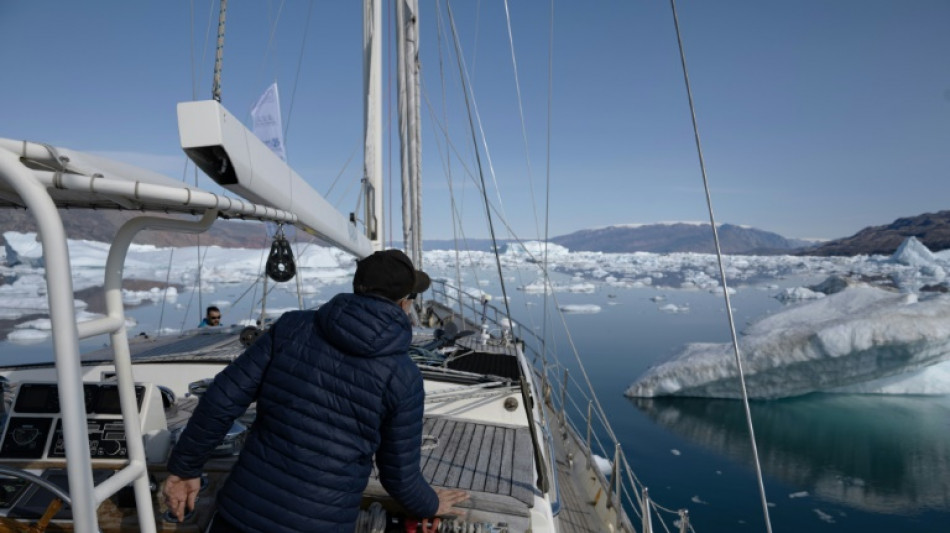
Scientists voyage to Greenland's melting sanctuary / Photo: Olivier MORIN - AFP

 Modi pitches India as global chipmaking hub

 Ukraine plans record defence spending in 2027

 NASA scan discovers new, 'once in a century' Moon crater

 Most stocks rise as Fed hikes and indicates drive to curb inflation

 UK-Sudanese author pens book to give children 'African history of Africa'

 US Congress passes sweeping Russia sanctions bill

 US stocks fall, dollar gains after Fed lifts interest rates

 US Fed raises rates to tackle 'too high' inflation in move sure to rile Trump

 US Fed raises rates to battle inflation in move likely to rile Trump

 US House faces test on sweeping Russia sanctions bill

 British PM says to make 'difficult decisions' as inflation rises

 Global fuel price demos: a round-up

 Leverate Launches MCP for Traders to Connect AI Assistants With Trading Platforms

 MEXC Launches $1M "Discover Your Wall Street DNA" Campaign to Help Traders Find Their Market Fit

 Stocks edge higher ahead of US Fed rate call

 BASIS.pro Expands On-Chain Infrastructure with XDC Network Partnership and Zypher DAO as Auto Earn Goes Live

 Pickle-flavoured tart? AI inspires Japan's convenience stores

 EU chief hosts Canada's Carney in push to 'deepen' alliance

 Meta chief pushes back on AI slowdown calls

 US Fed to deliver rate decision with markets betting on hike

 i-payout Expands U.S. Money Transmitter Licensing Footprint and Advances European EMI Strategy

 US Senate crypto bill collapses amid partisan deadlock

 OpenAI, Anthropic and Google are working to create an AI standards body

 Protesting shepherds, farmers clash with Romanian police

 Foundation Lets Ledger Users Switch to Open Source Without Starting Over

With rugged red mountains rising on either side, a sailboat carrying scientists deftly snakes between icebergs brimming Greenland's Scoresby Fjord, as they rush to document this understudied region on the frontline of climate change.
After the warmest July ever recorded at Summit Camp atop Greenland's ice sheet, the expedition members sailing the country's east coast are acutely aware of the urgency.
"The risk that we have here is the disappearance of the complete ecosystem," Eric Marechal, director of research at the French National Centre for Scientific Research (CNRS), tells AFP on board the sailboat Kamak.
In addition to the icebergs -- which in some areas blanket over half of the fjord -- the scientists also need an armed escort to protect against polar bears.
But for the researchers, facing the harsh environment is a risk worth taking for rare access into one of the world's most isolated ecosystems.
"We see that global warming is really entering a strong phase here. So we need to document that," says expedition leader Vincent Hilaire.
The expedition, arranged by the volunteer-run French initiative Greenlandia, aims to understand climate change's effects on Scoresby Fjord and its inhabitants.
Frozen in ice for eleven months of the year, the planet's largest fjord system, which remains vastly understudied, is a challenge to manoeuvre even for a seasoned crew.
"There is a big gap between what we see on the maps and the reality, so we have to move forward carefully," says Kamak's captain David Delample.
The warm sunlight carves pathways of melting snow on the sides of the icebergs, while the thundering sound of calving glaciers surrounding the fjord fills the air.
Some icebergs are chiselled monoliths of blue ice towering above the sea taller than the Arc de Triomphe monument in Paris, others smooth mounds with cascading layers of white snow.
The danger of the boat getting crushed between the mammoth blocks of ice is tangible, and the sound of the frozen giants banging against the ship's hull ensures an uneasy slumber.
The only human settlement within a 500-kilometre (310-mile) radius is the Greenlandic town of Ittoqqortoormiit near the mouth of the fjord, with its 300 or so inhabitants.
The scientists are working against the clock, well aware the fjord will freeze over again by mid-September.
"The future scientific generation will observe a massive melting in Greenland," Hilaire says.
For the team, filling the knowledge gap in the research of this remote region before it changes is essential to guide policy in the future.
"We will give them the maximum amount of samples," Hilaire says.
H.Müller--CPN