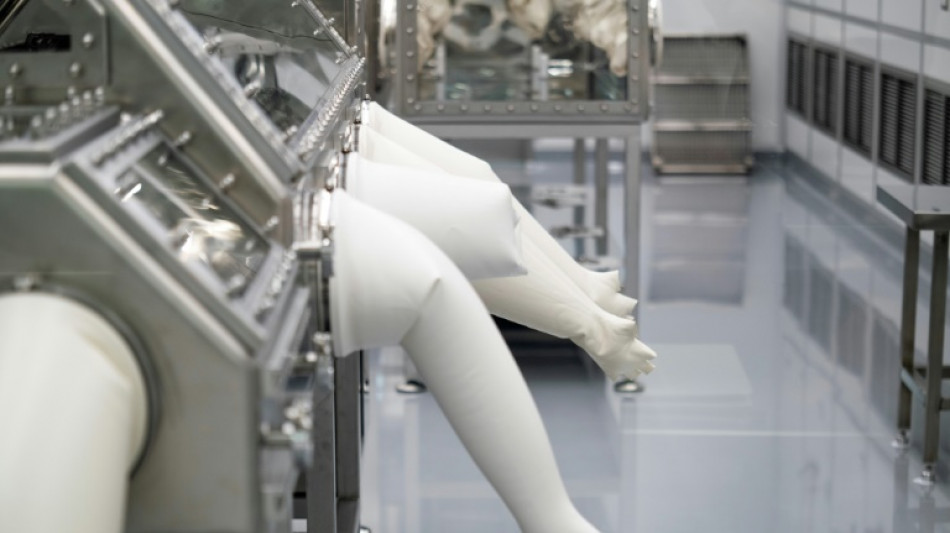
NASA lab hopes to find life's building blocks in asteroid sample / Photo: Mark Felix - AFP

 NASA scan discovers new, 'once in a century' Moon crater

 Most stocks rise as Fed hikes and indicates drive to curb inflation

 UK-Sudanese author pens book to give children 'African history of Africa'

 US Congress passes sweeping Russia sanctions bill

 US stocks fall, dollar gains after Fed lifts interest rates

 US Fed raises rates to tackle 'too high' inflation in move sure to rile Trump

 US Fed raises rates to battle inflation in move likely to rile Trump

 US House faces test on sweeping Russia sanctions bill

 British PM says to make 'difficult decisions' as inflation rises

 Global fuel price demos: a round-up

 Leverate Launches MCP for Traders to Connect AI Assistants With Trading Platforms

 MEXC Launches $1M "Discover Your Wall Street DNA" Campaign to Help Traders Find Their Market Fit

 Stocks edge higher ahead of US Fed rate call

 BASIS.pro Expands On-Chain Infrastructure with XDC Network Partnership and Zypher DAO as Auto Earn Goes Live

 Pickle-flavoured tart? AI inspires Japan's convenience stores

 EU chief hosts Canada's Carney in push to 'deepen' alliance

 Meta chief pushes back on AI slowdown calls

 US Fed to deliver rate decision with markets betting on hike

 i-payout Expands U.S. Money Transmitter Licensing Footprint and Advances European EMI Strategy

 US Senate crypto bill collapses amid partisan deadlock

 OpenAI, Anthropic and Google are working to create an AI standards body

 Protesting shepherds, farmers clash with Romanian police

 Foundation Lets Ledger Users Switch to Open Source Without Starting Over

 EU to propose curbing social media, online games for under 15s

 FX Junction Reaches 40,600 Members and 26 Million Trades

Eager scientists and a gleaming lab awaits.
A sample from the asteroid Bennu, which could be key to understanding the formation of the solar system and our own planet, is set to be analyzed at NASA's Johnson Space Center in Houston after it reaches Earth in late September.
The precious cargo is currently aboard OSIRIS-REx, a US space probe launched in 2016 to Bennu, which orbits the Sun at an average distance of about 105 million miles (168 million kilometers).
Long white sleeves hang from the huge metal and glass box in which the sample will be handled.
Scientists will separate pieces of the rock and dust for study now, while carefully storing away the rest for future generations equipped with better technology -- a practice first started during the Apollo missions to the Moon.
"We don't expect there to be anything living but (rather) the building blocks of life," Nicole Lunning, lead OSIRIS-Rex sample curator, told AFP.
"That's really what motivated going to this type of asteroid, to understand what the precursors were that may have fostered life in our solar system and on Earth."
Once the return vessel arrives at the Texas "cleanroom," Lunning's job will be to carefully disassemble it and separate the contents, all while keeping the material pure and uncontaminated.
- Origins of life -
The spacecraft is scheduled to land in the Utah desert on September 24, carrying an estimated 8.8 ounces, or 250 grams of material -- just over a cupful.
Obtaining it involved a high-risk operation in October 2020: the probe came into contact with the asteroid for a few seconds, and a blast of compressed nitrogen was emitted to raise the dust sample which was then captured.
The whole mission was imperiled when NASA realized a few days later that the valve of the collection compartment was failing to close, letting fragments escape into space.
But the precious cargo was finally secured after being transferred to a capsule fixed in the spacecraft's center.
The first samples brought to Earth by asteroids were carried out by Japanese probes in 2010 and 2020, with the latter found to contain uracil, one of the building blocks of RNA.
The finding lent weight to a longstanding theory that life on Earth may have been seeded from outer space when asteroids crashed into our planet carrying fundamental elements.
Cosmochemist Eve Berger can't wait to get to work on the Bennu material.
"These samples haven't hit the Earth. They haven't been exposed to our atmosphere. They haven't been exposed to really anything except harsh space for billions of years," she said.
Ultimately they "will help us to determine whether what we really think is true, is true," said Berger.
Not only might the Bennu sample add to our knowledge of the ingredients that brought life to our world, but "if we can figure out what happened here on the Earth, that helps us to extrapolate to other bodies where we might look or how we might interpret what we're seeing," she added.
Could Bennu bring back something that's never been seen before? "You never know," said Berger.
"Bennu is a trickster, so we'll know more in a few months when the sample comes back -- that would be exciting!"
Ch.Lefebvre--CPN